
Group Lead, Ved Krishna
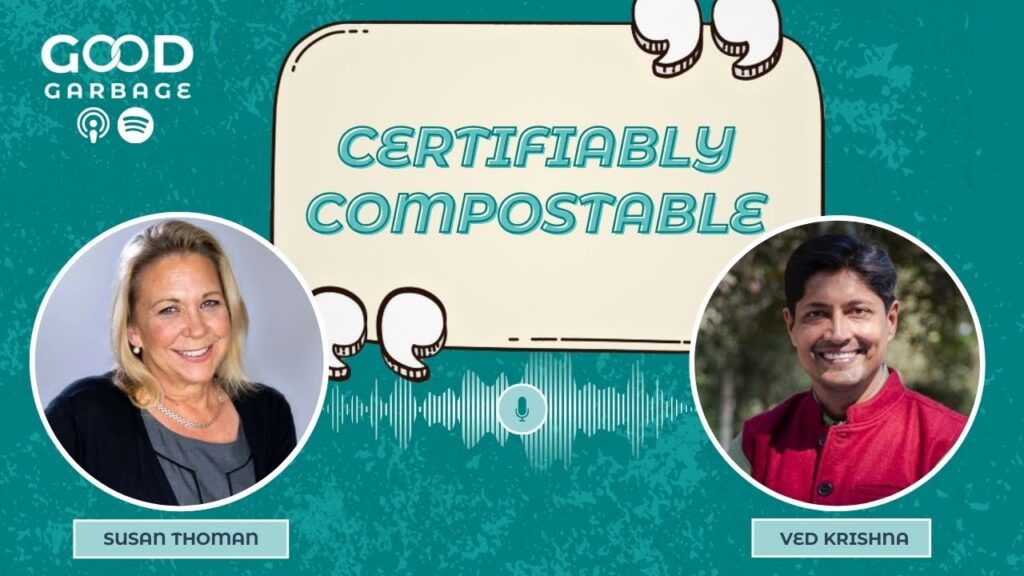
Hello, hello! We couldn’t have asked for a better guest to kick off the new year as we welcome 2025’s first guest Susan Thoman on our podcast! She brings with her 3 decades worth of wisdom and as the Managing Director of Compost Manufacturing Alliance, her insights in the field of composting and


0:00 – Introduction to the Compostable Manufacturing Alliance
Susan Toman, managing director of the Compostable Manufacturing Alliance, explains CMA’s function: connecting compostable packaging manufacturers with the industrial composting facilities that need to accept their products for the system to work.
11:00 – How Industrial Composting Works — From Input to Output
Industrial composting is a biological and logistical operation, not just a bin. Susan explains what actually happens from the moment a piece of packaging enters a composting facility, from feedstock selection and carbon-to-nitrogen ratios through to the finished compost.
22:00 – Certification Standards: What ASTM D6400 Actually Requires
ASTM D6400 and EN13432 are the key certification standards, but passing them requires more than just disintegration. Susan explains what the standards actually test, including biodegradation rate, ecotoxicity, and heavy metal thresholds, and why some certified products still cause real problems at composting sites.
33:00 – The Case for a Federal Composting Act
The US has no federal composting infrastructure programme, and that absence leaves composting access extremely uneven. Susan explains what a federal composting act would change and how it would create the market conditions that compostable packaging companies need.
44:00 – Greenwashing and the Problem of Fake Compostable Claims
Products labelled compostable that fail in real composting environments are a growing problem. Susan explains how CMA identifies non-compliant products, why greenwashing erodes trust across the whole category, and what auditing and certification can realistically do about it.
55:00 – The Business of Composting — Feedstocks, Seasons, and Economics
Running a composting operation means managing feedstock quality, seasonal variation, equipment maintenance, and community relations at the same time. Susan gives a ground-level view of what composters actually care about, which turns out to be quite different from what the packaging industry assumes.
66:00 – Consumer Sorting, Signage, and Getting Material to the Right Bin
Good compostable packaging fails if it ends up in the wrong bin. Susan shares examples of consumer communication that works, from video signage above collection points to colour-coded packaging, and what the research says about which approaches actually change behaviour.
77:00 – Policy Advocacy and Growing the Composting Market
Susan explains what policy measures she thinks would most expand composting access nationally, including a federal composting act, EPR frameworks, and closer collaboration between packaging manufacturers and composting operators.
Explore More Episodes































Let’s come together!