Group Lead, Ved Krishna
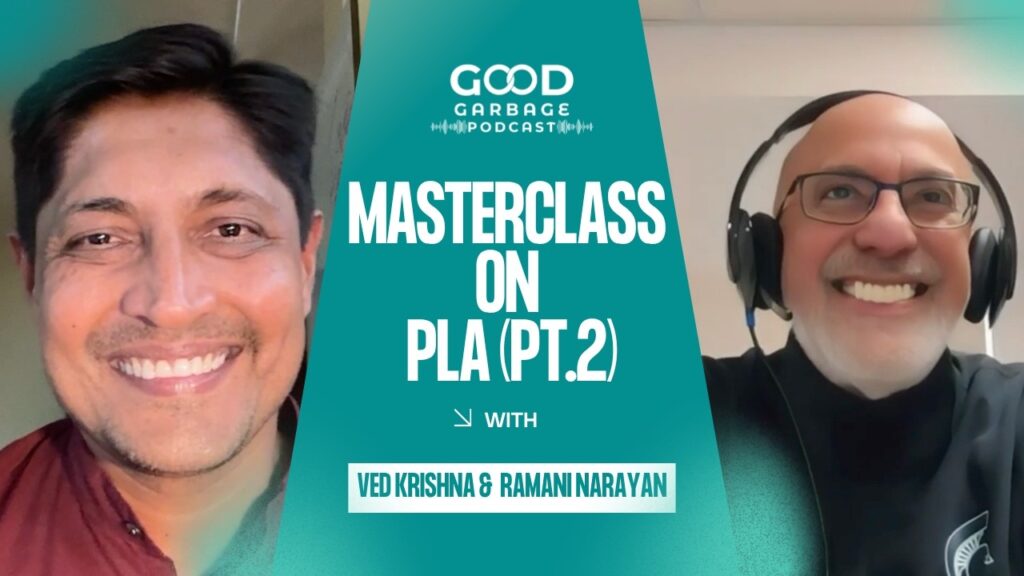
Hello, hello! Part two with Dr. Ramani Narayan. They get into PLA’s medical past, how Cargill’s search for a legacy polymer built the industry, the feedstock economics that put capacity in Nebraska and Thailand, why natural polymers do not make good materials, and what home composting really means for packaging in Indian temperatures.


00:00 – Intro
Cold open on the line that anchors part two, that we are carbon centric and this is a carbon world, cut with Dr. Narayan’s insistence that end of life must dominate the design of polymers.
02:25 – PLA's medical past, and why the body is not the environment
PLA is not new. Carothers at DuPont invented it in the 1950s and 60s and it has been in sutures, delivery systems, scaffolds and stents ever since. Dr. Narayan uses that history to park the question of whether PLA is a problem in the environment, while noting the body and the environment make different demands.
10:39 – Cargill's legacy polymer: how PLA got built at scale
Cargill wanted a legacy polymer rather than a quarterly product, and came to Michigan State asking what fermentation-based chemistry could be commercialised. Dr. Narayan tells the part of the story that had nothing to do with science and everything to do with what a corn wet milling business needed.
21:04 – Feedstock economics: corn, cane, and why Nebraska and Thailand won
Medical grade lactic acid was bought in, and purity mattered more than cost. For an agribusiness the calculation inverts: the feedstock has to be used, sugar cost dominates, and that economics is what put capacity in Nebraska and Thailand.
31:54 – Polymerization explained, and the carbon-carbon backbone problem
Dr. Narayan reduces polymerization to beads on a necklace, long carbon chains that entangle and cross-link. From there he explains why the carbon-carbon backbone is the root of the end of life problem rather than an incidental detail.
42:54 – From gas to granule: refineries, compounding, fossil vs biomass
The route from naphtha and natural gas through ethylene, propylene and styrene to a thermoplastic granule, and why agricultural feedstocks with their oxygen content do not slot neatly into a refinery built for the fossil version.
62:00 – Spider silk, natural polymers, and paper that hides plastic
Ved raises the water spider and its amino acid based web as a possible model. Dr. Narayan’s answer is blunt, that we are carbon centric and natural polymers do not make good materials, before turning to paper cups that are coated in plastic and still sold as paper.
74:50 – Starch vs lignocellulose, end of life must drive the design
Starch or lignocellulose is an economics question before it is an environmental one. Removing lignin costs roughly 30 percent of your sugar by mass, which is why cellulosic ethanol has never been competitive, and why Dr. Narayan insists end of life must drive the design.
87:50 – Coating paper: extrusion, solvents and water-based dispersions
Extrusion coating dominates because it is fast and cheap, which is how paper products stay affordable. Solvent and water-based dispersion routes open the door to smaller companies doing coatings, and Dr. Narayan walks through what each one demands.
93:50 – Home vs industrial composting, what composting actually is
Ved raises the practical problem that PLA at Indian ambient temperatures can begin composting on the shelf. Dr. Narayan sets out what composting actually is and where the line between home and industrial really sits.
104:45 – The scale gap, and what good garbage means
PLA capacity is nearing 75,000 tonnes in India and 150,000 in Thailand, against 400 million tonnes of plastics production. Dr. Narayan puts the ambition at 10 to 20 percent within five years and notes PLA alone cannot get there without PHAs and other polyesters.
Explore More Episodes











Let’s come together!