
Group Lead, Ved Krishna
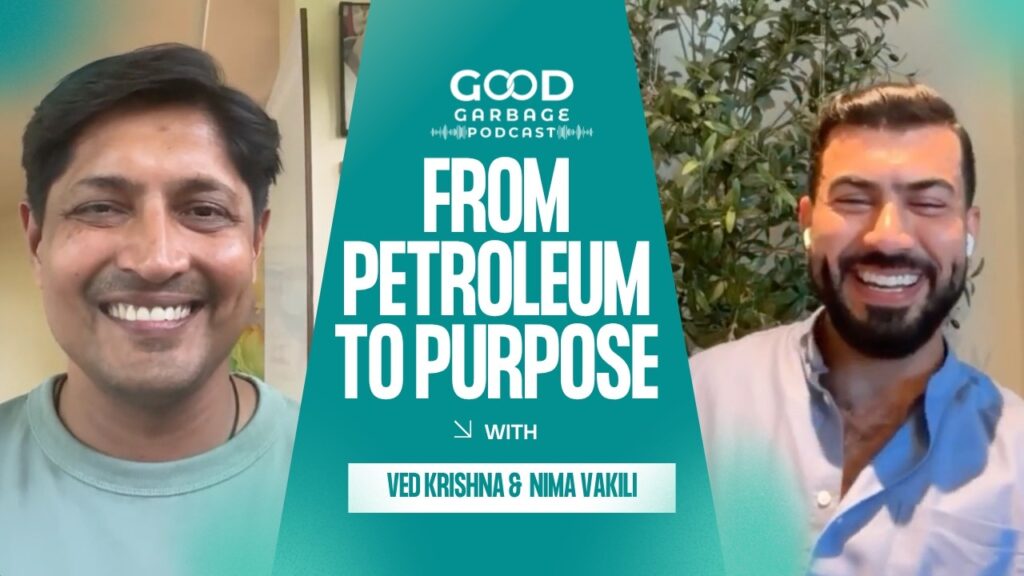
Hello, hello! Ved sits down with Nima Vakili, Founder and CEO of Safa Bioworks, who grew up inside the petrochemical world and chose to build outside it. They get into turning date palm waste into lactic acid, why bioplastics complement rather than replace fossil plastics, what the UAE gets right about long-term thinking, and why optimism is a working tool for a founder.


00:00 – Meet Nima Vakili, the petroleum heir who walked away
Cold open on Nima’s vision of building biomaterials at an infrastructure level. Ved welcomes the founder and CEO of Safa Bioworks and frames him as the first guest from the heartland of petroleum who refuses to do petroleum. Nima explains he always loved bioplastics but the difficulties scared him off, until his passion finally outweighed his caution and he exited that world five years ago.
02:00 – Chemplast, carpet recycling, and closed-loop with the car makers
Nima walks through the family business his father built: Chemplast, a high-performance petrochemical compounder in Tennessee serving automotive, food and beverage, medical, and wire and cable. They became the only US company cleaning post-industrial carpet fibers into recycled polypropylene for cars, and run closed-loop scrap programs with Nissan, Ford, and other tier-one customers.
06:00 – Why plastics aren't going anywhere, and the move to the UAE
Nima is blunt that you can’t live in a world without plastics; the job is to be responsible about producing, recycling, and reusing them. He describes moving to the UAE because the country is, in his words, big enough to dream and small enough to make it happen, with waste collection and analysis already mature enough to build on.
08:00 – Turning waste into high-value biomaterials, and how Safa began
The next step, Nima says, is valorizing waste into the highest-value materials rather than only recycling or cutting carbon. That goal is where Safa Bioworks was born. He and Ved also dig into whether petroleum engineers transition well into biopolymers, and why cost and long certification cycles slow adoption.
12:00 – Complementing the world's largest PLA plant, not competing with it
When Emirates Biotech announced the world’s largest PLA facility in the UAE, Nima took it as his signal. Rather than build another PLA, Safa aims to supply lactic acid and other biochemicals into that ecosystem, cut import reliance, and feed the UAE’s 2050 net neutrality vision. He admires how the government sets KPIs and actually meets them.
14:00 – Dubai's capability and two nature guys talking shop
Ved, who lives on a mango and lychee orchard, admits cities aren’t his place but his mind is blown by what the UAE built in the desert. Nima counters the misconception that the region lacks nature, pointing to mangroves in Abu Dhabi and Ras Al Khaimah, and ties his ability to hit goals to perspective and being hard on himself.
18:00 – A Toyota Corolla stuck in an Omani valley
Ved tells the story of following Google Maps deep into the Omani mountains in a Corolla, getting waved down by Land Rovers, and ending up stuck in loose soil until a village towed him out for a hundred dirhams. Nima reassures him it happens to the best of us.
20:00 – Will petroleum run out, and why diversify now
Nima argues the point isn’t predicting when oil ends but laying the groundwork before it does, pointing to the UAE’s 2071 economic diversification vision. Ved contrasts India’s reactive habit with China’s proactive planning, using the story of empty eight-lane highways built years ahead of demand.
24:00 – The palm tree as a symbol of circularity
Nima opens up about a lifelong connection to nature, from awe at a peeled pomegranate to watching trees in the wind. In the Middle East the date palm, Phoenix dactylifera, became symbolic for him: regenerative, ancient, and rising like the phoenix. Seeing hundreds of thousands of tons of date and frond waste burned or landfilled is what sparked Safa.
28:00 – From advertising to phone-screen patents
Nima explains he went into advertising to learn how to communicate good news instead of drowning in negativity. He traces his path through his immigrant father, Pepperdine and UCLA, a window-film business, and an antimicrobial phone-screen protector patented during COVID as a way to channel fear into building.
34:00 – What's really inside those silica gel packets
After 100 episodes, this is a first for the show: a deep dive into the desiccant packets in every vitamin bottle and snack bag. Nima explains silica and clay desiccants, the Tyvek and non-woven pouches, and how his earlier venture Vakko tried to make scented, food-grade versions. It is a huge, low-visibility market.
40:00 – Dates as feedstock and the first vs second generation fight
After the Pakka sponsor break, the talk turns technical. Nima compares date-based feedstock against the corn and sugarcane that Corbion and Cargill use for lactic acid. Because Safa attaches waste to a new feedstock, people are quick to label it second generation, a claim he works to invalidate, while noting the palm tree’s many waste streams.
46:00 – Designing a plant for messy, varied waste streams
Ved presses on homogeneity: dates vary by variety, region, and life cycle, so the sugars and lignin differ. Nima notes the UAE mainly grows Khalas dates while Saudi grows Majdool, and that the same regional approach could scale anywhere date palms grow. They detour through California date farms and the difference between date, palm, and lignocellulosic sugars.
50:00 – Plant size, timelines, and a $4.5 billion lactic acid market
Nima’s ambition says largest in the world; his technical team says slow down. The plan is a pilot-to-commercial facility within a year, near regional customers in Abu Dhabi and dream buyers like Agthia and Almarai. He frames it as a 10 to 50 year infrastructure project targeting a couple hundred thousand tons of lactic acid against a $4.5 billion regional market that is fully imported today.
56:00 – Platform chemicals, the plastic ban, and algae's promise
Safa is built as a biochemical platform, so lactic acid is the flagship but ethyl and methyl lactate and even sustainable aviation fuel are on the roadmap. Nima describes stepping away from trading toward industrial sovereignty amid regional uncertainty, the UAE’s single-use plastic ban, biopolymer compounding with PBAT and PBS, and why his team is excited about algae as a future feedstock.
64:00 – Scale-up challenges, optimism, and what good garbage means
Nima names his real challenges: getting commercialization right, using AI for predictive maintenance and yield, and competing with a century-old lactic acid market he would rather learn from and partner with. Ved shares the steel magnate’s line that a business owner survives on optimism, and Nima closes by reframing World Environment Day as gratitude and saying there is no such thing as just garbage, only good garbage.
Explore More Episodes




















Let’s come together!