
Group Lead, Ved Krishna
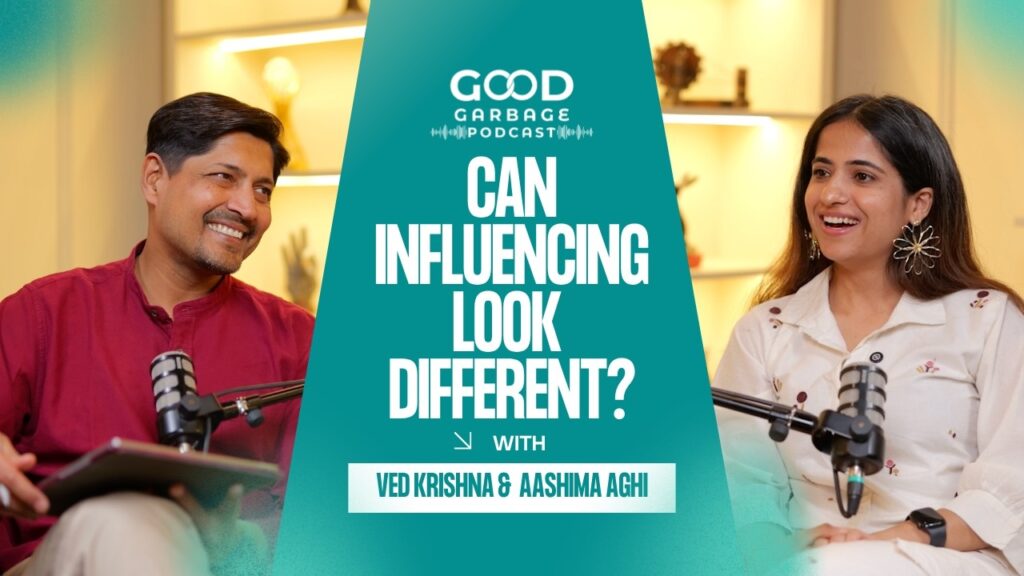
Hello, hello! Ved sits down with sustainability creator Aashima Aghi for a long, honest talk about conscious living and why we keep buying things we don’t need. They get into reusable products that actually feel better to use, conscious parenting, how to spot greenwashing, and how brands can make the sustainable choice the easy one.


00:00 – Meet Aashima, the show's first sustainability creator
Cold open on Aashima’s line that it’s better to have a hundred imperfect sustainable people than none. Ved gives his usual welcome, then introduces Aashima Aghi, the first sustainability content creator on the show, who drove two and a half hours each way to record in person.
03:00 – From a curious kid to a slower life
Aashima traces it back to a restless, curious childhood and a love of talking to anyone. COVID sent her home from Delhi, and the forced slowdown stuck. She started waking early, meditating, working out, and cooking clean breakfasts before she had ever heard the word sustainability.
08:00 – Why she went full-time on sustainability
People already came to her for habits, food, and how she lost weight, so she made lifestyle her niche and went all in on content. She’s blunt that she’s probably learned more than her audience, through composting, making bioenzymes, and changing how she eats.
09:30 – Commercialization of childhood, and buying less
The series started when her sister got pregnant and Aashima wanted to influence her choices without forcing anything. Her sister switched to reusable diapers and bought fewer clothes; Aashima gifted outfits in staggered sizes instead of ten things a newborn outgrows in 90 days. The takeaway: buy less, borrow, and remember the best packaging is no packaging.
16:00 – Consumption, GDP, and the Target story
Ved points out the whole economy is built to push consumption, since that’s what GDP rewards. He tells the Target analytics story: their models flagged a teenage girl as pregnant from her shopping before her own father knew. A look at how aggressively buying is engineered.
21:00 – Reusables you keep using because they feel better
Aashima admits she resisted period underwear for a year, even while making sustainability content. Now she pushes it on everyone, not for the planet but for how it feels, to the point she forgets she’s on her period. She frames every swap the same way: try it, keep it if it works for you, drop it if it doesn’t. The menstrual cup didn’t work for her, and that’s fine.
26:00 – Convenience culture and the sachet that never composts
Convenience is the engine behind overconsumption, from chips engineered to taste fresh months later to single-use everything. Ved explains why a sanitary pad tears like paper but won’t compost: it’s siliconized, and most of it is polyester and fluff pulp. The damage starts at the material, before anyone throws it away.
32:00 – Reading labels to catch greenwashing
Ved calls marketers the new-age shamans and says recycling is mostly a myth, since a plastic bottle never really becomes a bottle again. Aashima’s defense is reading labels: fewer ingredients, watch for palm oil hiding in vegan products, use scan-and-rate apps, and skip anything whose chemicals you can’t pronounce.
38:00 – Packaging's hardest problems
Sachets bother Aashima the most, which is what triggered her ketchup video. Her fixes for shoppers are to avoid sachets and buy in bulk or bigger portions. From five and a half years at Zomato she’s watched compostable packaging take off in restaurants because it looks premium and sells, though mixed and unsegregated waste is still a real problem on the disposal end.
44:30 – Masterclass: getting restaurants past the cost gap
After the Pakka sponsor break, Ved lays out his actual business problem: compostable food packaging runs about 30 percent more, and Zomato insists customers won’t pay even a few rupees extra. Aashima’s answer is to start with health-conscious, premium brands whose customers already worry about microplastics in hot food, where the small cost difference simply stops mattering.
56:30 – The 16,000-ton sachet problem
Ved describes a global shampoo brand that needed 16,000 tons of sachets a year to switch, where performance and scale are the real blockers. A single puncture kills a product meant to last 12 months. Aashima’s middle ground is a bigger sachet: a little less convenience in exchange for a compostable option that actually performs.
60:00 – Seeing the sugar, salt, and oil inside a pack
Health creators are pouring the palm oil, sugar, and salt out of a pack and into a jar so you can see it, breaking the out-of-sight-out-of-mind habit. Aashima ties it to parenting: kids copy what they watch, so adults have to model it. She points to food-label boards now appearing in schools.
68:00 – How shoppers move brands and governments
Ved and Aashima land on the idea that humans act more like destroyers than creators, but shoppers still have leverage. When people stop buying something, brands and governments notice; cold-drink and alcohol consumption are dropping, and plant-based options are showing up because demand moved first. Change your buying pattern and the options follow.
78:00 – Five habits worth changing
Aashima’s five: start with mindset and pause before impulse buying; compost, since roughly 60 percent of a kitchen bin can become fertilizer; make bioenzymes to cut cleaner bottles and cost; eat cleaner and only what you need; and simplify skincare, because skin is an organ and most of those products aren’t needed.
89:00 – What good garbage means to Aashima
She rounds off with product shout-outs first: tooth tabs, a bamboo toothbrush, period underwear, a reusable water bottle, and Dancing Cow’s oat-milk blend. Then her answer to the show’s closing question: good garbage is the garbage you never generated in the first place.
Explore More Episodes





















Let’s come together!