Molded Fibre Serviceware for Food Businesses: Material Properties, Cost Analysis, and Procurement Decisions

The global molded fibre packaging market reached USD 10.89 billion in 2024 and is projected to grow at 5.8% CAGR through 2030 (MarketsandMarkets, 2025). In India, the growth is faster because the regulatory floor has shifted: the Plastic Waste Management Rules ban single-use plastic plates, cups, cutlery, and trays. That ban removed the cheapest option from foodservice procurement. What replaced it is a set of alternatives with different performance characteristics, different cost profiles, and different end-of-life outcomes.
This article compares the options, with particular attention to bagasse-based molded fibre, because that is where most of the Indian foodservice volume is moving.
Key takeaways
- Bagasse molded fibre handles temperatures up to 220 degrees C, resists moderate grease, and is microwave and oven safe. It is IS 17088 certified compostable, decomposing in 90 to 180 days under industrial composting.
- The SUP ban makes plastic serviceware illegal. The practical alternatives are bagasse, areca leaf, palm leaf, paper board, and melamine (wash and reuse). Each has different performance and cost characteristics.
- At current Indian volumes, bagasse serviceware costs INR 2 to 7 per unit depending on format, compared to INR 0.50 to 1.50 for the now-banned plastic and INR 5 to 10 for melamine rental and wash.
- 67% of Indian consumers are willing to pay more for food served in eco-friendly packaging (FICCI-EY Packaging Report, 2024). That willingness translates to real purchasing behaviour in QSR and delivery channels.
- The material choice is not just environmental. Bagasse outperforms paper board on wet-food hold time and outperforms areca and palm leaf on supply consistency and format range.
What molded fibre actually is
Molded fibre is made by forming wet pulp over shaped moulds under heat and pressure. The pulp source determines the product’s properties. Recycled paper pulp produces egg cartons and electronics packaging. Agricultural fibre, primarily sugarcane bagasse, produces food-grade serviceware.
Bagasse is the fibrous residue left after extracting juice from sugarcane. India crushes roughly 350 million tonnes of sugarcane annually, generating approximately 100 million tonnes of bagasse (Indian Sugar Mills Association, 2024). Most bagasse goes to co-generation (burning for electricity in sugar mills). The fraction diverted to molded fibre production uses a waste stream that would otherwise be burned, which makes the raw material both abundant and inexpensive.
The thermoforming process matters because it determines final product quality. High-pressure thermoforming at 150 to 200 degrees C produces smooth, dense products with better grease resistance and structural rigidity than low-pressure alternatives. The difference between a bagasse plate that holds up during service and one that softens under gravy is often the forming process, not the raw material.
Performance comparison: bagasse vs alternatives
Every foodservice operation cares about the same things: will it hold the food, will it hold up during service, and will it cost more than what we used before? Here is how the current alternatives compare:
| Property | Bagasse (molded fibre) | Areca leaf | Palm leaf | Paper board | Melamine (reuse) |
|---|---|---|---|---|---|
| Temperature resistance | Up to 220C | Up to 150C | Up to 120C | Up to 100C | Up to 120C |
| Grease resistance | Good (coated: very good) | Moderate | Good | Poor | Excellent |
| Wet-food hold time | 45 to 60 min (coated) | 30 to 45 min | 45 to 60 min | 15 to 20 min | Unlimited |
| Microwave safe | Yes | Limited | No | No | Yes |
| Format range | Wide (plates, bowls, trays, clamshells, cups) | Limited (plates, bowls) | Limited (plates, bowls) | Wide | Wide |
| Supply consistency | High | Seasonal, regional | Seasonal, regional | High | High |
| Compostable | Yes (IS 17088) | Yes (natural) | Yes (natural) | Depends on coating | No |
| Cost per 9-inch plate (INR) | 2.50 to 4.00 | 3.00 to 5.00 | 4.00 to 6.00 | 1.50 to 2.50 | 5.00 to 8.00 (rental + wash) |

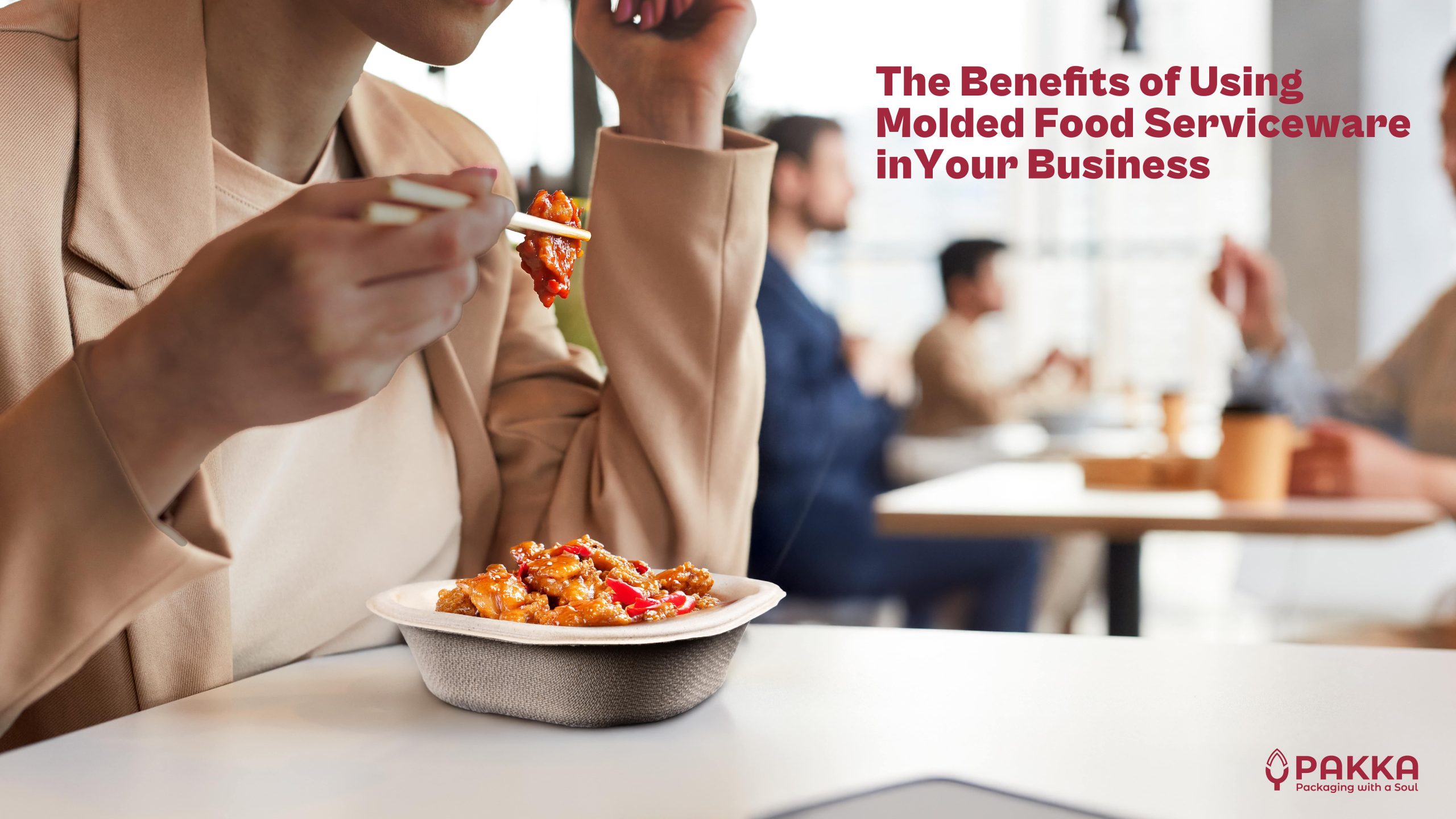
Photo via Pexels — Free to use
A few things stand out from this comparison.
Paper board is cheapest but fails with Indian food. Gravy, dal, and oily curries soften paper board within 15 to 20 minutes. That makes paper unsuitable for most sit-down and buffet service. It works only for dry items like sandwiches, burgers, and baked goods.
Areca and palm leaf produce attractive, natural-looking plates that photograph well. But supply is seasonal and regional, format range is limited, and the products cannot be produced at the volumes that QSR chains and large caterers need. For a boutique event or a premium restaurant, they work. For a 200-outlet QSR chain, they do not.
Melamine is the reusable option. It performs well, but requires wash infrastructure: water, detergent, drying space, and staff time. For dine-in restaurants with kitchen wash capacity, melamine is viable. For delivery, takeaway, catering events, and any operation without dedicated wash stations, it is not.
Bagasse occupies the middle ground: adequate performance across the full range of Indian food types, wide format availability, consistent supply at scale, and compostable end of life.
Where bagasse serviceware works in Indian foodservice
QSR and fast casual chains
QSR chains need format consistency, high volume supply, and packaging that survives the 20 to 30 minutes between food preparation and consumption. Bagasse clamshells and meal trays handle this window comfortably. The heat resistance means hot food straight from the kitchen does not deform the container.
Several Indian QSR chains have transitioned to bagasse serviceware for dine-in and takeaway. The operational feedback centres on consistency: once the formats are validated, the supply is predictable and the quality does not vary batch to batch the way natural leaf products can.
Cloud kitchens and delivery
Delivery adds transit stress. The container needs to handle stacking, jostling, and temperature loss during transport. Bagasse bowls with fitted lids resist spillage under moderate stacking pressure. For heavy gravies and liquids, specify coated products with PFAS-free water-based coatings that extend wet-food hold time to 45 to 60 minutes.
The delivery window for most cloud kitchen orders is 30 to 45 minutes from packing to consumption. Bagasse containers handle this comfortably. The failure point to test is lid-to-bowl fit: a loose lid allows spillage, and not every supplier’s lid seal is equally tight.
Corporate and institutional catering
Events serving 500 to 5,000 covers need compartment trays, portion cups, and flat plates in bulk. At order volumes of 10,000+ units, bagasse serviceware costs INR 20 to 25 per complete cover (plate, bowl, cup, cutlery equivalent). That is 2x to 3x the old plastic pricing but less than melamine rental and wash, and it eliminates the wash infrastructure requirement entirely.
Retail-ready meal packaging
Ready-to-eat meals sold at retail or through vending require food-contact certified packaging that looks presentable on a shelf. Bagasse trays with transparent lids (the lid can be PLA or rPET depending on compostability requirements) provide the visibility consumers expect while keeping the tray compostable.
The compliance picture
India’s regulatory framework for food serviceware has three layers, and procurement teams need to understand all three.
Plastic Waste Management Rules. Single-use plastic plates, cups, cutlery, stirrers, and trays are banned. Using them is a compliance violation with penalties under the Environment Protection Act. This is not a future requirement; it is current law.
EPR for Packaging Rules (effective April 2026). Extended Producer Responsibility requires brands, importers, and retailers to manage the end-of-life of their packaging. CPCB portal registration, half-yearly and annual returns, and recycling or composting targets are mandatory. Compostable serviceware certified under IS 17088 simplifies EPR compliance because it enters organic waste streams rather than requiring separate recycling infrastructure.
FSSAI food contact compliance. Any material that contacts food must meet FSSAI safety requirements. This is separate from compostability certification. A product can be IS 17088 certified compostable and still fail FSSAI food contact requirements if the coating or raw material contains restricted substances. Confirm both certifications before procurement.
Cost analysis at volume
The cost discussion for molded fibre serviceware is incomplete without context. The per-unit cost comparison against banned plastic is misleading because plastic is no longer legal. The relevant comparison is against paper, areca/palm leaf, and melamine.
At Indian market volumes for orders of 5,000+ units:
| Format | Paper board | Bagasse (uncoated) | Bagasse (coated) | Areca/palm leaf |
|---|---|---|---|---|
| 9-inch plate | INR 1.50 | INR 2.50 | INR 3.50 | INR 4.00 |
| 4-compartment tray | INR 4.00 | INR 5.50 | INR 7.00 | Not available |
| 750ml bowl + lid | INR 5.00 | INR 6.00 | INR 7.50 | Not available |
| Clamshell | INR 3.50 | INR 5.00 | INR 6.50 | Not available |
The premium for bagasse over paper is INR 1 to 3 per unit. The difference in wet-food performance is the gap between 15 minutes (paper fails) and 45 to 60 minutes (coated bagasse holds). For any operation serving Indian food with gravies, curries, or oils, that performance gap makes paper a false economy.
At 10,000+ unit volumes, per-unit costs drop by 15 to 20%. For QSR chains ordering 50,000+ units monthly, further volume discounts apply.
What to check before committing to a supplier
Procurement decisions in foodservice packaging are hard to reverse once you have validated the format with your operations team and integrated it into your supply chain. These checks prevent problems after commitment:
Ask for the IS 17088 certificate, not a brochure or a claim. Confirm that the specific products you are ordering (not just the raw material) are covered by the certificate. Ask for the FSSAI food contact test report for the specific coating used on your products. Confirm whether the coating is PFAS-free; PFAS compounds are being phased out globally and regulatory action in India is expected.
Request samples in every format you intend to use. Test with your actual food for the duration of your actual service window. A plate that holds up with dry starters may fail with butter chicken. Test the failure mode, not the success case.
Confirm supply consistency: what is the monthly production capacity, what is the lead time, and what happens if you need to scale volume by 50% for a seasonal peak? Seasonal demand spikes in Indian foodservice (wedding season, festivals) are when supply chain weaknesses surface.
Frequently asked questions
Is bagasse serviceware safe for hot food?
Bagasse handles temperatures up to 220 degrees C. It is safe for hot food straight from the kitchen, microwave reheating, and oven use. PLA-coated alternatives start softening above 60 degrees C, so confirm the coating material if heat resistance matters for your application.
How long does bagasse serviceware last with Indian food (gravy, oil)?
Uncoated bagasse handles moderate grease for 30 to 45 minutes. Coated products (water-based, PFAS-free coatings) extend wet-food hold time to 45 to 60 minutes. For heavy pooling gravies, coated products are necessary. Test with your specific menu items.
What certifications should foodservice operators check?
IS 17088 for compostability and FSSAI compliance for food contact safety. These are separate certifications. A product can hold one without the other. Also confirm that coatings are PFAS-free and that the specific formats you order are covered by the certificate.
How does bagasse compare to areca and palm leaf plates?
Bagasse offers wider format range (plates, bowls, trays, clamshells, cups), more consistent supply at scale, and lower cost at volume. Areca and palm leaf have a more natural appearance and work well for premium events but face seasonal supply constraints and limited format options.
Can bagasse serviceware be composted after use?
IS 17088 certified bagasse products decompose in 90 to 180 days under industrial composting conditions. Backyard composting takes 6 to 12 months. Food-contaminated bagasse items are accepted by composting facilities because the food residue and the container both compost. In landfill, decomposition is slower but still faster than plastic.
What minimum order quantities should foodservice operators expect?
Most Indian suppliers offer MOQs of 1,000 to 5,000 units per format. Volume discounts start at 10,000+ units (15 to 20% reduction). QSR chains ordering 50,000+ monthly negotiate further. Stock high-volume formats (plates, meal trays, bowls) and order speciality items as needed.
Evaluating molded fibre serviceware for your foodservice operation? Talk to our team about format selection, bulk pricing, and customisation options.
The Good Garbage Podcast
Why Composting is Having a Revolution with Frank Franciosi
Hear Frank Franciosi discuss this topic in depth with host Ved Krishna on The Good Garbage Podcast.
Specifying packaging for this application. Pakka’s food service packaging range covers moulded and paper-based food service formats, with compostability and food-contact data. Talk to the Pakka team for specifications, samples and pricing.
Browse all Pakka articles.
You may also like