Can Sugarcane Bagasse Make Compostable Packaging Mainstream? India’s Raw Material Advantage

The question is not whether compostable packaging works. The barrier performance is proven, the certifications exist, and the products are in commercial use. The question is whether it can scale to replace a meaningful fraction of conventional packaging. That requires abundant, low-cost raw material available within the geography where the packaging is manufactured and consumed.
India produces approximately 450 million tonnes of sugarcane annually, the second highest globally after Brazil (Indian Sugar Mills Association, 2024). Bagasse, the fibrous residue left after juice extraction, accounts for 25 to 30% of sugarcane weight. That means roughly 100 to 135 million tonnes of bagasse are generated every year in India. Most is burned for co-generation (electricity production in sugar mills). The fraction diverted to packaging uses a waste stream that would otherwise be combusted.
This raw material abundance is India’s structural advantage in compostable packaging. Other countries importing their compostable packaging raw materials face cost and supply chain constraints that limit scale. India has the fibre sitting next to the sugar mills, in the same states (Uttar Pradesh, Maharashtra, Karnataka) where packaging demand is highest.
Key takeaways
- India generates 100 to 135 million tonnes of bagasse annually. Even diverting 1% to packaging would supply 1 to 1.35 million tonnes of raw material, enough for the entire Indian compostable packaging market several times over.
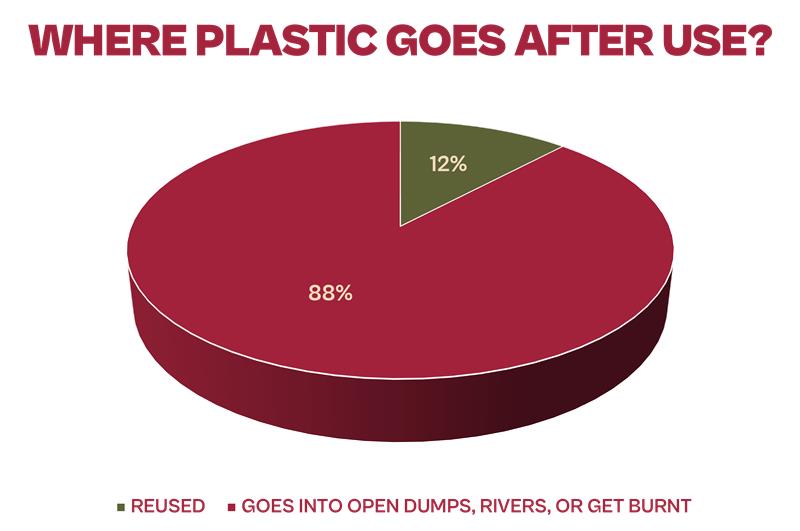
- Over 400 million tonnes of plastic waste enters the global environment annually. India generates over 3.5 million tonnes of plastic waste yearly, with only 12% reused (CPCB Annual Report, 2024).
- Previous compostable alternatives (palm leaf, areca, edible packaging, paper straws) failed at scale due to supply inconsistency, limited format range, or cost that was 4x to 6x conventional plastic.
- Bagasse addresses the supply constraint because it is an industrial waste stream with consistent output tied to sugar production, not a harvested crop that competes with food production.
- Compostable packaging from bagasse produces 30 to 50% lower greenhouse gas emissions compared to equivalent plastic packaging over its lifecycle (Environmental Science & Technology, 2023 meta-analysis).
Why previous alternatives failed to scale
Every compostable packaging material that preceded bagasse at scale faced the same question: can you make enough of it, cheaply enough, to serve a market currently supplied by plastic? The answer was consistently no.
Palm leaf and areca plates produce attractive, natural-looking products. They work well for premium events and boutique food service. But supply is seasonal (harvest dependent), regional (limited to specific growing areas), format range is narrow (plates and bowls only), and production volumes cannot serve a 200-outlet QSR chain with weekly deliveries.
Paper straws and paper alternatives address single-use plastic items but do not solve the broader packaging problem. Paper fails with hot, wet, oily Indian food. Paper-based alternatives for meal trays, containers, and bowls require coatings and treatments that often compromise compostability.
Edible packaging (seaweed-based, starch-based wraps) generated media attention but no commercial scale. The shelf life of the packaging itself is a constraint: a container that degrades before the food inside it is not a viable product.
PLA (polylactic acid) from corn starch is commercially used for cold cups and lids. It softens above 60 degrees C, which makes it unsuitable for hot food contact. India is not a major corn surplus country, so PLA raw material is imported, adding cost and supply chain complexity.
Each of these alternatives works in a niche. None scales to replace the 3.5 million tonnes of plastic waste India generates annually.
Why bagasse is different: the supply economics
Bagasse is different because it is an industrial by-product with predictable, large-scale output. Sugar mills generate bagasse continuously during the crushing season (October to April in most Indian states). The fibre does not require separate cultivation, harvesting, or processing. It is already there, in large volumes, at low cost.
The economic structure:
– Raw material cost: Near zero for integrated operations that own both sugar mill and packaging plant. The bagasse is a waste stream with negative or zero marginal cost.
– Processing cost: Pulping, moulding, and finishing. Modern thermoforming lines run at throughput rates comparable to conventional moulded fibre lines.
– Energy: Sugar mills generate electricity through bagasse co-generation. An integrated operation can power the packaging plant from the same co-generation facility, reducing energy costs and carbon footprint. Some operations achieve 95% off-grid renewable energy.
– Water: Modern pulp processing uses closed-loop water systems with 50% recycled water.
The result is a cost structure that, at scale, brings compostable packaging within 2x to 3x of conventional plastic pricing. That is still a premium, but it is a premium that regulation (SUP ban, EPR rules) and consumer demand are making commercially viable. For the current Indian position, see what changed in the Plastic Waste Management Rules in 2026.
The format range advantage
Bagasse pulp can be formed into virtually any shape that plastic can, subject to tooling design. Current commercial production includes:
- Moulded fibre serviceware: Plates, bowls, trays, clamshells, portion cups, meal trays (4 and 5 compartment), cup lids
- Paper products: Food wrapping paper, carry bags, grease-resistant liner sheets, napkins
- Flexible packaging substrates: Metallised paper for tea, coffee, confectionery, and snack packaging
This format range means a single raw material (bagasse) can serve QSR chains, delivery operators, caterers, D2C brands, and retail packaging needs. That breadth of application is what palm leaf, areca, and PLA cannot match.
India’s geographic advantage
The sugarcane belt in India — Uttar Pradesh, Maharashtra, Karnataka, Tamil Nadu, Gujarat — overlaps significantly with the major packaging demand centres. Manufacturing packaging from locally available bagasse eliminates the import dependency that limits compostable packaging in Europe and North America.
European compostable packaging manufacturers import PLA from the US or Asia, or import bagasse pulp from South America. Those supply chains add cost, lead time, and carbon footprint. India’s integrated model — sugarcane grown locally, crushed locally, bagasse processed locally, packaging manufactured locally — compresses the supply chain to within 200 km in many cases.
This geographic compression also reduces the packaging’s lifecycle carbon footprint. Transport emissions, which can account for 15 to 25% of a product’s total carbon footprint, are minimised when raw material and manufacturing are co-located.
The regulatory tailwind
Multiple countries have created market conditions where compostable packaging demand is forced by law:
- India: SUP ban (July 2022), EPR for Packaging Rules (April 2026)
- EU: Single-Use Plastics Directive (July 2021), PPWR (2024)
- US: State-level SUP bans in 11 states
- Australia: National Plastics Plan target for all packaging to be reusable, recyclable, or compostable by 2025
- Canada: Federal ban on six categories of single-use plastics (December 2022)
- UAE: Plastic bag ban (January 2024)
Each of these regulations creates demand for packaging materials that are food-safe, functional, and either recyclable or compostable. Bagasse-based packaging qualifies across all these markets with appropriate certification (IS 17088 for India, EN 13432 for EU, ASTM D6400 for North America).
The scale challenge that remains
The structural advantages are real. The constraints are also real.
Seasonal raw material availability. Sugarcane crushing runs October to April. Bagasse availability is concentrated in that window. Year-round packaging production requires either stockpiling bagasse or supplementing with other fibre sources during the off-season. Integrated operations manage this through pulp storage and inventory planning.
Quality consistency. Bagasse quality varies with sugarcane variety, crushing efficiency, and storage conditions. Inconsistent fibre length or moisture content in the bagasse produces inconsistent paper and moulded fibre quality. Integrated operations that control the full chain from cane to packaging manage this better than converters buying spot-market bagasse.
Cost gap. Compostable packaging is still 2x to 3x the price of the banned plastic it replaces. The cost gap is closing as volumes increase and production efficiency improves, but it has not closed. For price-sensitive segments of the market (street food, small restaurants, rural food service), the premium remains a barrier.
Composting infrastructure. Compostable packaging needs composting facilities at end of life. In cities without industrial composting, the products enter landfill. Expanding composting infrastructure is a municipal responsibility, not a packaging manufacturer’s, but the value proposition of compostable packaging is weaker without it.
Frequently asked questions
How much bagasse does India produce annually?
India produces approximately 100 to 135 million tonnes of bagasse per year, a by-product of crushing 450 million tonnes of sugarcane. Most is used for co-generation electricity in sugar mills. The fraction diverted to packaging is small relative to total availability.
Is bagasse packaging truly compostable?
Products certified under IS 17088 have passed biodegradation (90% within 180 days), disintegration, ecotoxicity, and heavy metal testing under industrial composting conditions. Certification covers the finished product including any coatings, not just the base material.
Why did palm leaf and areca plates not scale like bagasse?
Supply is seasonal and regional, limiting availability. Format range is narrow (mostly plates and bowls). Production volumes cannot serve large QSR chains or industrial caterers. Bagasse has consistent industrial-scale supply year-round from sugar mills.
How does bagasse packaging compare to plastic on greenhouse gas emissions?
Lifecycle analyses show 30 to 50% lower greenhouse gas emissions for bagasse packaging compared to equivalent plastic packaging. The advantage comes from renewable raw material, shorter transport distances in integrated operations, and carbon sequestration in the composting end-of-life pathway.
Is bagasse packaging available for flexible packaging, not just tableware?
Yes. Bagasse pulp produces paper substrates that can be metallised for flexible packaging applications. Metallised bagasse paper achieves MVTR below 2 g/m2/day and OTR below 10 cc/m2/day, suitable for tea, coffee, confectionery, and snack packaging.
What is the cost difference between bagasse packaging and the plastic it replaces?
Roughly 2x to 3x per unit at current volumes. A bagasse plate costs INR 2.50 to 4.00 compared to INR 0.80 for the now-banned polystyrene plate. At larger volumes (50,000+ units), the gap narrows. When EPR compliance costs for plastic are factored in, the total cost comparison shifts further in bagasse’s favour.
Exploring bagasse-based packaging for your operations? Talk to our team about material options, volume pricing, and IS 17088 certification details.
The Good Garbage Podcast
Can Seaweed Replace Plastic? with Neha Jain
Hear Neha Jain discuss this topic in depth with host Ved Krishna on The Good Garbage Podcast.
Moving a format from conventional plastic to bagasse. Pakka’s food service packaging range covers moulded and paper-based food service formats, with compostability and food-contact data. Talk to the Pakka team for specifications, samples and pricing.
Browse all Pakka articles.
You may also like
