Porosity and Air Permeability in Coating Base Paper: Why Your Silicone Consumption Depends On It

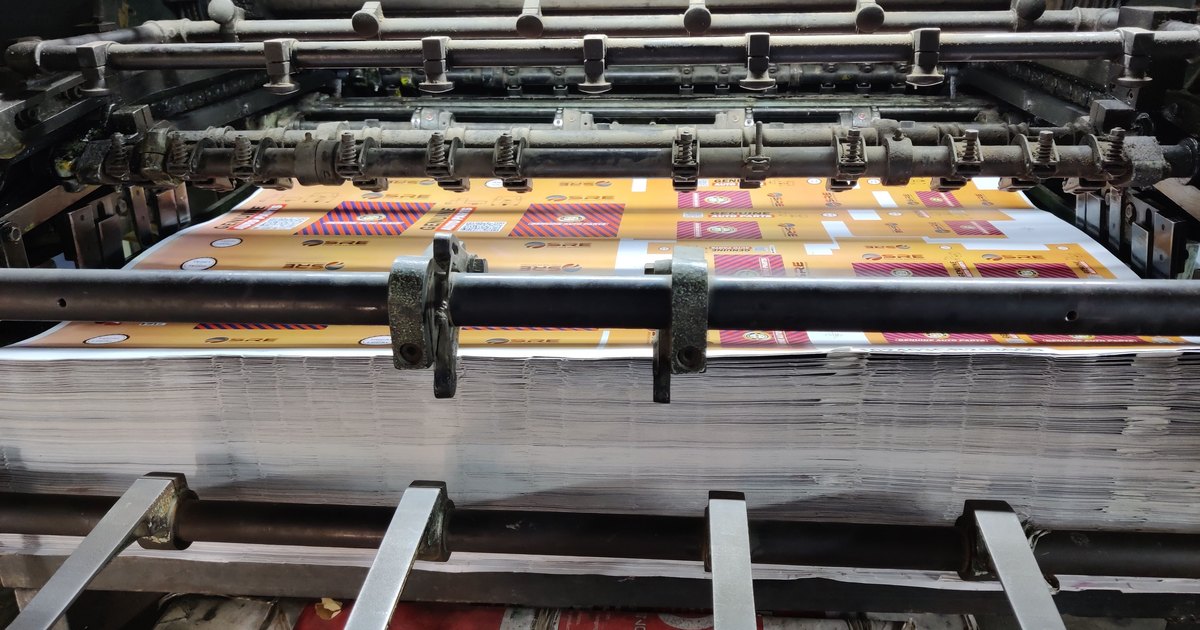
Porosity decides how much silicone a coating base paper drinks. An open sheet lets low-viscosity silicone migrate into the fibre network instead of holding it at the surface, so the coater lifts coat weight until release comes back on target, and pays for silicone that never does any work.
Most base paper certificates report that property as a single number, three lines below grammage, and it gets read as a formality. It is usually the cheapest lever a coater has on the most expensive input the line consumes.
Coating base paper is uncoated paper made specifically to receive a functional coating downstream: silicone, a barrier polymer, a biopolymer or an extrusion layer. It is sold by grammage as reel stock to coaters and converters, and it is judged almost entirely on what it does to the coating process rather than on how it looks.
How does base paper porosity change silicone consumption?
Silicone consumption rises with base paper porosity because a share of every applied gram sinks below the surface, where it contributes nothing to release. The coater compensates by lifting coat weight until the surface film is continuous again, which means an open sheet costs more silicone per square metre for identical release performance.
The mechanism is capillary, not chemical. Solventless silicone systems are applied at low viscosity so they level cleanly in the nip, and that same low viscosity is what makes them willing to wick into inter-fibre voids. Once silicone is inside the sheet it is still crosslinked and still paid for, but it has left the release surface. Downstream, the coater sees release force reading high or inconsistent at a coat weight that should have worked. The instinctive fix, adding more silicone, treats the symptom.
Silicone holdout is the degree to which a base keeps applied silicone on its surface instead of absorbing it into the fibre. Higher holdout means less silicone to reach a target release, which lands on the cost sheet rather than the quality report.
The arithmetic settles it faster than the argument does. Take a line coating one million square metres a month. At a nominal 1.0 g/m² of solventless silicone, that line consumes one tonne of silicone in the month. If the base is open enough that the same release needs 1.2 g/m², consumption becomes 1.2 tonnes: a twenty per cent increase in the most expensive input on the line, for no change in what the customer receives. None of that increase appears on the base paper invoice, which is why it usually surfaces in the silicone budget rather than in the purchasing decision that caused it. Release force can be pinned to a published method rather than to judgement. The FINAT Test Methods used across the self-adhesive industry define low-speed release measurement, and ASTM D6862 covers 90-degree peel, so the acceptance criterion goes into the contract instead of into a phone call.
The answer stops holding at the closed end of the scale. A surface that is too closed can starve mechanical anchorage, and silicone sitting entirely on top of a glazed surface can rub off or transfer to the adhesive face. Anchorage is the grip between the cured silicone and the sheet, and it needs some interaction with the fibre to develop. Reduced-penetration silicone systems exist because that trade-off is real. They are formulated to sit up on more open bases, and they are the honest compensation route when the base available to buy is more open than the base you would design. Chasing holdout on its own, without checking rub-off, relocates the failure rather than removing it.
Gurley, Bendtsen or Sheffield: which air permeability test belongs in a coating base specification?
Specify one air permeability method by name and hold to it, because the three common methods measure different things in different units and cannot be reliably converted between. Gurley reports a time. Bendtsen and Sheffield report a flow. Each has a range where it resolves well and a range where it stops telling two very different sheets apart.
Air permeability is how readily air passes through a sheet. It works as the practical proxy for porosity in a coating base, because the same open structure that lets air through lets liquid coating in. It is a different property from porosity, which describes void volume and its arrangement, and a specification that treats the two words as interchangeable will eventually be argued over in a dispute meeting.
| Method | Standard | What it reports | Units | Resolves best on | Limitation |
|---|---|---|---|---|---|
| Gurley | TAPPI T 460 / ISO 5636-5 | Time for a fixed air volume to pass | Seconds per 100 mL | Closed, dense, supercalendered sheets | Loses discrimination on open sheets; readings become impractically short |
| Bendtsen | ISO 5636-3 | Air flow at fixed differential pressure | mL/min | Mid-range to open sheets | Saturates at the closed end; instrument ceiling reached before the sheet stops varying |
| Sheffield | TAPPI T 547 | Air flow through an annular land area | Sheffield units | Mid-range work, and mill correlation | Less common in Indian labs; comparison data harder to source |
| Schopper | ISO 5636-2 | Air flow at fixed pressure | mL/min | General purpose | Least used of the four in release-liner practice |
The numbers inside the standards make the choice concrete. TAPPI T 460 measures the time in seconds for 100 mL of air to pass through a 6.45 cm² area at a pressure of roughly 1.22 kPa. ISO 5636-3 measures Bendtsen flow at a differential pressure of 1.47 kPa. Different pressures, different areas, which is why the conversion tables that circulate between Gurley seconds and Bendtsen mL/min are approximations that hold only over a narrow band, and only for sheets of similar structure. A supplier quoting one method against a specification written in the other is not being evasive, but the comparison is still not sound, and the gap tends to be discovered during a claim rather than during qualification. Both method families sit in published catalogues: the TAPPI standards and methods index and the ISO 5636 series. Either is defensible in a specification. Using both, or converting between them halfway through a negotiation, is not.
The practical consequence shows up at the ends of each instrument’s range. A very closed sheet drives a Bendtsen reading towards the bottom of the scale, where two genuinely different grades return near-identical flows, while the same pair separates cleanly on Gurley. Run it the other way and Gurley times collapse to a few seconds on an open sheet, at which point operator technique starts to matter more than the paper does. Match the method to the grade you actually buy.
Air permeability is also incomplete on its own. Print-surf roughness under ISO 8791-4 or TAPPI T 555, measured at a stated clamping pressure, describes the micro-topography that decides whether a thin silicone film stays continuous or bridges over voids. Two reels can match on Bendtsen and behave differently in the nip because their roughness profiles differ. The test-method guide for porosity, burst and tear on base paper covers the incoming-inspection side of these methods in more detail. The question here is narrower: which of them belongs in the purchase specification in the first place.
Why does porosity get harder to control as grammage falls?
Porosity control gets harder at low grammage because there is less fibre available to close the sheet, and because any given formation defect occupies a larger proportion of a thin sheet than of a heavy one. A pinhole that stays a local curiosity at high grammage becomes a through-path at low grammage, and the calender has less material to densify before it starts crushing rather than closing.
Release-liner base grades sold as glassine are conventionally specified in a 50-80 g/m² band, and part of the reason that convention exists is that the band is where the papermaking is comfortable. Below it, three things move at once. Formation variation, the evenness of fibre distribution, stops averaging out through the thickness of the sheet. Moisture profile across the web becomes proportionally more influential on both porosity and dimensional stability. And the calender stack, the main tool for closing a surface, works in a narrower window between closed enough and crushed, because bulk lost at low grammage does not come back.
Supercalendering resolves most of this at the heavy end: alternating hard and soft rolls under high pressure that close the surface and give glassine its holdout. It also explains why supercalendered grades cost more per tonne and often less per square metre of coated output, since the silicone saved can exceed the premium paid. That trade is the commercial logic of the glassine segment, and it is worth understanding before assuming a cheaper base makes a cheaper line. Grammage selection behaves the same way in adjacent paper applications, where the lowest sustainable grammage is set by the process that has to run it rather than by the sheet in isolation.
The limitation deserves stating plainly. A lighter base is a real cost and sustainability lever, and it is also the hardest version of the porosity problem. Anyone presenting low grammage purely as a saving, without addressing air permeability, web tension and moisture profile in the same conversation, is selling rather than specifying. A converter is right to make “will it run on my line” the first question, and right to want it answered with trial data instead of a certificate.
What actually controls porosity in a coating base: refining, size press or calendering?
Porosity is set by four levers acting together, and none of them can be adjusted without paying for it somewhere else. There is no additive that closes a sheet for free, which is why porosity is a papermaking outcome rather than a value the mill can dial in on request.
- Furnish. Fibre type and length distribution set the baseline void structure. Shorter, finer fibre packs more densely and closes the sheet, at the cost of tear strength, which matters on a coating line because tear resistance is what survives a splice.
- Refining. Mechanical treatment fibrillates fibre and raises bonded area, reducing porosity. It also slows drainage on the machine and lowers tear, so refining as a closure strategy hits a ceiling set by machine speed and runnability rather than by the sheet.
- Size-press chemistry. Surface sizing with starch or a synthetic size fills surface voids and raises holdout directly. This is the most targeted lever available and the one most often adjusted between trial reels, but it changes surface energy as well as closure, which affects how the silicone wets and anchors.
- Calendering. Pressure and temperature densify the surface. It acts fastest and is easiest to write into a specification, and it costs bulk and can crush a light sheet.
Whether those levers stacked or interacted is visible in the sheet properties a mill reports alongside air permeability. Grammage under TAPPI T 410 and thickness under TAPPI T 411 together give apparent density. A porosity change that shows up as a density change is structural; one that does not is a surface change. That distinction tells a coater which lever was pulled between two trial reels, which is more useful than the air permeability number on its own. The base paper procurement checklist covers what else to ask a mill to certify at order stage, and whether a grade is bleached or unbleached changes the surface chemistry the size press is working with, beyond any difference in appearance.
None of the four levers is free of downstream consequence for barrier behaviour either. Closing a sheet raises resistance to air and moisture transfer, which is wanted for barrier coating and unwanted where the application needs breathability. The moisture-barrier behaviour of paper-based structures shows the same relationship from the finished-pack end, where the substrate contributes one term out of several.

How do you write air permeability into a base paper specification?
Write air permeability as a named method, a target with a two-sided tolerance, a stated measurement position across the web, and an acceptance test run on your own line. A one-sided maximum on a certificate is the most common error in this category, because it permits a sheet far more closed than agreed, which then fails on anchorage instead of on holdout.
A specification that survives contact with a real supply relationship covers five things:
- One method, named with its standard number. “Bendtsen air permeance per ISO 5636-3” is a specification. “Porosity: low” is not.
- A target and a two-sided tolerance. State the value the coating recipe was designed around and the band either side that you will accept, because failures come from both directions and only one of them usually gets written down.
- Measurement position and frequency. Cross-direction profile matters more than the mill average. Specify positions across the web and per-reel frequency, since a reel can average correctly and still carry an edge that behaves differently at the nip.
- A line-based acceptance test. Tie approval to release force and coat weight measured on your own coater against a named method, the FINAT low-speed release procedure or ASTM D6862, rather than to the mill laboratory report alone.
- Retained samples and reel traceability. Require retained samples per reel and a certificate identifying the reel, so a downstream problem traces back to a point in the run rather than to a delivery note.
There are limits to what any specification can do. It cannot make one number describe a distribution: the mill certificate reports a value per reel, while the variation that causes trouble is within-reel and across-web. It also does not replace a trial. Where food-contact end uses are involved, the specification reaches past physical properties as well. Food-contact compliance for paper in India runs through the Food Safety and Standards (Packaging) Regulations, 2018 administered by the FSSAI, and IS 15495:2020, the Bureau of Indian Standards code of practice for printing ink used in food packaging, applies to whatever gets printed on the coated web.
Where the wider team needs the vocabulary these specifications assume, the paper converter glossary defines the substrate terms used above.
Where a paper coating base fits
Start with what paper does not do. At equal thickness, paper does not match a polymer film for gas barrier, and no amount of surface closure changes that; gas barrier on a paper structure comes from what is coated or laminated onto it. Porosity control at the light end of the grammage range is difficult, and porosity is the property most likely to vary reel to reel. Any supplier quoting a porosity or holdout figure for a base paper that has not completed pilot production is quoting an intention, and a coating technologist is right to discount it.
That is the honest frame for our own work. Pakka is developing flexC base, a coating base paper in the 40-60 GSM band, in bleached and unbleached form, intended as a substrate for barrier chemistries generally rather than for one coating system: silicone, biopolymer or plastic. The company has disclosed eight target applications for it, namely confectionery wraps, snack pouches, sachets, medical packaging, seed packs, release liners, dry food liners and tea pouches (Pakka Limited, Investor Presentation Q1 FY2026-27, filed 18 August 2026, BSE 516030 / NSE PAKKA).
The name needs care, because two products share it. flexC is Pakka’s finished compostable flexible-packaging laminate, sold to brand owners as a converted material. flexC base is the uncoated coating base paper described here, sold to the coater or converter who applies their own barrier chemistry. Different products, different buyers, and a specification written for one does not describe the other.
We are not attaching performance numbers to flexC base. No air permeability, holdout, coat weight, smoothness or release figures are published for it, because it is a development programme and pilot data does not exist yet. Publishing a number now would be marketing rather than specification, and this reader can tell the difference. The useful conversation at this stage runs on requirements: what your line needs, which method you specify against, and what a trial would have to demonstrate before a reel is worth qualifying.
Frequently asked questions
What is a good Gurley value for a release liner base paper?
No single Gurley value is correct, because the target depends on the silicone system, the coat weight and the line speed you run. Supercalendered glassine grades sit at the closed end of the scale, and reduced-penetration silicone systems are designed to tolerate more open bases. The question worth asking is which combination of base and chemistry reaches your release specification at the lowest total cost, rather than which base carries the highest number.
Is porosity the same thing as air permeability?
No. Porosity is the volume and structure of void space in the sheet. Air permeability is a measurable consequence of that structure, reported as a time (Gurley, TAPPI T 460) or a flow (Bendtsen, ISO 5636-3). Two sheets can share an air permeability reading and differ in how the voids are distributed, which is why they can behave differently under a coating nip while matching on the certificate.
Can you convert a Bendtsen reading to a Gurley reading?
Only approximately, and not reliably enough to write into a specification. The methods use different test pressures and different measurement areas, roughly 1.22 kPa over 6.45 cm² for Gurley against 1.47 kPa for Bendtsen, so published conversion tables hold across a narrow range and only for sheets of similar structure. Specify one method by its standard number and require the supplier to report against that method.
Why do two reels with the same grammage behave differently on the coating line?
Because grammage describes mass per unit area and says nothing about how that mass is arranged. Two reels at identical grammage can differ in formation, apparent density, surface closure and cross-direction moisture profile, and each of those changes how much silicone the sheet absorbs and how the web behaves under tension. Comparing thickness (TAPPI T 411) alongside grammage (TAPPI T 410) reveals a density difference; a roughness measurement reveals a surface difference.
Does lower air permeability always mean lower silicone consumption?
Not always. Closing the sheet raises holdout and reduces the silicone lost into the fibre, but a surface that is too closed can compromise anchorage, producing rub-off or transfer to the adhesive face. The efficient point is where the silicone film stays continuous and still keys into the surface, which is why anchorage should be tested on the same trial reels used to evaluate consumption rather than assumed from the porosity number.
Last reviewed: August 2026.
Specifying a coating base and want to test the assumptions above against your own line? Talk to our technical team. Mark the enquiry as a flexC base trial enquiry and tell us the coating chemistry, the grammage band and the air permeability method you specify against, and we will answer with what we can and cannot yet evidence. Contact Pakka. Technical brochures and material documentation for our current paper and packaging range sit on the resources page.
Browse all Pakka articles.
You may also like