Contract Pricing for Paper Bag Converters: How to Quote, Negotiate, and Protect Your Margins


Paper bag pricing in India is won by costing the full programme and defending the number, not by quoting the lowest rate per bag. A converter who builds a quote layer by layer (base paper, conversion, certification, logistics, and a margin sized for the contract term) can hold profitability across a multi-year deal, while a flat per-piece rate pegged to today’s reel price surrenders margin the month after signing. The discipline is commercial, not just technical: the line can already make the bag, but the business is kept or lost on how the bag is priced.
This is not a quote. It is a cost model the customer can interrogate. The converters who treat pricing as a structured build, with a stated revision mechanism, keep the margin that thin-quoting rivals give away within a quarter.
Key Takeaways
- Price a contract as a full cost build held stable across the term, not a spot rate pegged to today’s base paper price.
- Base paper is the largest and most volatile input; quoting a flat rate with no revision clause means you absorb every price swing alone.
- A formula-linked or quarterly-revised price protects margin better than a padded fixed rate, and procurement teams generally trust it more.
- Roughly four-fifths of a converter’s cost sits in material and conversion, so margin is protected at the costing stage, not at the negotiating table.
- Quote, negotiate, and contract are three separate disciplines. Win all three, and the order is profitable; win only the first, and it is merely busy.
What drives the price of a paper bag in India?
The price of a paper bag in India is driven first by base paper cost, then by conversion efficiency, certification overhead, logistics, and tax, with base paper alone accounting for the largest single share of the finished cost. A converter who understands which lever moves the price most can quote with confidence and resist the customer’s instinct to treat every bag as a commodity. The market context behind this is straightforward: demand is structural, not cyclical. According to the Central Pollution Control Board (CPCB), plastic carry bags below 120 microns are banned nationwide, and that single thickness rule is the largest demand driver pushing retailers and food chains onto paper carry bags, which means converters are quoting into a growing, not shrinking, market and have more pricing room than they often assume.
Demand sits behind the pricing room a converter actually has. According to the National Restaurant Association of India India Food Services Report, the organised food-services market has crossed ₹5.5 lakh crore and is growing at roughly 9–10% a year, and that growth, layered on the plastic ban, is why converters quoting paper carry bags are negotiating into expanding volume rather than a shrinking one.
Base paper is the dominant cost. According to the Indian Agro & Recycled Paper Mills Association and published price trackers, kraft and recycled-fibre paper prices in India have moved in double-digit percentage swings within single years, driven by pulp cost, waste-paper availability, and import parity. That volatility is the single most important fact in converter pricing, because it determines whether a fixed quote is brave or reckless.
Tax and compliance are real line items, not rounding. Paper carry bags attract 18% GST under HSN 4819 per Central Board of Indirect Taxes and Customs schedules, and food-grade or certified-fibre work adds testing and chain-of-custody cost on top. A converter who buries these inside a vague per-bag figure cannot defend the quote when a procurement team asks what sits inside it.

Conversion cost per bag is set on the line, at real speed and real waste.
How do you build a paper bag costing formula?
You build a paper bag costing formula by pricing each cost layer separately and only summing them at the end, so every number in the quote can be traced and defended. A converter who quotes a single round figure invites suspicion, because the buyer cannot see whether the price is lean or padded. The professional build separates five layers, each costed on real production data rather than rules of thumb. The same procurement discipline that secures a clean reel secures a clean quote, which is why a strong cost model starts upstream with base paper procurement discipline that protects cost and consistency.
The five-layer build runs in this order:
- Base paper. Grade, GSM, certified-fibre premium, and inward freight, costed at the reel price you can actually secure, not last quarter’s. This is the largest and most volatile layer.
- Conversion. Printing, die-cutting, gluing, and finishing, costed at realistic line speed and measured waste. A line running at 180 bags per minute with 6% waste has a very different cost-per-bag from one assumed to run flawlessly at 250.
- Certification and testing. FSSAI conformity, BIS alignment, FSC or PEFC chain-of-custody, and per-batch quality control. This layer is routinely under-costed and non-negotiable for serious buyers. No Bureau of Indian Standards specification covers paper carry bags, so there is no legal minimum grammage and 80 GSM is the commercial floor, meaning a brief specifying 90–120 GSM already sits above the legal floor, and the cost of testing to prove the band belongs in this layer, not in an afterthought.
- Logistics and packaging. Cartons, palletising, and multi-location distribution. A national programme delivered to many distribution centres carries real cost a single-site quote ignores.
- Margin and risk. A margin sized for the contract’s duration, plus a buffer for input volatility and payment terms.
Definitions matter here. Conversion cost, the total cost of transforming a flat reel into a finished, packed bag at realistic line speed and waste, is the layer a converter controls most directly, and the one where efficiency gains drop straight to margin. Technical terms such as GSM, burst factor, and Cobb value belong in the spec the price is built against, because a quote detached from its specification is impossible to defend when the brief tightens.
| Cost layer | What to include | Why it moves the price |
|---|---|---|
| Base paper | Grade, GSM, certified-fibre premium, inward freight | Largest input; most volatile; revision-sensitive |
| Conversion | Printing, die-cutting, gluing, line speed, waste | Determines true cost-per-bag at volume |
| Certification & testing | FSSAI, BIS, FSC/PEFC, per-batch QC | Routinely under-costed; non-negotiable for QSR and retail |
| Logistics & packaging | Cartons, palletising, multi-DC delivery | Multi-location programmes add real, hidden cost |
| Margin & risk | Contract-term margin, volatility and payment buffer | Protects profitability across the deal, not the first order |
Fixed, formula-linked, or spot pricing: which contract model protects margin?
The pricing model that best protects margin for most paper bag contracts is formula-linked, because it shares input volatility with the customer instead of forcing the converter to absorb it alone. A fixed price is simplest to administer but exposes the converter fully to base paper swings; a spot price protects the converter but unsettles buyers who need budget certainty. A converter quoting a multi-year programme should default to a transparent build with a quarterly or input-linked revision, and reserve fixed pricing for short terms or stable-input periods only. The matrix below scores the three models across the criteria that actually decide profitability, and reading it tells a converter where to spend negotiating effort.
| Pricing model | Margin protection (/5) | Customer trust (/5) | Admin simplicity (/5) | Volatility resilience (/5) | Total /20 |
|---|---|---|---|---|---|
| Fixed flat rate | 2 | 3 | 5 | 1 | 11 |
| Formula-linked / indexed | 5 | 4 | 3 | 5 | 17 |
| Spot / per-order | 4 | 2 | 2 | 4 | 12 |
How to read this: the formula-linked model scores highest because it protects margin and resilience without sacrificing the trust a buyer needs, provided the index is transparent. A flat rate wins only on administrative ease, which is the least valuable axis over a multi-year contract. Spot pricing protects the converter but reads as instability to a procurement team trying to lock a budget. For a converter supplying organised buyers, the formula-linked build is almost always the defensible choice, and it is the model large QSR paper bag specifications and supplier programmes are increasingly comfortable with because it removes the hidden risk a too-low fixed quote always carries.
Costing a contract? Start with the grade specs
The grade specifications, GSM ranges and substrate options that set your base paper cost are detailed in Pakka’s Food Wrap & Carry paper brochure. Open the “Food Wrap & Carry Paper” card on our resources page to download it.
How should converters negotiate a paper bag contract?
Converters should negotiate a paper bag contract by defending the cost build line by line rather than discounting the total, because a defensible quote moves the conversation from price to value. When a buyer pushes on price, the converter who can show exactly which layer the saving would come from (and what it costs in spec, certification, or reliability) keeps control of the negotiation. A round-number discount, by contrast, signals there was padding in the quote all along and invites a second cut. The strongest negotiating position is a transparent build the buyer can audit, paired with a revision mechanism that removes the converter’s incentive to inflate the base figure as a hedge.
Three negotiating principles hold across QSR, retail, and export contracts. First, separate price from terms: a converter can often hold the unit price by improving payment terms or order consolidation rather than cutting margin. Second, quote the programme, not the order, so volume commitments earn genuine efficiency that can be shared rather than a discount conceded under pressure. Third, never accept a price-validity period longer than the input forecast supports, because a twelve-month fixed validity on a volatile reel cost is a margin loss agreed in advance. This is the same evidence-led posture that wins a formal tender, and the discipline of responding to a QSR paper bag RFQ where procurement scores far more than price carries directly into one-to-one contract talks.
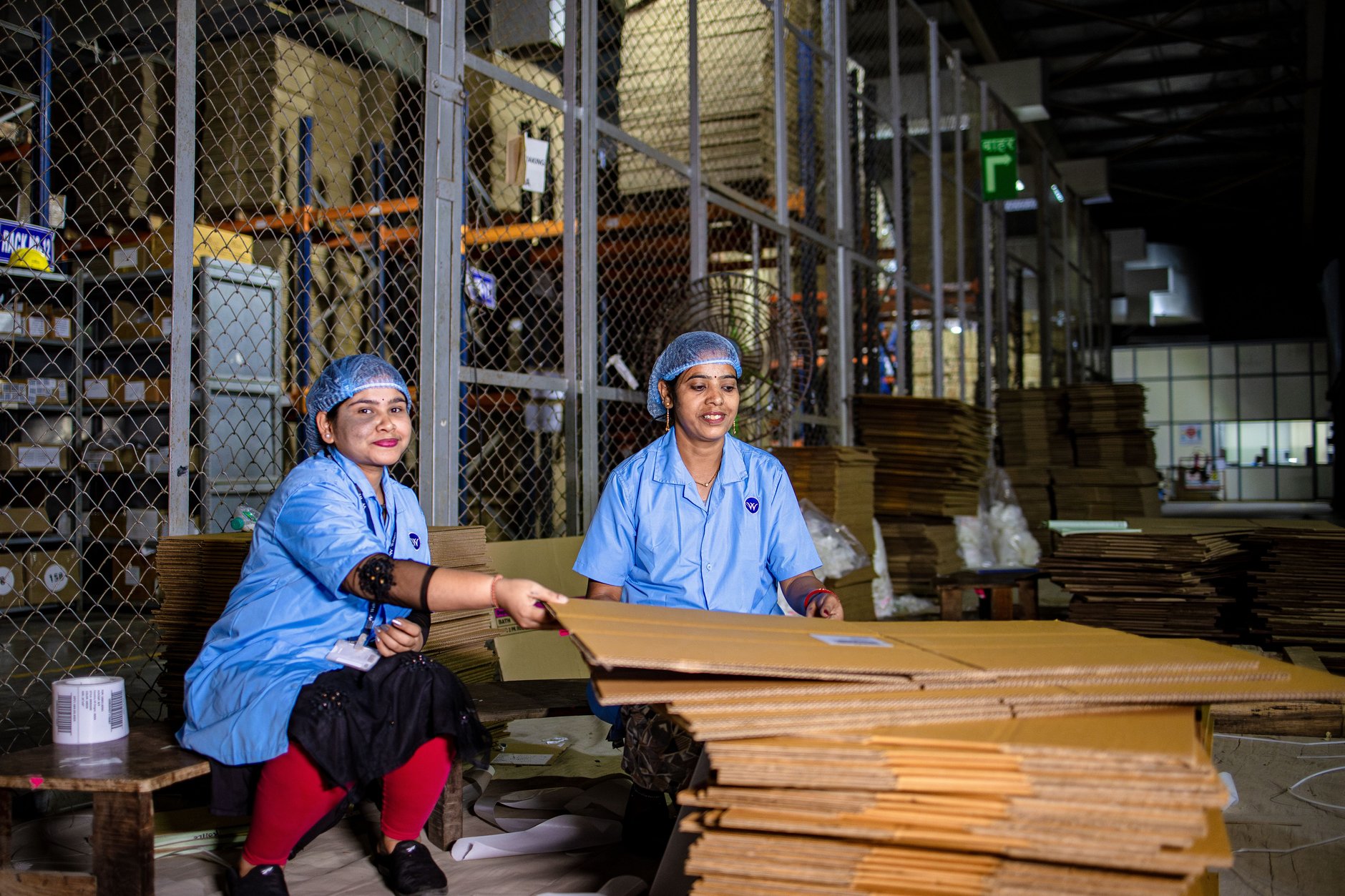
Logistics and multi-location delivery are a real cost layer, not an afterthought.
How do you protect margins after the contract is signed?
You protect margins after signing by managing the inputs you priced against and triggering the revision mechanism you negotiated, because a contract only protects margin if it is actively run. The most common post-signing margin leak is silence: a converter watches base paper rise for two quarters without invoking the revision clause, then absorbs the loss rather than have an awkward conversation. A formula-linked price exists precisely to make that conversation routine and contractual rather than confrontational. The second leak is unpriced compliance drift, where a buyer’s certification or testing demands grow mid-contract and the converter quietly funds them.
Regulatory cost is the clearest example of drift to watch. Compliance obligations such as extended producer responsibility now carry real, recurring cost, and the EPR rules and recycled-content data converters must now provide feed into both the brand’s filing and the converter’s overhead. A pricing model that did not account for EPR, food-grade testing, or chain-of-custody renewal at quote stage will bleed margin as those obligations tighten. The converter who built these into the original layered cost, and who reviews them at each revision point, keeps the margin the contract was meant to deliver. Protecting margin, in the end, is not a single negotiation but a habit of costing honestly and revising on schedule.

Margin is protected by costing every layer, then defending the number line by line.
Frequently asked questions
How do you calculate the price of a paper bag in India?
You calculate the price of a paper bag by costing five layers separately and summing them: base paper (grade, GSM, certified-fibre premium and inward freight), conversion (printing, die-cutting, gluing at real line speed and waste), certification and testing, logistics and packaging, and a margin sized for the contract term. Base paper is the largest layer, so the quote should be anchored to the reel price you can actually secure today, not a stale figure, and built so each number can be defended if procurement asks what sits inside it.
What is a fair margin for a paper bag converter?
A fair margin depends on the contract term, volume, and how much input risk the converter is carrying. On a flat fixed-price contract a converter must build a wider buffer because it absorbs all base paper volatility alone, whereas a formula-linked or quarterly-revised price allows a leaner, more competitive margin because the volatility is shared with the customer. The principle that matters more than any single percentage is that margin is protected at the costing stage, through accurate layered costs and a revision mechanism, not recovered later at the negotiating table.
Should I quote a fixed price or a formula-linked price for a paper bag contract?
For most multi-year paper carry bags contracts, a formula-linked or quarterly-revised price protects margin better than a fixed flat rate, because kraft and recycled paper prices in India swing in double-digit percentages within a year. A fixed price is only safe for short terms or genuinely stable input periods. Procurement teams generally trust a transparent indexed build more than a padded fixed quote, because they can see the number is lean rather than carrying a hidden volatility hedge.
How do you protect margin when base paper prices rise mid-contract?
You protect margin by negotiating a revision mechanism at quote stage and then actually invoking it. A quarterly or input-linked clause makes a price increase contractual and routine rather than a confrontation, so the converter does not absorb rising kraft paper bags costs in silence. Equally important is pricing recurring compliance cost, such as EPR and food-grade testing, into the original build, because unpriced regulatory drift erodes margin just as quietly as input swings do.
Why do converters lose money on contracts they quoted carefully?
Converters most often lose money not on the quote but on the run: they fail to trigger an agreed price revision when inputs rise, absorb compliance demands that grew mid-contract, or accept a price-validity period longer than their input forecast supports. Each is a self-inflicted margin leak fixable at the contracting stage. A layered cost model, a transparent revision clause, and the discipline to use it convert a carefully quoted contract into a profitable one.
Last reviewed: June 2026
If you are specifying kraft for a carry-bag programme, our food wrap and carry range lists each grade with a downloadable spec-sheet PDF covering GSM band, burst factor, Cobb value and food-contact status, so you can check the numbers against your brief before you speak to anyone. If the published spec looks close but not exact, write to our technical team and we will tell you plainly whether a grade can hold your requirement.
Browse all Pakka articles.
You may also like