Flexible Packaging for Chocolates, Protein Bars, and Powders: What D2C Brands Should Know Before Choosing a Material

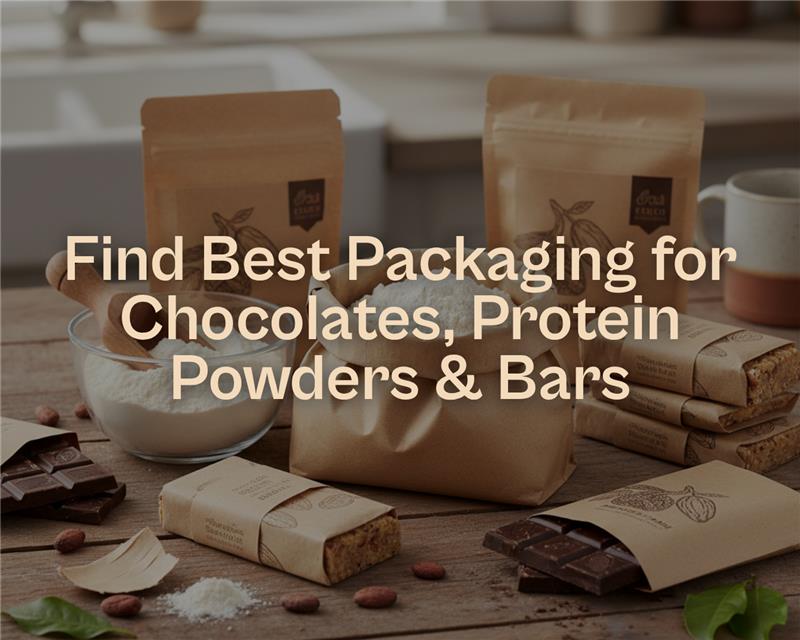
India’s chocolate market is valued at roughly USD 2.5 billion in 2025, growing at 7.6% CAGR (Mordor Intelligence). The energy bar segment, where chocolate variants account for 39% of market share (Mordor Intelligence, 2025), is growing even faster. Behind both numbers is a wave of D2C brands that are building their businesses online, shipping directly to consumers, and making packaging decisions that will define their product quality, shelf life, and brand perception for years.
Most of those packaging decisions happen under pressure. You are trying to launch quickly, keep unit economics tight, and tell a sustainability story that your customers care about. The result is often a default choice: whatever the packaging supplier recommends or whatever the competitor uses. That works until it does not, and it usually stops working when a batch of protein bars arrives stale, a chocolate pouch leaks at the seal, or a customer posts about your plastic overwrap on social media.
Key takeaways
- Chocolates need low MVTR (below 2 g/m2/24hr) and light barrier protection. Protein powders need moisture and oxygen barriers plus resealability. Bars need flow wrap compatibility and grease resistance. Each product category has different packaging specs.
- Compostable flexible packaging now exists for all three categories. Brawny Bear launched India’s first energy bars in compostable flexible packaging in partnership with Pakka.
- Low MOQ options (1,000 to 5,000 units) are available from several Indian suppliers, which lets D2C brands test packaging without large capital commitment.
- The real cost comparison is not material price per unit. It is material cost plus damage rates, return rates, shelf life losses, and EPR compliance fees.
- Custom printed pouches on compostable substrates now match the visual quality of conventional films for most D2C applications.
Why flexible packaging, not rigid
Rigid packaging (tins, jars, boxes) has its place, but for D2C food brands shipping through e-commerce channels, flexible packaging wins on three practical dimensions.
Weight. A stand up pouch weighs a fraction of an equivalent tin or jar. That translates directly to lower shipping costs, and for D2C brands paying per-shipment courier rates, the savings are measurable at even modest volumes.
Storage. Flexible pouches lie flat before filling. You do not need warehouse space for pre-formed containers. For a startup operating out of a shared kitchen or small facility, this matters more than most packaging guides acknowledge.
Customisation at low volume. Digital and flexographic printing on flexible films allows full colour custom designs at quantities that would be uneconomical for rigid packaging. You can test three pouch designs and see which one performs before committing to a large run.
What each product category actually needs from its packaging
Chocolates
Chocolate is sensitive to three things: moisture, light, and temperature. Cocoa butter absorbs odours from its environment and melts above 34 degrees C. Fat bloom (that white film on chocolate that has been temperature cycled) is a visual quality problem that customers interpret as spoilage even when the product is safe to eat.
For chocolate packaging, the numbers that matter are:
- MVTR below 2 g/m2/24hr at 38 degrees C / 90% RH. Higher than that and you risk moisture driven texture changes within weeks.
- Light barrier. Opaque or metallised films prevent UV degradation of flavour compounds.
- Heat seal integrity. The seal has to hold through temperature fluctuations during transit. A pouch that opens in a delivery vehicle during Indian summer is not a theoretical risk; it happens regularly.
Conventional chocolate packaging uses metallised BOPP or PET laminates. Compostable alternatives using metallised paper or PLA based laminates now hit the moisture barrier targets for most ambient-stored chocolate products. They do not yet match the performance needed for chocolate stored or shipped without temperature control in peak summer conditions. That limitation is worth knowing upfront.
Protein powders
Photo via Pexels — Free to use
Protein powders are hygroscopic. They pull moisture from the air. Once moisture content exceeds about 5 to 6%, you get clumping, off-flavours, and reduced solubility. Whey protein is also susceptible to lipid oxidation, which produces rancid notes.
The packaging requirements:
- MVTR below 1.5 g/m2/24hr. Powders are more moisture sensitive than solid bars or chocolates.
- OTR below 5 cc/m2/24hr for whey based products. Plant protein powders (pea, rice) are somewhat less oxygen sensitive.
- Resealable zipper. Consumers open protein powder pouches daily over weeks or months. The reseal has to maintain barrier integrity through hundreds of open and close cycles.
- Scoop compatibility. The pouch needs enough structural rigidity when standing to allow scooping without collapsing.
Stand up pouches with zip closures are the standard format. On compostable substrates, the zipper component is the hardest part to make compostable while maintaining seal performance. Some suppliers offer partially compostable options where the zipper is conventional but the film body is compostable. Full compostability including the zipper is available but at a cost premium.
Protein and energy bars
Bars are typically flow wrapped on horizontal form fill seal (HFFS) lines at speeds of 100 to 400 packs per minute. The packaging material has to be compatible with high speed sealing, which means predictable heat seal performance across a narrow temperature window.
Beyond line compatibility:
- Grease resistance. Bars with nut butters or chocolate coatings will transfer oil to the inner packaging surface. The film needs to resist oil migration without delamination.
- Puncture resistance. Bars with nuts, seeds, or crispy inclusions can puncture thin films during transit. This is the most common cause of bar packaging failures in e-commerce shipments.
- Oxygen barrier. Most bars have a target shelf life of 9 to 12 months. OTR below 10 cc/m2/24hr is typical for this category.
Brawny Bear launched India’s first energy bars in compostable flexible packaging, partnering with Pakka for the material development. That proved the format works on commercial lines, though adoption beyond early movers is still limited.
Compostable vs conventional: an honest comparison
There is no point pretending that compostable flexible packaging is a drop-in replacement for conventional films in every application. Here is where it works well and where it still has limitations.
| Parameter | Conventional (metallised PET/BOPP) | Compostable (current generation) |
|---|---|---|
| MVTR (g/m2/24hr) | 0.5 to 1.0 | 1.0 to 3.0 |
| OTR (cc/m2/24hr) | 0.5 to 2.0 | 5.0 to 15.0 |
| Heat seal range | Well characterised, wide window | Narrower, supplier dependent |
| Print quality | Excellent | Good to excellent |
| Cost per unit | Baseline | 15 to 40% premium |
| End of life | Landfill or incineration | Compostable (IS 17088 / EN 13432) |
| EPR compliance | Requires plastic EPR registration | Simplifies EPR through organic waste |
| Line compatibility | Standard | Requires validation per line |
For ambient stored products with 6 to 9 month shelf life targets (most D2C chocolates, bars, and single serve powder sachets), compostable films can meet the barrier requirements. For products needing 12+ month shelf life or shipped without temperature control, conventional films still have the edge on pure barrier performance.
Evaluate compostable options against your specific product rather than assuming they either work or do not. Request test samples, run your own shelf life studies, and compare real performance data rather than relying on spec sheets alone.
How to evaluate a flexible packaging supplier for D2C
Whether you choose compostable or conventional, these are the questions that separate a capable supplier from one that will cause you problems at scale.
Can they provide validated shelf life data for your product category? Not accelerated estimates, real time data from actual products in their films. What is their minimum order quantity, and does it match your current production volumes? Most D2C brands need 1,000 to 5,000 pouches per SKU per run. If the supplier’s minimum is 50,000, you are not aligned.
Do they have FSSAI compliant food contact certification for the specific materials you will use? Ask for the test reports. Is the material certified compostable under IS 17088 or EN 13432? If they claim compostable, ask for the certificate. Not a brochure. The certificate.
Can they run your format on their production line and provide samples that you can test on your filling and sealing equipment? Compatibility issues surface during trials, not during specification discussions.
Frequently asked questions
What is the best flexible packaging material for premium chocolates?
Metallised films (either conventional BOPP/PET or compostable metallised paper) provide the moisture, light, and oxygen barriers that chocolate requires. For ambient storage in Indian conditions, target MVTR below 2 g/m2/24hr and an opaque or metallised light barrier. Test seal integrity at temperatures representative of your worst case transit conditions.
Can protein powder pouches be fully compostable?
The film body can be compostable. The zipper is the harder component. Some suppliers offer fully compostable zippers, others use a conventional zipper on a compostable pouch. If full compostability matters for your brand story, confirm that the zipper material is included in the IS 17088 or EN 13432 certification.
What MOQ should D2C brands expect for custom printed flexible pouches?
MOQs from Indian flexible packaging suppliers range from 1,000 to 5,000 pouches per SKU for digitally printed options, and 10,000 to 25,000 for flexographic printing. Digital printing has higher per-unit cost but no plate charges and allows fast design iteration.
How much does compostable flexible packaging cost compared to conventional?
Current premiums range from 15 to 40% depending on barrier specification and order volume. The premium is higher for high barrier applications (protein powders) and lower for simpler structures (bar wraps). Factor in EPR compliance fees and waste management costs for a full comparison.
Does compostable packaging affect the shelf life of food products?
It can, depending on the product’s moisture and oxygen sensitivity. For products with 6 to 9 month shelf life targets, current generation compostable films typically meet the barrier requirements. For 12+ month targets, run your own accelerated and real time studies before committing.
What certifications should D2C food brands look for in packaging?
FSSAI food contact compliance is mandatory. For compostable claims, IS 17088 (India) or EN 13432 (Europe) certification. For export markets, check ASTM D6400 (North America). Also confirm the material is free from intentionally added PFAS compounds, which are being phased out globally.
If you are evaluating flexible packaging for your D2C food brand, contact our packaging team to discuss barrier requirements, sample orders, and compostable options for your specific product.
The Good Garbage Podcast
Meta Materials & Bioplastics in Packaging with Vaibhav Anand
Hear Vaibhav Anand discuss this topic in depth with host Ved Krishna on The Good Garbage Podcast.
Browse all Pakka articles.
You may also like