Tea Pouch Base Paper: What the Substrate Has to Do Before the Barrier Goes On

A tea pouch base paper has three jobs before any barrier is applied: carry that barrier without cracking at the gusset, add no odour to a product that picks up odour readily, and survive CTC tea dust in the seal area. The barrier keeps moisture out. The base decides whether that barrier is still intact six months later.
Most conversations about paper tea packs begin and end with the barrier: what WVTR the coating reaches and how it compares with a metallised film. That comparison matters, but by the time it comes up the base sheet has already set most of the limits. This piece covers what a tea pack demands of the substrate under the coating, what belongs on the specification, and where a paper-based tea pouch is the wrong choice.
It is written for the converter or laminator who buys the reel and builds the pouch web, and for the technical procurement head asked to approve a paper structure for a tea customer. It is not written for the tea brand choosing a pack for the shelf; our tea packaging guides cover that side. It is also not about tea bag paper. The filter paper inside an infusion bag is a very light, porous, wet-strength sheet built to let water through, which is the opposite of what a pouch base has to do.
What does a tea pouch actually ask of its base paper?
A tea pouch asks its base paper to be a stable, clean, stiff carrier for a barrier and a sealant, not to be the barrier. Most tea pouches are pillow packs, stand-up pouches with a bottom gusset, or flat-bottom pouches, and in each the paper supplies the print surface, the stiffness and the fibre content. The coating, metallised layer or film supplies the protection.
The standards make the protection requirement clear and leave the material choice open. ISO 3720:2011, the international definition of black tea, requires tea to be “packed in closed, clean and dry containers, made of material which does not affect the quality of the tea”. The Indian specification, IS 3633:2003, uses almost the same words and adds that the container must let the tea “retain its freshness”. Neither sets a barrier figure, so the numbers have to come from the converter’s own specification.
For terms used below, such as Cobb, air permeability and dead fold, see our coating base paper glossary for converters.
The base serves three layers. The barrier layer, whether a dispersion coating, a metallised film or a vacuum-deposited coating, controls moisture and oxygen. The print side carries the brand and has to stay clean against the tea. The sealant closes the pack. If the base cracks at a fold, gives off an odour, or lets dust into the seal, the pack fails regardless of the barrier datasheet.
The answer changes with the tea. A bulk CTC pack for a high-turnover market is not the same as a first-flush Darjeeling meant to sit on a shelf for a year. Specify from the tea and its route to market, not from the pouch format.
How much moisture can packed tea take before quality drops?
Neither the Indian nor the international standard sets a moisture limit for packed black tea, so the moisture budget for a tea pouch comes from the buyer’s quality target and the climate the pack will sit in. That puts the onus on the converter to know where the pack is going and what humidity it will meet.
ISO 3720:2011 says it outright: “No limit is specified for the ‘moisture’ content of the tea as received.” Its chemical limits, including water extract of at least 32 per cent and total ash of 4 to 8 per cent, are stated on an oven-dry basis. IS 3633:2003 carries the same note in its Table 1. The FSSAI tea standard, as set out in a NIFTEM training deck for the Ministry of Food Processing Industries, also lists ash, water extract and crude fibre on a dry basis and no moisture parameter. Some packaging guides quote an Indian “maximum moisture” for tea, but we could not find one in either standard. The one standard we found that does put a number on it is a draft. Kenya’s public review draft of its black tea specification, DKS 65:2016, caps moisture at 7.0 per cent by mass. It is not Indian law, but it is a useful outer marker for what a large tea-producing country considers the ceiling.
The climate is what makes the moisture budget hard in India. According to Jaswal and Koppar of the India Meteorological Department, writing in Mausam in 2011 from 215 stations, all-India mean relative humidity in the monsoon months of June to September is 74.7 per cent, and coastal regions average above 80 per cent. Those are seasonal means; daily peaks go higher.
So a pouch that holds a good barrier in a dry warehouse can let tea take on moisture over a monsoon spent in a Kolkata or Mumbai godown. That is why WVTR should be tested at tropical conditions. ASTM F1249 testing at 38 °C and 90 per cent relative humidity is the usual choice, and a figure measured at 23 °C and 50 per cent should not be compared with it. Our tea stream’s work on MVTR benchmarks for tea pouches through an Indian monsoon sets out the barrier side of this in detail.
Where the base comes in is its own moisture. A reel that arrives with uneven moisture across its width coats unevenly and curls once laminated, and a base that is wetter than the tea will give moisture up to it inside a sealed pack. Ask for moisture content and its cross-reel variation on the certificate, not just an average.
Why do aroma and taint matter more for tea than for most dry foods?
Tea is graded on its aroma and is penalised for any foreign odour, so a tea pouch base must be odour-neutral and must not let printing ink or adhesive odours through to the tea. Both the standards and the cup-tasting card treat taint as a defect in its own right, separate from moisture damage.
ISO 3720 requires that tea “shall have no taint”. IS 3633 lists “Taint” and “Stale” among the defects on its cup-test card, and the FSSAI standard, as given in the NIFTEM deck, requires a characteristic flavour “free from any off odour, taint and mustiness”. A taint carried in from the packaging fails all three.
In sensory terms, a taint is a foreign odour or flavour that a food picks up from its surroundings. It is different from staleness, which is the food’s own aroma fading over time.
Aroma loss is measurable even under ordinary storage. Tao and colleagues, writing in Foods in 2022, compared fresh Keemun black tea with the same tea after a year in storage. Of the 27 key aroma compounds they tracked, almost all those above their odour threshold were higher in the fresh tea, with concentration ratios of up to 10.9 times; dimethyl sulphide, one of the compounds behind a fresh tea’s top note, was about ten times higher in the fresh sample. The study did not report the packaging, so it shows that aroma is lost over a year, not which barrier stops it.
For the base paper, odour has two sources. One is the paper itself: residual chemistry from pulping, sizing or recycled fibre. The other is the print and adhesive layers the paper sits next to, whose solvents and residues can migrate through an open sheet. A dense, well-closed base slows that migration; an open base gives it a short path. The same pore structure that governs how much coating a base drinks, covered in our piece on porosity and air permeability in coating base paper, governs how freely odour moves through it, and it is the same surface discipline a silicone coater writes into a release liner base paper specification.
The test that catches this is named. ISO 13302:2003 sets out sensory methods for flavour changes caused by packaging and says it applies to “paper, cardboard, plastic, foils”. Its validated transfer test, derived from the Robinson test, holds grated milk chocolate with 6 dm² of packaging material in a one-litre jar at 75 per cent relative humidity and 23 °C for 48 hours, then has a panel taste it. A converter supplying tea should run it on the finished laminate, and ideally on the base alone, because a base that passes on its own can still fail once the print and adhesive are added.
The limitation is that the chocolate model is a proxy. Tea picks up odour differently from chocolate, and a panel test is only as good as its panel. No tea-specific taint method appears in the standards we reviewed.
Can CTC tea dust damage a paper tea pouch?
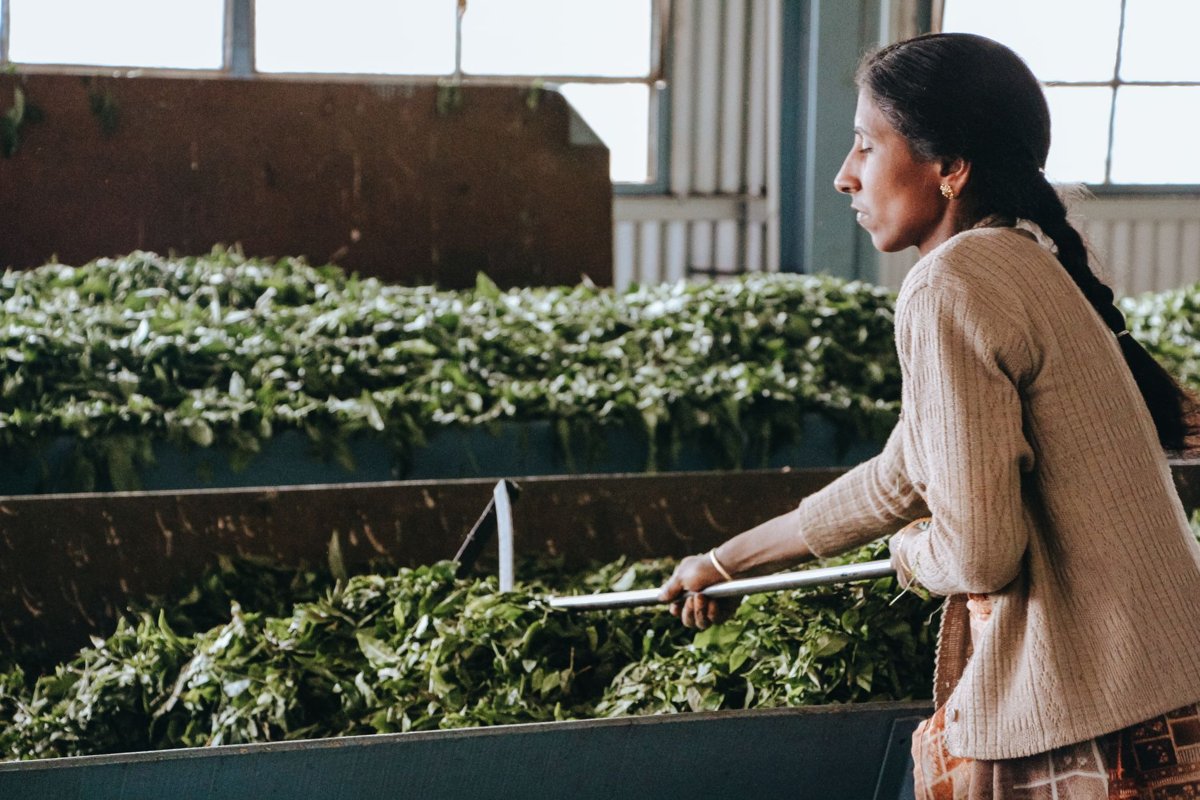
Yes. Fine CTC grades and dust carry abrasive particles that settle in the seal area and can open small channels through a heat seal. On a paper structure that is a bigger risk than on film, because there is less molten sealant to flow round each particle. India’s output is overwhelmingly CTC, so fine particles are what most Indian tea packing lines handle every day.
According to the Tea Board of India, the country produced 1,284.78 million kg of tea in calendar 2024 (provisional), of which 1,149.21 million kg, about 89 per cent, was CTC. Orthodox tea was 118.67 million kg and green tea 16.90 million kg.
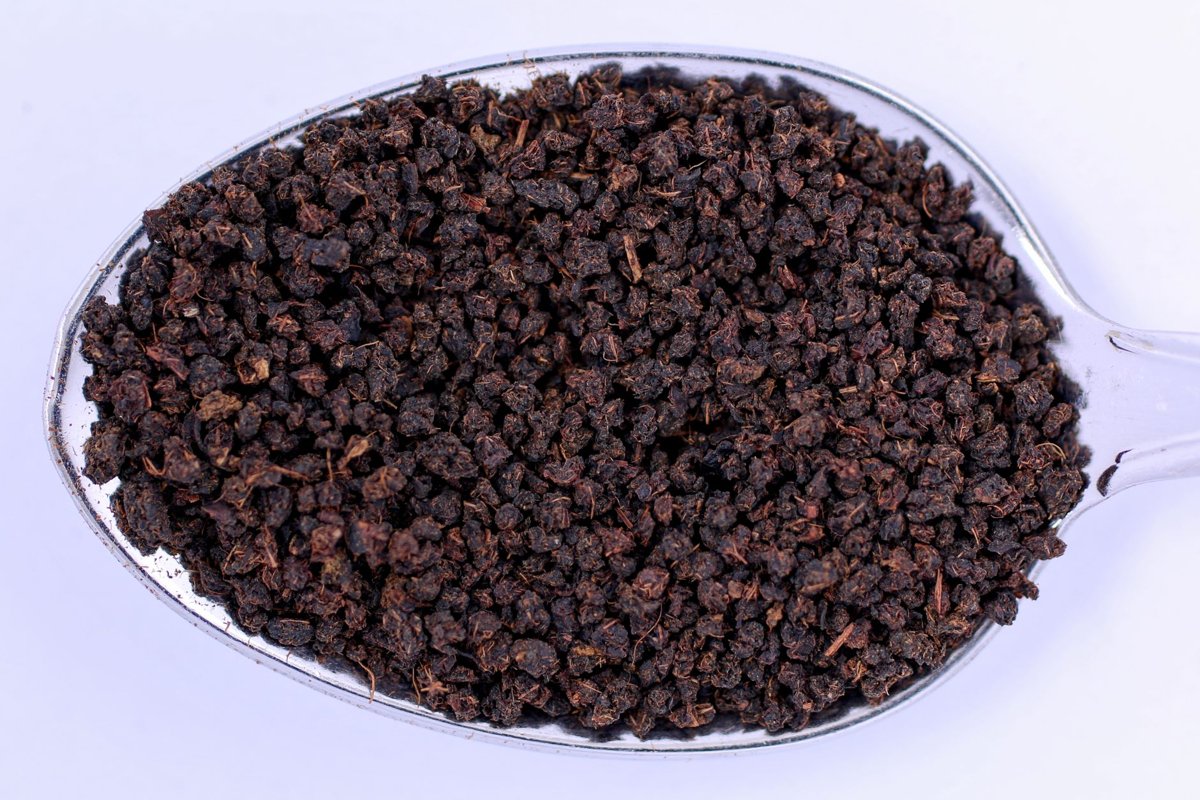
CTC, short for crush, tear, curl, is the machine process that cuts withered leaf into small hard granules. It gives a strong, quick-brewing tea and a large share of fine particles.
The particle sizes are part of the trade’s own grade system. The Tea Board’s standard CTC nomenclature, in force from March 2011 and published by the Indian Tea Association, includes seven dust grades, from Pekoe Dust to Super Fine Dust, alongside fannings grades such as Orange Fannings and BOP Fannings. Dust grades are a staple of the loose-tea retail pouch.
Three problems follow for a paper-based pouch:
- Dust in the seal. As tea is dosed through a VFFS tube, fines drift into the seal zone. A thick polyolefin sealant can flow round a particle; a thin heat-seal lacquer on paper often cannot, and the particle becomes a leak path.
- Abrasion on the inside face. Hard, granular CTC rubs against the inner layer during filling, transport and handling. If the barrier sits on the inside, abrasion can damage it; if a film or sealant sits over it, the problem moves to that layer.
- Pinholes at the gusset and crimp. Granules caught in a fold act as a point load. On a stiff paper web the coating cracks at that point more readily than a film would.
The tests are standard: seal strength to ASTM F88, and leak testing on finished, filled packs by bubble emission to ASTM F2096. Run the seal tests with dust in the seal area, because clean strips will flatter the result. Our page on snack pouch base paper and the FFS line covers the fin-seal junction leak, which is the same failure on a tea pillow pack.
The limitation is that we found no published figure linking a given dust grade to a given seal failure rate. The risk is well understood on packing lines, but it has to be measured on your own line, with your customer’s grade.
How stiff does a tea pouch base need to be at the gusset?
Stiff enough for the pouch to stand and hold its shape, but not so stiff that the barrier coating cracks where the gusset is folded. A stand-up tea pouch puts a sharp fold into the web at the bottom gusset and at the side seals, and that fold is where a coating on paper most often fails.
The mechanism is the same as on any coated board. A fold stretches the outer face and compresses the inner one. Paper stretches very little, so most of that strain lands in the coating, and a brittle or thick coating cracks along the fold line. Once cracked, the barrier at the gusset is gone, and the gusset is the part of a stand-up pouch that sits on the shelf carrying the weight of the tea.
A heavier base gives the pouch more body but puts more strain into the coating at each fold. A lighter base folds more easily and puts less strain on the coating, but leaves more of the pouch’s stiffness to be supplied by the laminate. That trade-off is the real decision behind base grammage for a stand-up tea pouch, and it is worth settling with the barrier supplier before choosing either.
Bending stiffness is a sheet’s resistance to bending under a set load. It rises steeply with thickness, so a small change in grammage changes how a pouch stands.
Stiffness should be specified by test, not by feel: Taber-type bending stiffness to TAPPI T 489 or bending resistance to ISO 2493-1, in both machine and cross direction. Dead fold, the paper’s ability to stay where it is folded, helps a pillow pack and a folded overwrap but matters less for a stand-up pouch. We found no published stiffness targets for tea pouch bases; they come from trials on the pouch-making machine.
One caveat: a stiffness figure on a datasheet will not tell you whether the gusset coating cracks. Only creased and filled samples, tested for WVTR after folding, will.
Does light matter for tea in a paper pouch?
For green tea, light matters a great deal, and plain paper does not block enough of it. For black tea it matters less, but an opaque, printed or metallised structure is still the safer choice for any premium tea that will sit under shop lighting.
The clearest evidence comes from green tea. Ošťádalová and colleagues, in Acta Veterinaria Brno in 2014, stored 14 commercial green teas for 12 months at 20 °C. Chlorophyll fell from an average of 1.47 mg/g to about 0.1 mg/g over the year. Green tea kept in paper packaging in direct daylight dropped to 0.7 mg/g within two months and was practically free of chlorophyll by month 12, at 0.06 mg/g. Tea in metal packaging lost about 90 per cent and tea in its original coated-paper bag with an outer film lost about 70 per cent over the same period. For a converter, the lesson is that a light barrier has to be designed in, either by a metallised or pigmented layer, heavy print coverage or an opaque base. Bleached and unbleached bases differ here in appearance more than in protection, since neither blocks much light uncoated. Our comparison of bleached and unbleached coating base covers what changes for print and coating between the two.
The limitation is that the green tea study measured chlorophyll, a colour marker, not taste. Green tea is also a small share of Indian production, so for most CTC packs moisture and taint will matter more than light.
Which paper-based tea pouch structure fits which tea?
The structure depends on how long the tea must keep its aroma and how humid its route to market is. For short shelf life in a dry market, a coated paper can be enough. For export or long shelf life through a monsoon, paper usually becomes the outer layer of a structure that still carries a metallised or film barrier.
The table compares the incumbent film laminate with four paper-based routes. Ratings are relative, drawn from the sources cited above and from general converting practice. They are not measured values for any particular product.
| Structure | Moisture barrier | Aroma and taint protection | Gusset and fold tolerance | Seal tolerance to CTC dust | Best fit |
|---|---|---|---|---|---|
| PET / metallised film / PE laminate (incumbent) | Very high | Very high | Excellent | Good with thick PE sealant | Long-life, export and premium tea |
| Paper / metallised film / PE laminate | Very high | High | Good | Good with thick PE sealant | Paper look on a long-life tea |
| Paper with extrusion PE sealant | Moderate | Moderate | Good | Good | Fast-moving CTC packs in drier markets |
| Paper with dispersion barrier and heat-seal coating | Low to moderate | Low to moderate | Narrow window; cracks at creases | Poor; thin sealant | Short-life tea, dry routes, outer cartons |
| Paper with metallised or vacuum-deposited barrier and heat-seal lacquer | High | High if base is odour-neutral | Narrow window; coating cracking risk | Moderate | The structure most paper tea pouch projects aim for |
Commercial high-barrier paper structures do exist for this category. Mondi markets an “Ultra-high FunctionalBarrier Paper” for coffee and tea that it describes as 90 per cent paper content, with oxygen and water vapour transmission “below 0.5”. Its product page does not state the units or test conditions, so treat it as a manufacturer claim, not a benchmark to specify against.
Two cautions. First, the paper face of a laminate does not change its legal category. Under India’s EPR rules a pack with a plastic layer and a non-plastic layer is multilayered plastic packaging, which our food-contact compliance guide for coated paper in India touches on alongside the food-contact rules. Second, “recyclable” on a paper laminate is a repulping test result, not a material property.
What belongs on a tea pouch base paper specification?
A tea pouch base paper specification needs properties for the paper and separate performance targets for the finished web, because the paper supplier controls the first list and the converter answers for the second. For tea, odour neutrality and moisture uniformity deserve their own lines, since they are the two properties a generic base paper certificate usually leaves out.
For the base paper, specify at minimum:
- Grammage to ISO 536 or TAPPI T 410, with a tolerance, and thickness to TAPPI T 411.
- Moisture content to TAPPI T 412, with a limit on variation across the reel width as well as the average.
- Air permeability (Gurley or Bendtsen) and surface smoothness, which set how much coating the base absorbs and how evenly.
- Bending stiffness to TAPPI T 489 or ISO 2493-1, machine and cross direction.
- Tensile strength and stretch to ISO 1924-2, both directions.
- Water absorptiveness (Cobb) to ISO 535.
- Odour and taint: an inherent-odour test and a transfer test under ISO 13302, with the panel method agreed in advance.
- Food-contact declarations for the paper and any wet-end chemistry, and confirmation that no recycled fibre is used unless the customer has approved it.
- Reel details: width and tolerance, core diameter, maximum joins per reel and how joins are marked.
For the finished web and pack, agree targets with the tea customer for WVTR to ASTM F1249 at 38 °C and 90 per cent relative humidity, oxygen transmission to ASTM D3985 where the tea needs it, seal strength to ASTM F88 with dust in the seal, leak testing to ASTM F2096 on filled packs, and WVTR measured again on creased gusset samples.
The specification cannot tell you whether the web will run on a particular pouch-making or VFFS machine. Only a reel trial on the actual line, long enough to see reel-to-reel variation, can tell you that. The same discipline applies to a release liner base, and the release liner hub linked above sets out the surface properties the two applications share.
Where a coating base paper fits in a tea pouch
A coating base paper is not a tea pouch material on its own. It arrives uncoated, with no moisture barrier, no light barrier and no heat-seal layer, so it cannot go straight onto a pouch line and it cannot hold tea through a monsoon by itself. A converter who wants a ready-to-run tea pouch web should buy a finished laminate or coated web, not a base. And for long-life export tea, a structure with a metallised or film barrier is still the dependable choice; paper changes the outside of that pack more than the protection inside it.
A base fits the converter or coater who builds the structure. If your business applies the barrier, metallises, lacquers or laminates onto paper, the base decides how much coating it absorbs, how evenly, whether it adds odour to the tea, and whether the coating survives the gusset fold. Those properties are fixed at the paper machine, before the reel reaches your line.
Pakka is developing flexC base, a coating base paper in the 40-60 GSM band, bleached and unbleached, intended as a substrate for barrier chemistries including silicone, biopolymer and plastic coatings. Tea pouches are one of the eight applications named for it, alongside confectionery wraps, snack pouches, sachets, medical packaging, seed packs, release liners and dry food liners. These details are disclosed in Pakka Limited’s Investor Presentation for Q1 FY2026-27, filed on 18 August 2026 (BSE 516030 / NSE PAKKA). It is a development programme, not a stocked product, and it has no published performance data, so no barrier, odour, stiffness or runnability figure should be attributed to it by anyone, including us.
The two names are easy to confuse, so to be clear: flexC base is the coating base paper described above, sold to coaters and converters. flexC is a separate product, a finished compostable flexible-packaging laminate that Pakka already supplies to brand owners, with its own published specifications. A converter looking for a base to coat or laminate wants the first; a tea brand looking for a finished laminate wants the second.
If you build tea pouch structures, ask any base supplier, us included, for reels you can coat with your own chemistry, run on your own pouch line and put through an odour panel with your customer’s tea. A datasheet will not tell you how that goes.
Frequently asked questions
What paper is used for tea pouches?
Most paper-based tea pouches use a light kraft or machine-glazed base that carries a barrier layer and a heat-seal layer. The barrier is a dispersion coating, a metallised or vacuum-deposited layer, or a laminated film. The paper gives the print surface, stiffness and fibre content; the added layers protect the tea from moisture, odour and light. Uncoated paper alone cannot protect packed tea.
Is tea pouch paper the same as tea bag paper?
No. Tea bag paper is the very light, porous filter paper inside an infusion bag, made to let water through and to hold strength when wet. A tea pouch base is a denser packaging paper that carries a barrier and keeps moisture and odour out. They are different grades for opposite jobs.
What moisture limit applies to packed tea in India?
Neither IS 3633:2003 nor ISO 3720:2011 sets a moisture limit for black tea, and the FSSAI tea standard lists no moisture parameter. The pack’s moisture budget therefore comes from the buyer’s quality target and the climate on its route. Kenya’s draft standard uses 7 per cent as a maximum, which is a useful outer marker but not Indian law.
How do I test a tea pouch for packaging taint?
Use ISO 13302:2003, which covers flavour changes caused by packaging for paper, board, plastic and foil. It includes an inherent-odour test and a transfer test derived from the Robinson test. Run it on the finished laminate and, where possible, on the base paper alone, with the panel method agreed with the tea customer in advance.
Why do paper tea pouches leak more often than film pouches?
Usually because of seal contamination and folding. CTC dust settles in the seal area, and a thin heat-seal lacquer on paper flows round it less well than a thick film sealant. Paper also cracks its coating at gusset and crimp folds more readily. Test filled packs with dust in the seal using ASTM F2096, and test WVTR on creased samples.
Last reviewed: October 2026.
Building your own tea pouch structure on a paper base? Pakka’s flexC base programme covers the 40-60 GSM band in bleached and unbleached, for coaters and converters who coat, metallise or laminate their own webs. If you would like to discuss a trial, send us a flexC base trial enquiry with the pouch format, the barrier and sealant you apply, the tea grades you pack and your reel width. Technical brochures for our paper and packaging range are on the resources page, and general enquiries reach us through the same contact page.
Sources
- ISO 3720:2011, Black tea: Definition and basic requirements
- Bureau of Indian Standards, IS 3633:2003, Black Tea: Specification
- NIFTEM (Ministry of Food Processing Industries), Tea: FSSAI standard and regulations, PMFME training material
- Kenya Bureau of Standards, DKS 65:2016 Black tea: Specification, public review draft
- Jaswal and Koppar, Recent climatology and trends in surface humidity over India for 1969-2007, Mausam 62(2), 2011
- Tea Board of India, State/region-wise and month-wise tea production, 2024 and 2024-25
- Indian Tea Association, CTC tea grades
- Tao et al., Characterization and quantitative comparison of key aroma volatiles in fresh and 1-year-stored Keemun black tea infusions, Foods, 2022
- Ošťádalová et al., Chlorophyll as an indicator of green tea quality, Acta Veterinaria Brno 83, 2014
- ISO 13302:2003, Sensory analysis: Methods for assessing modifications to the flavour of foodstuffs due to packaging
- Mondi, Ultra-high FunctionalBarrier Paper
- ASTM F1249 (WVTR), ASTM D3985 (OTR), ASTM F88 (seal strength), ASTM F2096 (bubble leak); TAPPI T 410, T 411, T 412, T 489; ISO 536, ISO 535, ISO 1924-2, ISO 2493-1
- Pakka Limited, Investor Presentation Q1 FY2026-27, filed 18 August 2026 (BSE 516030 / NSE PAKKA)
Browse all Pakka articles.
You may also like
