Silicone Holdout Explained: Coat Weight, Anchorage, and the Cost of a Porous Base


Silicone holdout is how well a base paper keeps a silicone release coating on its surface instead of letting it sink into the fibre. You see it in three places on your own line: the coat weight you need to reach full coverage, whether the cured silicone rubs off, and how much of it stays uncured.
It is not a number printed on a datasheet, although coaters often buy a base as if holdout were a paper property they could read off a certificate. It behaves more like a result of the base, the silicone system and the oven together. This piece covers what holdout costs you in silicone, how to measure it, why an open base shows up as anchorage and cure trouble, and what you can do when the base is more open than glassine.
This is written for the release-liner coater and the technical buyer who has to approve a base paper. The base-side measurement of porosity, Gurley and Bendtsen is covered in our piece on porosity and air permeability in coating base paper. This piece starts where that one stops: at the silicone.
What is silicone holdout, and why do coaters pay for it?
Silicone holdout is the ability of a base paper to resist silicone penetration, so that a thin applied layer stays on top as a continuous release film. Coaters pay for it because silicone is the expensive component of a release liner, and every gram that soaks into the sheet is a gram that does no release work.
The mechanism is capillary. Solventless silicone goes on as a low-viscosity liquid and stays liquid until it cures in the oven, which on a production line may be a matter of seconds. During that window it wicks into any open pore it touches. A closed, dense surface leaves it nowhere to go. An open one drinks part of the coat, and the coater has to add more to close the surface.
The clearest evidence for the cost sits in patents, where mills and silicone makers are more candid than in their brochures. An Avery Dennison patent (US6824828B2, 2004) describes supercalendered papers as absorbing much less silicone than open papers, and describes those papers as much more expensive. A Kammerer patent on primed release papers (US5807781A, 1998) puts the solventless silicone lost into the paper at up to 20 per cent. On a line running a nominal coat weight of 1 g/m², that is up to a fifth of a gram per square metre paid for and buried.
Silicone holdout has a formal definition in our coating base paper glossary, alongside coat weight, anchorage and release force. The short version: holdout is judged by what the silicone does on the base, never by the base alone.
Holdout is not the only thing a base must deliver. A base can hold silicone beautifully and still fail on moisture profile, flatness or die-cutting, which is why our hub on how to specify a release liner base paper treats it as one line among several.
How much silicone does a paper release base actually need?
Most paper release liners run a silicone coat weight of roughly 0.5 to 2 g/m², and where a particular line sits in that band depends mostly on the base. A glassine or other closed, supercalendered base sits towards the low end; a clay-coated or open base needs more silicone to reach the same full coverage.
Dow’s formulation guide for its solventless SYL-OFF platinum-cured systems gives 1 g/m² as a starting point, and its own cure and extractables data on supercalendered kraft use 1.1 g/m². Dow is careful to say that pick-up depends on the coating equipment and the substrate, and that trials are needed. A Koehler patent on release base papers (US11465431B2, 2022) gives 0.5 to 1.5 g/m² as preferred and 0.3 to 2.5 g/m² as workable, and notes that below 0.3 g/m² good release is not assured.
The spread between bases is where holdout becomes money. In a technical paper for the Pressure Sensitive Tape Council, Sandra Holtschoppen of Laufenberg sets out the silicone needed for full coverage by base type:
| Base | Silicone for full coverage | Why |
|---|---|---|
| Glassine | About 1.8 g/m², minimum about 0.7 g/m² | Heavily supercalendered, dense and smooth, so less penetration |
| Supercalendered kraft (SCK) | Higher than glassine at equal coverage | Calendered, but less closed than glassine |
| Clay-coated kraft (CCK) | About 2.0 g/m² | Coating layer closes the surface but adds its own absorption |
| Film and poly-coated kraft | Minimum about 0.4 to 1.0 g/m² | Non-porous surface; the silicone has nowhere to go |
Source: Holtschoppen, “How to find the right release liner”, PSTC technical paper. Values are indicative, for full coverage as judged by stain test, and vary with silicone system and line.
A worked example shows why coaters argue over tenths of a gram. A line coating 10 million m² a year at 1.0 g/m² uses 10 tonnes of silicone. The same line at 1.4 g/m², to cover a more open base, uses 14 tonnes. Nothing about the finished liner looks different, but the silicone bill has gone up by 40 per cent.
One caution on that example: Holtschoppen’s stain-test photographs show a fully closed glassine surface at about 1.8 g/m² next to a lower coat weight she describes as the industry standard. Many lines deliberately run below full coverage and accept a little exposed base. The right target is the lowest coat weight that gives stable release on your adhesive, not the one that closes every pore.
How do you measure whether the silicone stayed on the surface?
You measure holdout indirectly, with two tests run on the coated web: X-ray fluorescence to find how much silicone is there, and a stain test to show where it is not. Neither test works on the uncoated base, which is why a base can only be qualified by coating it.
Start with how much silicone is there. Coat weight is measured by energy-dispersive X-ray fluorescence, which counts the silicon on the web. FINAT publishes it as test method FTM 7. XRF is a relative method: every carrier gives off its own background signal, so each base needs its own calibration curve, and the uncoated base is the blank. The Koehler patent puts the accuracy at between about ±0.05 and ±0.01 g/m², better with longer measuring time. Change the base, and the calibration has to change with it, or the coat weight readings drift.
Then check where it is not. A dye such as methylene blue, malachite green or new fuchsin is applied to the cured surface for one to two minutes, then rinsed off. Wherever silicone has left the base exposed, the dye takes. The Koehler patent grades a 120-second methylene blue test from “+” (barely visible) to “++++” (base fully stained). A 2001 Western Michigan University thesis by R. Haraga, Assessing Silicone Holdout for Release Papers, used the stain test for exactly this purpose: to measure the area not covered by silicone as a check on the quality of the sized base.

You need both tests, because they answer different questions. XRF tells you the silicone is present. The stain test tells you whether it forms a closed film or sits in islands with base showing between them. A base with poor holdout often reads the right coat weight on XRF and still stains, because part of the silicone has gone below the surface where the XRF can count it and the adhesive cannot use it.
The stain test has a limit worth knowing. It only works on paper that takes the dye, and its grading is visual, so two operators can score the same sample differently. Keep a set of reference strips from an approved base and grade against them.
Why does a porous base cause anchorage and rub-off problems?
A porous base causes anchorage problems because the silicone that penetrates the sheet cures unevenly and leaves a weaker, patchier film on the surface. Poor anchorage shows up as rub-off: cured silicone that smears or flakes away under a thumb, then transfers into the adhesive and makes release drift over time.
Dow sets out the target in its guide as “NNN”: no smear, no migration and no rub-off. It lists what cure depends on, and the list is mostly about the base: substrate type, substrate age, coat weight and the degree of surface penetration. The chemistry of the surface matters as much as the pores. Holtschoppen notes that the polyvinyl alcohol finish on glassine gives better long-term anchorage than the starch on SCK, and that clay coatings harm long-term anchorage, which is why she does not recommend CCK for critical uses.
The finger rub is still the first check on most lines, but it can be made numerical. A Dow Silicones patent (US10023767B2, 2018) describes an instrumented method: measure coat weight by XRF, abrade the sample on an Elcometer 1720 with a 900 g load for 15 cycles, and measure again. The rub-off figure is the coat weight after abrasion as a percentage of the coat weight before. The same patent ages samples for 10 days at room temperature and for 7 days at 70 °C and 90 per cent relative humidity, because anchorage that passes on day one can fail after storage.
That ageing step is the part to copy. Anchorage failures on paper often appear weeks later, once humidity has cycled through the sheet, and a base that is more open lets more moisture reach the silicone interface.
Can the base paper itself stop the silicone curing?
Yes. Platinum-catalysed addition-cure silicones are poisoned by several chemical families that can be present in or on a base paper, and a poisoned catalyst leaves uncured silicone behind. You detect it with an extractables test, which measures how much silicone a solvent can wash out of the cured coating.
Dow lists the poisons as compounds containing nitrogen, sulphur, tin, phosphorus, arsenic, antimony, selenium or tellurium, plus some residual solvents and monomers. It also warns that additives in films, in clay- and poly-coated krafts, and in the pre-coat on most glassines and SCK can inhibit cure, as can the vulcanising agents in rubber rolls on the coater. Its guidance is to fix the source before adding catalyst, which it calls a last resort because platinum is expensive.
Extractable silicone is the share of the applied silicone that has not cross-linked into the cured film. Holtschoppen describes the standard method: soak a coated sample in methyl isobutyl ketone for at least 24 hours, then measure the silicon in the solvent by atomic absorption spectroscopy and express it as a percentage of coat weight. She treats below 5 per cent straight after coating as a good result, with very tight-release formulations running higher. Oven conditions move this figure more than anything else. Dow’s guide shows extractables on supercalendered kraft at 1.1 g/m² with a six-second dwell falling from roughly 45 per cent at around 80 °C to roughly 2 to 5 per cent at 170 °C and above. The values are read from a chart and belong to one silicone system, so treat them as the shape of the curve rather than a target. The same oven also dries the base, and a lighter sheet dries harder and curls sooner, which our piece on running 40-60 GSM paper on a coating line covers alongside web tension and moisture profile.
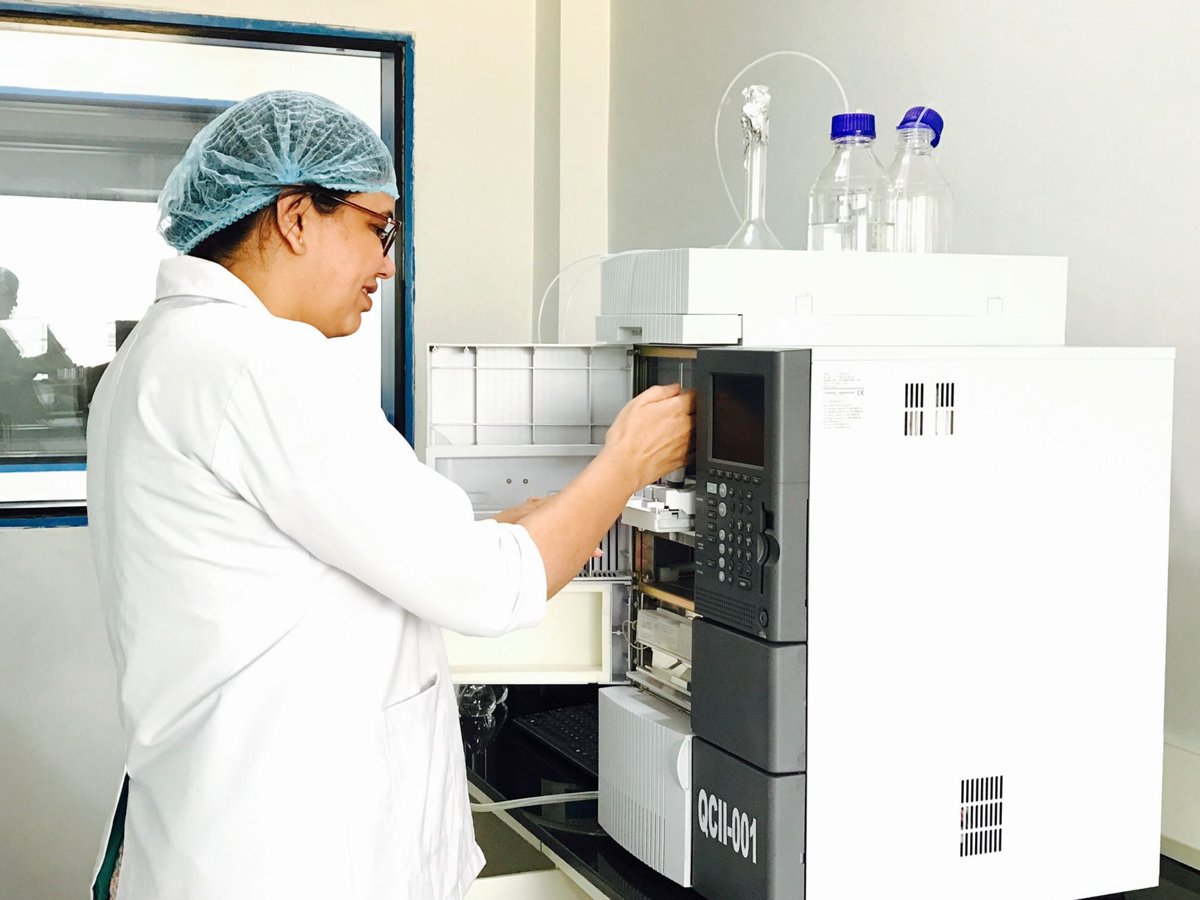
The practical point for a base qualification: if a new base raises extractables at the same coat weight and oven settings, suspect the base chemistry before the oven. Ask the supplier what sizing agents, wet-strength resins and surface treatments it uses, and whether any contain amine or sulphur compounds. For food-contact liners, the same question feeds the migration discussion in our guide to food-contact compliance for coated paper in India.
What can a coater do when the base is more open than glassine?
A coater facing a base more open than glassine has four levers: add coat weight, switch to a silicone system designed to resist penetration, seal the base with a primer, or change the cure. All four work. Each one moves cost somewhere else, so the choice comes down to economics more than chemistry.
The silicone makers design products for exactly this case. When Wacker launched its DEHESIVE SFX range in 2015, it described SFX 380 as the grade for porous papers, with a comparatively high viscosity, and SFX 195 as the lowest-viscosity grade for smooth, dense papers. A thicker silicone wicks more slowly, so less of it has gone into the sheet by the time it cures. The trade calls these reduced-penetration or high-holdout systems; they let a coater run a slightly more open base without paying for the difference in coat weight. Priming is the older route. The Kammerer patent describes sealing the paper with a sodium or potassium silicate primer, after which silicone could be cut by at least 20 per cent, from about 1 g/m² to 0.5 to 0.9 g/m², at the same release. The catch is an extra coating station, an extra drying step and an extra material to qualify.
| Lever | What it changes | What it costs | When it fits |
|---|---|---|---|
| Raise coat weight | Fills the open surface with more silicone | Silicone, the most expensive input, on every square metre | Short runs or a temporary base substitution |
| Reduced-penetration silicone | Slows wicking through higher viscosity | Formulation cost; re-qualification of release on your adhesives | A base that is consistently a little more open than glassine |
| Primer or barrier pre-coat | Seals the base before the silicone goes on | An extra station, drying energy and a second material | Integrated lines with a spare coating unit |
| Hotter or longer cure | Reduces extractables on a difficult base | Oven energy and line speed; scorching risk on lighter or heat-sensitive bases | When extractables, not coverage, are the failure |
None of these levers fixes a base that varies. A reel-to-reel swing in porosity forces the coater to set coat weight for the most open reel in the delivery, which is why consistency often matters more than the average. The comparison of the incumbent bases in our glassine, SCK and CCK decision matrix shows how each one sits on this trade-off.
What should a holdout qualification trial record?
A holdout qualification trial should record the coat weight needed to reach full coverage, the coverage itself, anchorage after ageing, extractables, and release force against your own adhesive, all on the same reels and the same oven settings. Recording only release force is the most common mistake, because it can pass on day one and drift later.
A workable protocol, drawing on the methods above:
- Calibrate XRF on the uncoated candidate base, not on your current base, and record the blank (FINAT FTM 7).
- Coat at your current target and at two steps above and below it, holding silicone system, bath age, oven temperature and line speed constant.
- Stain-test each coat weight with methylene blue and grade against reference strips from your approved base.
- Measure extractables by solvent extraction on the same samples, straight after coating.
- Test rub-off before and after ageing, including a humid-heat ageing step such as 7 days at 70 °C and 90 per cent relative humidity.
- Laminate to your production adhesive and measure release force at low speed (FINAT FTM 3 or FTM 10) and, if your customers run fast dispensing, at high speed (FTM 4), then check subsequent adhesion (FTM 11).
- Repeat on at least three reels from different production dates, and record the spread as well as the mean.
The output of this trial is the true holdout figure for your line: the coat weight at which that base passes every test. Compare bases on that number and on its spread across reels, not on the Gurley value on the certificate. Our converters’ guide to porosity and strength testing covers the base-side tests that sit alongside this protocol.
Where a paper coating base fits
A new coating base is a poor bet for a coater whose glassine supply is stable, whose silicone system is tuned to it and whose customers accept the price. Switching base means re-running every test above, re-calibrating XRF and possibly re-qualifying release with every adhesive customer. A lighter or more open base can also raise silicone use, and no base supplier can promise otherwise before the base has been coated on your line.
A new base is worth trialling when the business case is elsewhere: lower base cost per square metre, a shorter supply chain than imported glassine, a lighter grammage for lightweighting, or a base that also serves barrier coatings on other lines. In each case the question to test is the one in this article: what coat weight does this base need on my line to pass coverage, anchorage and extractables?
Pakka is developing flexC base, a coating base paper in the 40-60 GSM band, available bleached and unbleached, intended as a substrate for barrier chemistries including silicone, biopolymer and plastic coatings. Release liners are one of eight applications named for it. These details are disclosed in Pakka Limited’s Investor Presentation for Q1 FY2026-27, filed on 18 August 2026 (BSE 516030 / NSE PAKKA). It is a development programme, not a stocked product, and it has no published performance data. No holdout, coat weight, porosity or release figure should be attributed to it by anyone, including us.
The name sits close to another Pakka product, so to be clear: flexC base is the coating base paper described above, for coaters and converters. flexC is a separate product, a finished compostable flexible-packaging laminate supplied to brand owners with its own published specifications. A release-liner coater wants the first.
Frequently asked questions
What is silicone holdout in release paper?
Silicone holdout is a base paper’s resistance to silicone soaking into it. A base with good holdout keeps a thin silicone layer on the surface as a closed release film, so the coater needs less silicone to reach full coverage and stable release. It is judged by coat weight, stain tests and rub-off on the coated web, not by a single test on the base.
How much silicone is applied to release liner paper?
Most paper release liners carry roughly 0.5 to 2 g/m² of silicone. Dow gives 1 g/m² as a starting point for its solventless systems, and a PSTC paper puts full coverage at about 1.8 g/m² on glassine and about 2.0 g/m² on clay-coated kraft. The right figure is the lowest that gives stable release on your adhesive.
How do you test silicone coverage on a release liner?
Apply a dye such as methylene blue or malachite green to the cured surface for one to two minutes, rinse, and look for staining. Stained areas are where the base shows through the silicone. Pair it with XRF coat weight (FINAT FTM 7) so you know both how much silicone is there and whether it forms a closed film.
What causes silicone rub-off on paper liners?
Rub-off usually comes from incomplete cure or poor anchorage. Common causes are catalyst poisons in the base or on rolls, too low an oven temperature or dwell, silicone lost into an open base, and surface chemistry that bonds poorly to silicone, such as some clay coatings. Test rub-off again after humid ageing, because it can appear weeks later.
Does a lighter base paper need more silicone?
Not necessarily, but it often does. Grammage itself does not decide holdout; surface closure does. A lighter sheet has less material to calender into a closed surface, so it can be harder to hold the same porosity at lower weight. The only reliable answer is the coat weight that base needs on your own line.
Last reviewed: September 2026.
Qualifying a paper base for silicone coating? Pakka’s flexC base programme covers the 40-60 GSM band in bleached and unbleached, for coaters and converters who apply their own silicone or barrier coatings. If you would like to discuss a trial, send us a flexC base trial enquiry with your silicone system, target coat weight, oven settings and reel width. Technical brochures for our paper and packaging range are on the resources page, and general enquiries reach us through the same contact page.
Sources
- Dow, SYL-OFF Solventless, Platinum-Catalyzed Hexenyl Silicone Release Coatings: release system information guide, Form 30-1162-01, 2021
- Sandra Holtschoppen (Laufenberg), How to find the right release liner, Pressure Sensitive Tape Council technical paper
- FINAT, FINAT test methods: FTM 3, FTM 4, FTM 7, FTM 10, FTM 11
- Papierfabrik August Koehler SE, US11465431B2, 2022
- Avery Dennison, US6824828B2, 2004
- Kammerer GmbH, US5807781A, 1998
- Dow Silicones, US10023767B2, 2018
- R. Haraga, Assessing Silicone Holdout for Release Papers, MS thesis, Western Michigan University, 2001
- Wacker Chemie, new high-performance release agents for PSA labels, press release, 19 August 2015
- Pakka Limited, Investor Presentation Q1 FY2026-27, filed 18 August 2026 (BSE 516030 / NSE PAKKA)
Browse all Pakka articles.
You may also like
