Paper-Based Wrapper vs Aluminium Foil Laminate for Chocolate: A Total Cost-of-Ownership Comparison


On a total cost-of-ownership basis, an aluminium foil laminate and a paper-based metallised chocolate wrapper sit far closer than their reel prices suggest. Foil usually looks cheaper per metre, but once you add Extended Producer Responsibility fees, rising recycled-content obligations and end-of-life liability, the gap narrows and can reverse.
Barrier, not headline price, is what should decide the material, and for most bars a metallised paper structure now clears the bar. This comparison sets the two structures against each other line by line: reel price, EPR cost, line modification, waste, and returns. It is written for the packaging or procurement manager who has to defend a chocolate packaging material choice on cost, not on sentiment.
What goes into the total cost of a chocolate wrapper?
The total cost of a chocolate wrapper is the reel price plus every recurring cost that the wrapper triggers downstream: EPR fees, Rule 11 marking, recycled-content obligations, line waste, and quality returns. Reel price is usually less than two-thirds of the real number, which is why a cheaper-per-metre foil laminate can end up costing more than a paper-based alternative once the full picture is counted.
Five cost lines make up the total, and only the first is visible on a supplier quote:
- Reel or laminate price: the per-metre or per-kilogram cost of the substrate, quoted by GSM and structure.
- EPR liability: the recurring Extended Producer Responsibility fee a brand owner pays on plastic packaging placed on the Indian market, through the Central Pollution Control Board portal.
- Compliance overhead: Rule 11 unique-marking obligations and Category III recycled-content targets, both material-specific in how hard they hit.
- Line cost: sealing-window tuning, jaw changes, line-speed impact, and the downtime of a material trial.
- Quality cost: waste from seal failures and rework, plus returns from barrier or bloom problems in the field.
A comparison that stops at line one flatters foil. The tea sector already ran this exact analysis when it moved off plastic laminate; the line-by-line cost of switching from plastic laminate to paper transfers almost directly to chocolate, because the cost structure is the same and only the barrier target changes.
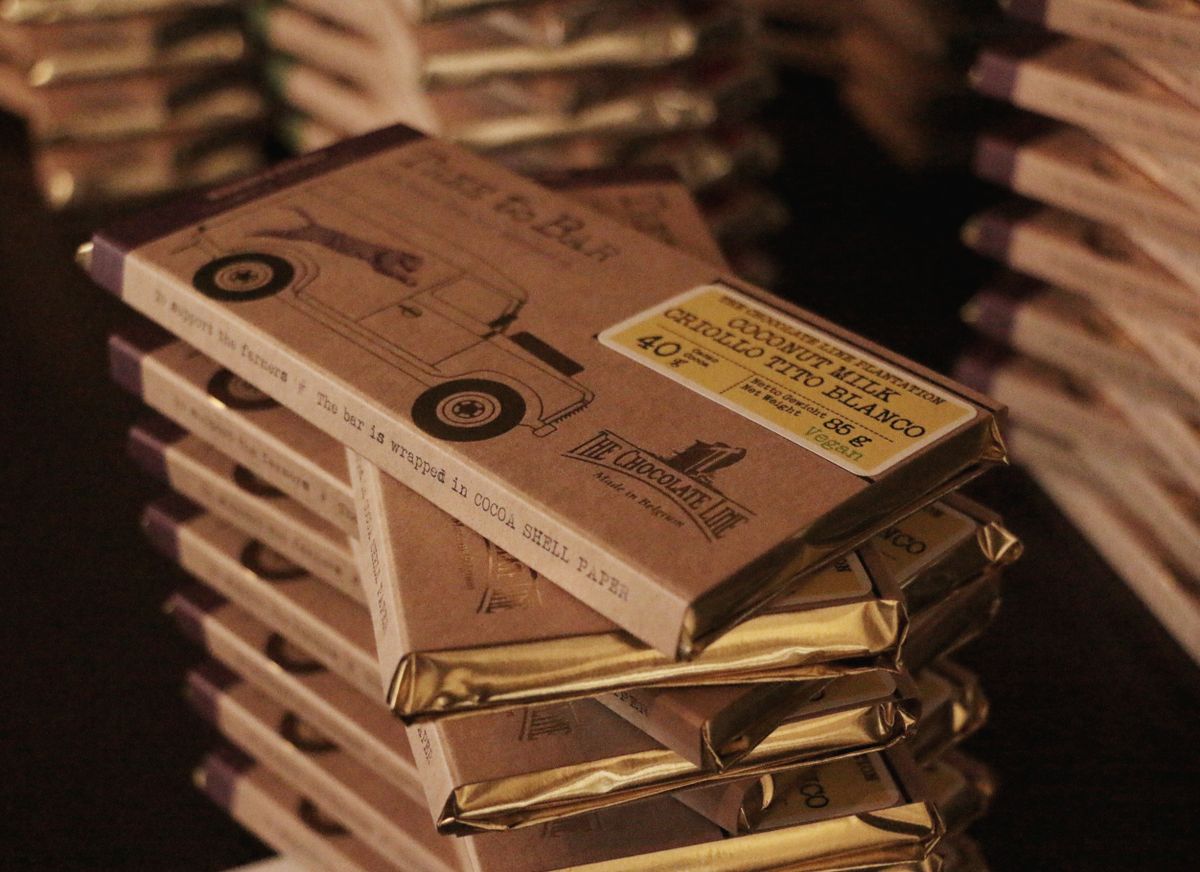
Foil laminate vs metallised paper: how do the four structures score?
For chocolate, four structures cover almost every commercial decision: aluminium foil laminate, metallised paper, metallised PET laminate, and recyclable mono-material polyethylene film. Scored across the five criteria that drive total cost, no structure wins on every axis, which is exactly why the decision is a trade-off rather than a ranking. Foil owns barrier; mono-PE owns recyclability; metallised paper is the balanced middle.
The matrix below scores each structure directionally (5 = strongest) under typical Indian sourcing conditions in 2026. Read it across, not down: the right answer depends on which columns your product actually cares about.
| Structure | Barrier (MVTR/OTR) | Reel cost | EPR liability | Recyclability | Line compatibility |
|---|---|---|---|---|---|
| Aluminium foil laminate | 5 (barrier ceiling) | 2 (highest true cost) | 2 (full multi-layer plastic) | 1 (very hard to recycle) | 5 (runs on most lines) |
| Metallised paper (paper-based) | 4 (foil-approaching) | 3 (mid) | 3 (paper-dominant, lower) | 3 (paper-dominant stream) | 3 (needs sealing-window tuning) |
| Metallised PET laminate | 4 (very good) | 3 (mid) | 2 (full multi-layer plastic) | 2 (poor) | 5 (drop-in) |
| Recyclable mono-PE film | 2 (barrier gap on cocoa) | 3 (mid) | 3 (single polymer) | 4 (recyclable stream exists) | 4 (near drop-in) |
The headline the matrix delivers: foil laminate and metallised PET buy you the top of the barrier scale but sit at the bottom on both recyclability and EPR exposure, because both are full multi-layer plastic structures. Metallised paper gives up a single point of barrier and one point of line compatibility, and buys back two full points of end-of-life and EPR performance. For a brand whose cost model counts EPR and whose barrier target is a standard milk or dark bar, that is a favourable trade. For the highest-cocoa, longest-life premium lines, foil’s extra barrier point is not negotiable, and the matrix says so plainly.
Definitions for every term in that table (MVTR, OTR, metallisation, cold seal, dead fold) sit in our confectionery packaging glossary, and the full barrier-by-material breakdown is set out in the chocolate packaging materials guide that anchors this cluster.

Where does aluminium foil laminate still win?
Aluminium foil laminate wins wherever absolute barrier is the deciding criterion, because an unbroken metal layer is effectively impermeable to both moisture and oxygen. No paper-based or metallised structure fully matches it. For the longest shelf lives, the highest cocoa loadings, and inclusion-heavy or nut-loaded bars sitting in hot supply chains, foil remains the reference material, and pretending otherwise is how brands end up with bloom returns.
Two product profiles keep foil in the specification honestly. The first is high-cocoa dark chocolate with a long declared shelf life, where oxygen ingress oxidises cocoa fat and flattens flavour long before the code date; the difference between an OTR of 2 and an OTR of 10 cubic centimetres per square metre per day is measurable on the shelf here. The second is any bar with nut or fruit inclusions, whose exposed fats oxidise faster than the chocolate around them. For these, the barrier headroom foil provides is a genuine risk-reduction cost, not a vanity spec. A chocolate foil wrapper earns its price on these products, and a comparison that refused to say so would not be worth reading.
What does switching from foil to paper actually cost the line?
Switching a chocolate line from foil to a paper-based metallised wrapper is a one-time engineering cost, not a recurring one, and it concentrates in the sealing window. Paper-based substrates have a narrower usable heat-seal window than forgiving foil laminate, so the line needs its temperature, dwell, and pressure re-dialled, and often a short jaw or former adjustment. Budget for trial reels and a few hours of downtime, then it is done.
Three line costs matter when you model the switch, and all three are finite:
- Sealing-window tuning. Heat seal strength on paper substrates lives in a tighter temperature band than on foil laminate, so the flow-wrap line needs re-qualification. This is where most of the trial time goes.
- Cold seal advantage. Cold seal bonds under pressure alone with no heat, which suits chocolate because it avoids marring the product at the jaws. A structure that offers both heat and cold seal gives the line a second route if the heat-seal window proves tight.
- Line speed and waste. Expect a modest line-speed impact during re-qualification and a spike in trim waste on the first reels, both of which settle once the window is set. The recurring line cost after that is effectively unchanged.
None of this is unique to chocolate. The confectionery line runs on the same horizontal form-fill-seal principle as the tea pouching lines that have already made this transition, so the switching mechanics, and their costs, are well documented rather than speculative. What you are buying with that one-time spend is a structure that reduces every recurring cost line below it.
How does EPR change the foil-versus-paper maths?
Extended Producer Responsibility changes the maths by converting the wrapper’s end-of-life into a recurring line item that scales with how much plastic you place on the market. Because foil laminate and metallised PET are full multi-layer plastic structures, they carry the heaviest EPR exposure and the steepest recycled-content obligations, while a paper-dominant metallised structure can sit in a different, lower category depending on its construction. Over a product’s life, that gap compounds.
EPR (Extended Producer Responsibility) obligates brand owners to finance the collection and recycling of the packaging they sell, registered and reported through the CPCB portal. Two instruments set the cost, and both are material-specific enough to matter in a foil-versus-paper comparison:
- Category III recycled-content targets. Multi-layer plastic packaging falls in EPR Category III, which under G.S.R. 237(E) of 31 March 2026 carries recycled-content targets rising from 5% in 2025-26 to 10% by 2028-29. Foil and metallised-PET chocolate wrappers sit squarely in this category; a paper-dominant structure may not.
- Rule 11 marking. Under the Plastic Waste Management Rules, G.S.R. 73(E) of 23 January 2025 requires plastic packaging to carry a barcode, QR code, or unique number for traceability, effective 1 July 2025. It is a compliance cost of remaining on plastic, applied regardless of the polymer.
One point has to be stated precisely, because the confectionery sector repeats the opposite. There is no Indian regulation banning or restricting plastic for chocolate, candy, or protein bars, and none is proposed. The FSSAI in fact moved the other way in March 2025, permitting recycled PET for food-contact use. So EPR is not a deadline forcing a switch; it is a cost that shifts the total-cost comparison in paper’s favour over time. The mechanics of Rule 4, Rule 11, and the EPR categories are laid out in the Plastic Waste Management Rules guide, and the registration and filing workflow is walked through in the EPR obligations guide. Globally the read is the same: FoodNavigator reported in July 2026 that the sector is consolidating around recyclable plastic rather than plastic elimination, because paper still needs functional barrier coatings that then frustrate recycling.
Where a paper-based metallised wrapper fits
Before the case for it, the limitation, stated plainly: for chocolate, metallisation is still required today. A plain, non-metallised paper wrapper cannot hold the moisture and oxygen barrier that cocoa fat and volatile cocoa aroma need across a retail shelf life. This is not a marketing hedge; it is visible in the product data. Pakka’s own flexC range lists chocolate as an application for its metallised structure only, and reserves the non-metallised paper structure for energy bars, cookies, biscuits, and nuts. If a supplier offers a bare paper wrapper for high-cocoa chocolate, ask for the barrier numbers before you believe it.
Within that boundary, a paper-based metallised structure is a credible chocolate material now, and it is the structure that makes the total-cost argument work. flexC’s Bleached Confectionary Metalized (90 GSM) is a paper-based, compostable, metallised wrapper that publishes first-party barrier data with named test methods: WVTR below 2 g/m²/day (ASTM F1249, 50% RH, 23°C) and OTR below 10 cc/m²/day (ASTM F1927). It is both heat and cold sealable, and the cold-seal route is exactly what a chocolate line wants to avoid marring product at the sealing jaws. Thickness is 75 ± 2 µm and grammage is verified to TAPPI T410. It ships as reel or laminate stock by GSM and runs on digital, flexographic, and gravure lines, so it drops into the flow-wrap workflow the line already knows.
The trade-off stays honest on both sides. Against foil you give up a slice of absolute barrier and you spend one-time engineering effort tuning the sealing window. In exchange you get a paper-dominant structure with a materially better end-of-life profile, lower EPR exposure, and barrier numbers that hold for the great majority of milk and dark bars over a normal Indian retail shelf life. For the longest-life, highest-cocoa, inclusion-heavy premium lines in hot supply chains, foil still sets the ceiling. On total cost of ownership, for everything else, the paper-based metallised wrapper is the stronger number, and that is the comparison without the sales gloss.
Frequently asked questions
Is a paper chocolate wrapper cheaper than aluminium foil laminate?
Not usually on reel price alone, where foil often looks cheaper per metre. On total cost of ownership, which adds EPR fees, recycled-content obligations, and end-of-life liability to the reel price, a paper-based metallised wrapper closes most of the gap and can come out ahead, because foil carries full multi-layer-plastic EPR exposure that a paper-dominant structure may avoid.
Can a paper wrapper match aluminium foil’s barrier for chocolate?
Not fully. An unbroken foil layer is effectively impermeable and sets the barrier ceiling. A paper-based metallised structure approaches it and meets the barrier target for most standard milk and dark bars, but for the highest-cocoa, inclusion-heavy, or longest-shelf-life products, foil still holds a measurable edge on oxygen barrier.
What is the real cost of switching a chocolate line from foil to paper?
It is a one-time engineering cost concentrated in the sealing window: re-qualifying heat-seal temperature, dwell and pressure, sometimes a jaw adjustment, plus trial-reel waste and a few hours of downtime. After the window is set, the recurring line cost is effectively unchanged, and the lower EPR and waste costs persist for the product’s life.
Does EPR make foil chocolate wrappers more expensive?
Yes, over time. Foil laminate is a full multi-layer plastic structure in EPR Category III, so it carries recycled-content targets rising from 5% in 2025-26 to 10% by 2028-29 and full CPCB reporting liability. A paper-dominant metallised structure can fall in a lower-cost position, which widens paper’s total-cost advantage as the targets climb.
Is there a law banning aluminium foil chocolate wrappers in India?
No. There is no Indian regulation banning or restricting plastic or foil for chocolate, candy, or protein bars, and none is proposed. Rule 11 marking and Category III recycled-content targets are material-neutral cost and reporting obligations, not a ban. FSSAI permitted recycled PET for food contact in March 2025, moving in the opposite direction.
Last reviewed: August 2026
Choosing between a foil laminate and a paper-based metallised chocolate wrapper is a total-cost decision before it is a sustainability one, and the honest answer turns on your product’s cocoa content, shelf life, and supply-chain temperatures. If you are modelling where a paper-based metallised structure beats foil on total cost, and where foil still earns its place, the flexC range and its published barrier data are set out on the flexC food packaging page. For a spec-level conversation about your specific bar, inclusions, and flow-wrap line, get in touch with the Pakka team.
Browse all Pakka articles.
You may also like