Why Restaurants Are Switching to Sustainable Packaging: Regulation, Cost, and Consumer Pressure in 2026

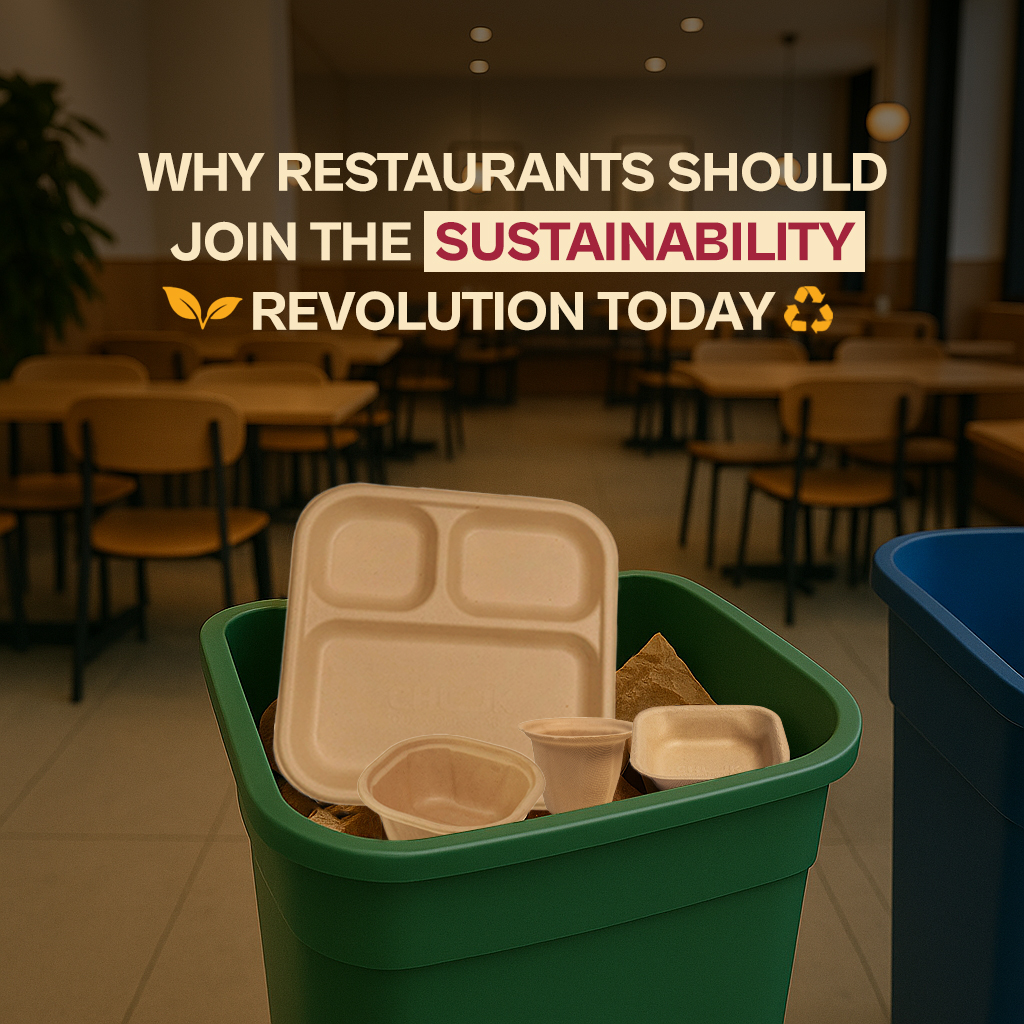
Three forces are converging on Indian restaurant operators simultaneously. The SUP ban has made plastic disposables illegal. The EPR for Packaging Rules (effective April 2026) are adding compliance costs for non-compostable packaging. And consumer expectations have shifted to the point where eco-friendly packaging is no longer a differentiator but a baseline.
India’s restaurant industry reached USD 60 billion in 2025, with organised food service growing at 11.2% CAGR (National Restaurant Association of India, 2025). Within that market, delivery and takeaway now account for 35 to 40% of revenue for most urban restaurants. Every delivery order involves disposable packaging. The material that packaging is made from is now a compliance question, a cost question, and a brand perception question, all at once.
This article breaks down each of those pressures and provides a practical transition path for restaurant operators who have not yet made the switch.
Key takeaways
- The SUP ban is current law. Plastic plates, cups, cutlery, thermocol containers, and thin plastic bags are illegal for food service. Non-compliance penalties reach INR 1 crore under the Environment Protection Act.
- EPR for Packaging Rules (April 2026) require restaurants and cloud kitchens to manage end-of-life of their packaging. Compostable packaging simplifies this obligation.
- 75% of Gen Z and millennial consumers consider sustainability practices before choosing a restaurant (Deloitte Global Sustainability Survey, 2023).
- Restaurants tagged as eco-friendly on delivery platforms see 12 to 15% higher order volumes during peak periods (Zomato Sustainability Report, 2022).
- The packaging transition does not require a large upfront investment. Start with the highest volume disposable items and switch incrementally.
The regulatory floor: what is already required
SUP ban compliance
The Plastic Waste Management (Amendment) Rules, 2022, ban specific single-use plastic items effective July 2022. For restaurants, the banned items include:
- Plastic plates and trays
- Plastic cups and glasses
- Plastic cutlery (forks, spoons, knives, stirrers)
- Plastic straws
- Polystyrene (thermocol) containers
- Plastic carry bags below 120 microns
These items are banned regardless of whether you use them for dine-in, takeaway, or delivery. The ban applies to restaurants, cloud kitchens, caterers, and any food service operation.
Enforcement varies by city. Delhi, Mumbai, Chennai, and Bengaluru have active enforcement with inspections and penalties. Smaller cities and towns have less consistent enforcement, but this is changing as state pollution control boards expand their inspection capacity.
EPR obligations from April 2026
The EPR for Packaging Rules add a new compliance layer. Restaurant brands, cloud kitchen operators, and food service companies that put packaging into the market must:
- Register on the CPCB portal
- Declare the quantity and type of packaging used
- Meet recycling or composting targets for that packaging
- File half-yearly and annual returns
Compostable packaging certified under IS 17088 simplifies compliance because it enters organic waste streams. Non-compostable packaging requires proof of recycling, which depends on local recycling infrastructure that may not exist.
For multi-outlet restaurant chains, the EPR obligation scales with the number of outlets and the volume of packaging used. The administrative burden alone makes compostable packaging the simpler compliance path.
The consumer pressure: real numbers, not assumptions
Consumer preference for sustainable restaurants has moved from stated preference (survey responses) to revealed preference (purchasing behaviour).
75% of Gen Z and millennial consumers consider a brand’s sustainability practices before making a purchase (Deloitte, 2023). In Indian food delivery specifically, restaurants tagged as eco-friendly on Zomato experienced 12 to 15% higher order volumes during festivals and bulk ordering periods (Zomato Sustainability Report, 2022).
70% of Indian diners prefer eco-friendly restaurants when choosing between comparable options (FICCI Food Service Report, 2022). That preference does not mean they will pay dramatically more. It means that when food quality and price are similar, the restaurant using compostable packaging wins the order.
For restaurant operators, the calculation is straightforward: sustainable packaging is a customer retention and acquisition tool. The question is not whether it works but whether the cost is justified. For most operators, the numbers say yes.
The cost reality: what the switch actually costs
The most common objection to sustainable packaging is cost. Here is what the numbers actually look like for a restaurant doing 200 delivery orders per day:
| Item | Banned plastic (reference) | Paper | Bagasse (compostable) |
|---|---|---|---|
| Main container (750ml) | INR 3.00 | INR 5.00 | INR 7.00 |
| Side container (250ml) | INR 1.50 | INR 2.50 | INR 3.50 |
| Cutlery set | INR 1.00 | INR 2.00 | INR 3.00 (wooden) |
| Carry bag | INR 0.50 | INR 2.00 | INR 2.50 |
| Cost per order | INR 6.00 | INR 11.50 | INR 16.00 |
| Monthly cost (200 orders/day) | INR 36,000 | INR 69,000 | INR 96,000 |
The monthly difference between banned plastic (reference only) and bagasse compostable is INR 60,000 for a restaurant doing 200 orders daily. That is INR 10 per order, or roughly 2 to 3% of the average delivery order value.
Paper is cheaper per unit but fails with Indian food. A paper container that softens under dal or biryani generates customer complaints and reorders, which cost more than the per-unit savings. For dry food (sandwiches, rolls, baked goods), paper works. For the full range of Indian food, bagasse is the functional choice.
The cost perspective shifts further when you factor in:
– EPR compliance savings from using compostable vs non-compostable packaging
– Customer acquisition benefit from eco-friendly positioning on delivery platforms
– Penalty avoidance from SUP ban compliance
– Waste management simplification from a single compostable waste stream
How to transition without disruption
The packaging switch does not need to happen in one day. A phased approach reduces risk, spreads cost, and allows the team to adapt.
Phase 1 (Month 1): Replace banned items. If you are still using any SUP-banned items, replace them immediately. This is a compliance requirement, not an option. Focus on the highest risk items: thermocol containers and plastic cutlery.
Phase 2 (Month 2-3): Switch high-volume items. Replace the main delivery containers (the item you use the most of) with compostable alternatives. Test 2 to 3 suppliers with small orders before committing to bulk.
Phase 3 (Month 4-6): Complete the transition. Replace remaining items: side containers, portion cups, carry bags. Standardise on compostable materials across all formats to simplify waste management and EPR reporting.
Phase 4 (Ongoing): Train staff. Ensure kitchen and packing staff know which packaging to use for which items. The most common post-transition problem is staff reverting to old habits or substituting non-compliant items during stock shortages.
Communicating the change to customers
Switching to sustainable packaging without telling customers about it wastes half the value. The packaging change is a brand story that resonates with the 70% of consumers who prefer eco-friendly restaurants.
Practical communication channels:
– Update your delivery platform profile with eco-friendly tags
– Add a one-line note to delivery receipts or packaging inserts
– Post on social media showing the new packaging in use
– Train delivery staff to mention the switch if customers ask
Avoid overclaiming. “We use compostable packaging certified under IS 17088” is a factual, verifiable claim. “We are saving the planet” is not. Consumers, particularly younger demographics, are sceptical of vague sustainability claims and respond better to specific, honest statements.
Frequently asked questions
Is sustainable packaging mandatory for restaurants in India?
The SUP ban makes plastic plates, cups, cutlery, and thermocol containers illegal. The ban is mandatory. The choice of replacement material (paper, bagasse, melamine) is up to the restaurant. EPR for Packaging Rules (April 2026) create additional compliance requirements for all packaging.
How much more does sustainable packaging cost per delivery order?
Approximately INR 10 more per order compared to the now-banned plastic option. For a restaurant doing 200 deliveries daily, that is roughly INR 60,000 per month. Paper is cheaper but fails with hot, wet Indian food. Bagasse is the functional choice for the full range of Indian cuisine.
Do customers actually care about restaurant packaging?
70% of Indian diners prefer eco-friendly restaurants (FICCI, 2022). Restaurants tagged as eco-friendly on Zomato see 12 to 15% higher order volumes during peak periods. The preference translates to real ordering behaviour, not just survey responses.
Can bagasse containers handle biryani, dal, and curries?
Coated bagasse containers (water-based, PFAS-free coatings) hold wet, oily food for 45 to 60 minutes. That covers the typical delivery window. For heavy pooling gravies beyond 60 minutes, performance depends on coating quality. Test with your specific dishes before committing.
What is EPR and how does it affect restaurants?
Extended Producer Responsibility requires businesses to manage the end-of-life of their packaging. From April 2026, restaurants and cloud kitchens must register on the CPCB portal and report packaging quantities. Using IS 17088 certified compostable packaging simplifies compliance because it enters organic waste streams.
Where do I start if I want to switch to sustainable packaging?
Start with the highest volume item (usually the main delivery container) and test 2 to 3 suppliers with small orders. Replace banned plastic items immediately. Phase in compostable alternatives over 3 to 6 months. Standardise on compostable materials to simplify waste management and EPR reporting.
Ready to transition your restaurant’s packaging? Talk to our team about bulk pricing, format selection, and compliance support for your operation.
The Good Garbage Podcast
The Truth About Sustainable Packaging with Sandeep Kulkarni
Hear Sandeep Kulkarni discuss this topic in depth with host Ved Krishna on The Good Garbage Podcast.
Browse all Pakka articles.
You may also like