Is Coated Paper Allowed for Food Packaging in India? FSSAI Rules, PFAS Restrictions, and Compliance Guide

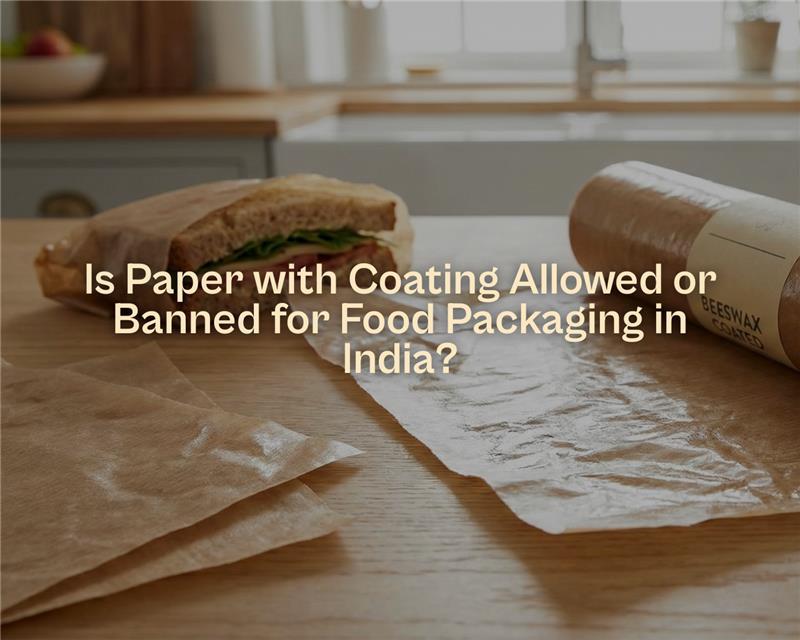
Coated paper is not banned for food packaging in India. It is regulated. The distinction matters because the answer to “can I use coated paper?” depends entirely on what the coating is, whether the paper meets the relevant Indian Standard, and whether the combination has been tested for food-contact safety.
This is the question that packaging converters, QSR procurement teams, and food brand managers ask most frequently when sourcing paper-based food packaging. The confusion exists because the FSSAI regulations reference multiple IS codes, the SUP ban affects some plastic-based coatings, and a draft FSSAI amendment proposes restricting PFAS compounds that are used in many grease-resistant coatings.
This article clarifies what is allowed, what is restricted, what is coming, and how to verify compliance for your specific products.
Key takeaways
- Coated paper is permitted for food packaging in India provided both the base paper and the coating meet FSSAI food-contact safety requirements and the relevant Indian Standards.
- Base paper must conform to IS 6622 (greaseproof), IS 7161 (vegetable parchment), IS 6615 (wrapping paper), or IS 1776 (folding box board).
- PFAS-based coatings are under regulatory review. FSSAI’s draft Food Safety and Standards (Packaging) Amendment Regulations, 2025, propose restricting PFAS in food-contact materials. The amendment is not yet finalised, but brands should begin transitioning to PFAS-free coatings now.
- Newspaper and non-food-grade recycled paper are explicitly prohibited for food contact under FSSAI rules, regardless of any coating applied.
- The coating itself must be tested for migration: the transfer of chemicals from the coating into the food must be below specified limits.
The regulatory framework for coated paper in food packaging
FSSAI Packaging Regulations 2018
The Food Safety and Standards (Packaging) Regulations, 2018, are the primary regulatory document. They establish that all materials in direct or indirect contact with food must be food grade, safe for human consumption, and must not transfer harmful substances to food.
Schedule I of the regulations lists acceptable packaging materials with their corresponding Indian Standards:
| Material | IS code | Typical application |
|---|---|---|
| Greaseproof paper | IS 6622 | Burger wraps, bakery packaging |
| Vegetable parchment | IS 7161 | Butter wraps, wet food contact |
| General wrapping paper | IS 6615 | Secondary wrapping, dry food |
| Folding box board (uncoated) | IS 1776 | Cartons, boxes |
| Aluminium foil (laminates) | IS 8970 | Barrier packaging |
Paper that conforms to one of these IS codes and has not been treated with a non-food-safe coating is compliant for food contact. The regulation does not ban coatings; it requires that coated paper meet food-contact safety standards as a complete system (base paper plus coating).
What FSSAI explicitly prohibits
Newspaper. Explicitly prohibited for food contact. Printing inks in newspaper contain mineral oil hydrocarbons (MOSH and MOAH) that migrate into food. This ban is absolute; no coating applied to newspaper makes it food-safe.
Non-food-grade recycled paper. Post-consumer recycled paper may contain adhesive residues, ink contaminants, and other substances that are not food-safe. Recycled paper for food contact must demonstrate migration compliance through laboratory testing.
Non-food-safe coatings. Any coating that transfers harmful substances into food above specified limits is non-compliant. This includes coatings containing restricted heavy metals, certain solvents, and (potentially, under the draft amendment) PFAS compounds.
Types of paper coatings and their regulatory status
Wax coatings
Food-grade wax coatings (paraffin wax conforming to specified purity standards) are permitted. Wax provides moisture resistance for applications like bread wraps and confectionery packaging. The wax must be food-grade; industrial-grade paraffin wax is not compliant.
Water-based barrier coatings
Water-based coatings that provide grease and moisture resistance are permitted provided they meet food-contact migration limits. These coatings are increasingly used as alternatives to PFAS-based treatments. The coating formulation must be tested for food contact; “water-based” alone does not guarantee food safety.
PFAS-based coatings (under review)
Per- and polyfluoroalkyl substances (PFAS) have been widely used in food packaging for grease resistance. They are effective, durable, and relatively inexpensive. They are also persistent environmental pollutants that accumulate in human tissue and are linked to health concerns.
FSSAI’s draft Food Safety and Standards (Packaging) Amendment Regulations, 2025, propose restricting PFAS in food-contact materials. The amendment is in draft stage and has not been finalised. However:
- The EU restricted PFAS in food-contact materials effective February 2026 under Regulation (EU) 2025/360
- Denmark banned PFAS in food packaging in 2020
- Several US states (California, Washington, Maine) have enacted PFAS restrictions for food packaging
The regulatory direction is clear. Brands and converters using PFAS-based coatings should begin transitioning to PFAS-free alternatives to avoid being caught by the final regulation. Waiting for the amendment to be finalised creates a transition burden that is harder to manage under time pressure.
PE and plastic lamination coatings
Polyethylene (PE) lamination on paper provides excellent moisture and grease resistance. It is permitted for food packaging where the PE layer meets food-contact safety standards. However, PE-laminated paper is not compostable and may not be recyclable (because separating the PE from the paper fibre is difficult). Under EPR rules, PE-laminated paper carries the compliance burden of non-recyclable packaging.
Compostable coatings
Paper with compostable coatings that meet IS 17088 certification provides both food-contact compliance and compostability. The entire system (base paper + coating) must be certified, not just the individual components. Compostable coatings are typically biopolymer-based or water-based formulations designed to decompose under composting conditions.
How to verify compliance for your coated paper products
Step 1: Confirm the base paper
Ask the paper supplier which IS code the base paper conforms to. Request the test certificate from an NABL-accredited laboratory. If the paper does not conform to a listed IS code, it is not automatically compliant for food contact.
Step 2: Confirm the coating
Request the coating formulation’s food-contact safety test report. The report should show migration test results: the transfer of chemicals from the coated paper into a food simulant, under specified conditions of time and temperature. Migration must be below the limits specified in the FSSAI regulations.
Specifically ask about:
– Total migration (overall transfer of substances)
– Specific migration of restricted substances (heavy metals, solvents)
– PFAS content (intentionally added PFAS and total fluorine content)
Step 3: Test the finished product
If the base paper meets its IS code and the coating meets migration limits, the combination should be compliant. However, food-contact compliance must be verified on the finished product (paper + coating + printing if applicable), not inferred from the individual components.
Request an overall migration test on the finished coated paper product from an NABL-accredited laboratory. This is the definitive compliance document.
Step 4: Maintain documentation
Keep all test certificates, migration reports, and IS code conformance documents on file. FSSAI inspectors can request these documents during compliance checks. Suppliers should provide updated certificates when formulations change.
The PFAS transition: what brands should do now
Even though the FSSAI PFAS amendment is not yet final, the practical advice is to begin the transition now.
Audit current packaging. Identify which products use PFAS-based coatings. The most likely candidates are greaseproof wraps, pizza boxes, and bakery bags where grease resistance is a primary requirement.
Request PFAS-free alternatives from suppliers. Water-based barrier coatings and biopolymer coatings provide grease resistance without PFAS. Test these alternatives with your specific food products to confirm they meet performance requirements.
Set a transition timeline. Give yourself 6 to 12 months to validate alternatives, adjust production processes, and update packaging specifications. Attempting the transition under regulatory deadline pressure increases the risk of choosing an inadequate alternative.
Document the transition. When the amendment is finalised, brands that have already transitioned to PFAS-free coatings will have a compliance advantage. Brands that have not will face compressed timelines and potentially limited supplier capacity as the entire market transitions simultaneously.
Frequently asked questions
Is coated paper banned for food packaging in India?
No. Coated paper is permitted provided the base paper meets the relevant IS code and the coating meets FSSAI food-contact migration limits. The coating must be food-safe and tested on the finished product.
Can I use wax-coated paper for food wrapping?
Yes, if the wax is food-grade paraffin conforming to purity specifications. Industrial-grade wax is not compliant. Request the food-grade certification for the wax from the supplier.
Are PFAS coatings currently banned in India?
Not yet. FSSAI has published a draft amendment proposing restrictions, but it has not been finalised. However, the EU, Denmark, and several US states have already restricted PFAS in food packaging. The regulatory direction is clear, and brands should begin transitioning to PFAS-free alternatives.
Is recycled paper safe for food contact?
Not inherently. Post-consumer recycled paper may contain MOSH/MOAH from printing inks and other contaminants. Recycled paper for food contact must demonstrate migration compliance through laboratory testing. For direct food contact, virgin fibre paper is the safer default.
What documentation do I need to prove coated paper compliance?
IS code conformance certificate for the base paper, food-contact migration test report for the coating (from an NABL-accredited lab), and overall migration test on the finished product. Maintain these documents on file for FSSAI inspection.
Does coated paper meet compostability requirements?
Only if the entire product (paper + coating) is certified under IS 17088. PE-laminated paper is not compostable. Wax-coated paper may not be compostable depending on the wax type. Paper with certified compostable coatings (biopolymer or water-based) can meet IS 17088 if tested and certified as a complete system.
Need food-safe coated paper for your packaging operations? Talk to our team about PFAS-free barrier papers, food-contact testing, and IS 17088 certified compostable options.
Specifying packaging for this application. Pakka’s food wrap and carry range covers paper wraps, bags and carry formats, with food-contact and barrier data on the category page. Talk to the Pakka team for specifications, samples and pricing.
Browse all Pakka articles.
You may also like