FlexC Metallised Paper: How It Replaces Conventional Laminates for Tea Packaging Without Sacrificing Barrier Performance

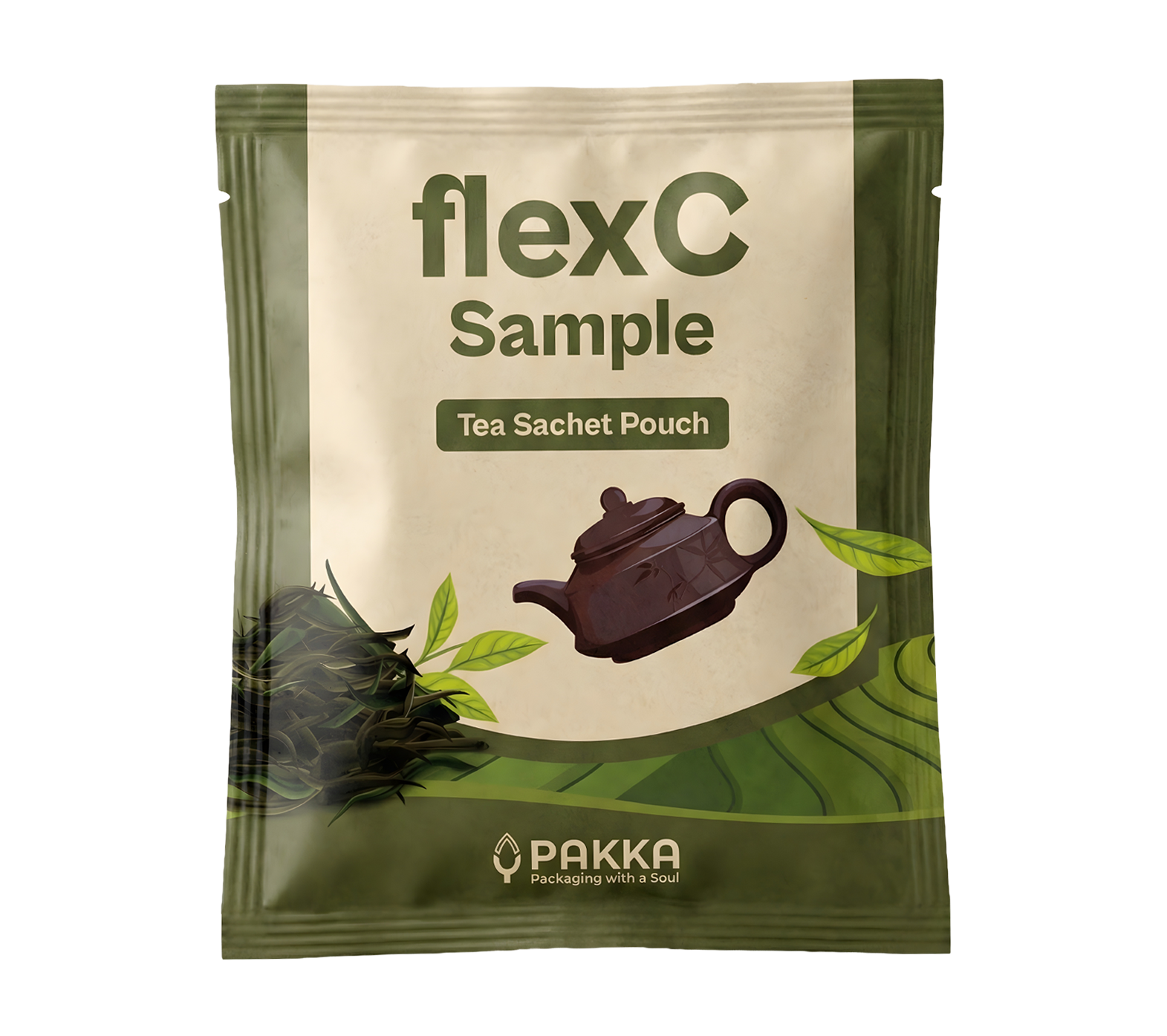
Roughly 3 billion tea bag overwrap sachets are produced globally every year. The standard packaging for these sachets, and for most tea pouches, is a multilayer laminate: PET or BOPP as the outer layer, metallised aluminium for barrier, and polyethylene for heat seal. This structure delivers excellent moisture and oxygen protection. It also cannot be recycled because the bonded layers cannot be separated economically.
India’s tea industry produced 1,395.76 million kg in 2024, with exports reaching USD 826 million (Tea Board of India, Annual Report 2024-25). The packaging for this production volume is overwhelmingly conventional multilayer laminates. As the EU’s Packaging and Packaging Waste Regulation (PPWR) and India’s EPR for Packaging Rules (April 2026) begin penalising non-recyclable and non-compostable packaging, the economic equation for these laminates is changing.
FlexC metallised paper is a paper-based substrate with vacuum-deposited metallic coating designed to provide equivalent barrier function while remaining compostable through standard paper recycling or organic waste streams. This article covers the technical specifications, machine compatibility, and transition considerations for tea brands and converters evaluating the material.
Key takeaways
- FlexC metallised paper achieves MVTR below 2 g/m2/day and OTR below 10 cc/m2/day, which is adequate for tea sachets and pouches with 6 to 9 month shelf life targets.
- The material runs on existing VFFS and HFFS packing lines with seal temperature adjustments (typically 10 to 20 degrees C lower than conventional PE sealant layers).
- Paper-based structure enables recycling through paper streams or composting under IS 17088 / EN 13432 certification. Conventional multilayer laminates cannot achieve either pathway.
- The metallised surface provides the light barrier that tea requires to prevent UV-driven degradation of volatile aromatic compounds.
- Material cost is 15 to 30% higher than conventional laminates. When EPR compliance costs for non-recyclable packaging are included, the total cost gap narrows to 5 to 15%.
What FlexC replaces and why it matters
The conventional tea packaging structure
A standard tea sachet overwrap or pouch uses: BOPP (12 to 15 microns) / adhesive / metallised PET or metallised BOPP (12 microns) / adhesive / PE (25 to 50 microns). Total structure thickness: 50 to 80 microns.
This delivers MVTR of 0.3 to 1 g/m2/day and OTR of 0.5 to 2 cc/m2/day. The barrier is more than adequate for tea, which typically requires MVTR below 2 and OTR below 5 for 9-month shelf life. In fact, most tea packaging is over-specified on barrier: the conventional laminate provides barrier performance that exceeds what tea actually needs.
The problem is end-of-life. The three materials (BOPP, metallised PET, PE) are bonded with adhesive. They cannot be separated for recycling. The structure is not compostable. Under EPR rules, brands using this packaging face the highest compliance burden because neither recycling nor composting pathways are available.
What FlexC offers instead
FlexC is a paper-based substrate (60 to 90 GSM) with vacuum-deposited metallic coating on one side and a heat-sealable layer. The paper provides structure and printability. The metallisation provides oxygen, moisture, and light barrier. The sealant layer enables machine sealing.
Because the base is paper, the material can enter paper recycling streams (the thin metallisation layer is removed during repulping) or compost under industrial conditions (IS 17088 / EN 13432 certified).
Barrier specifications compared
| Parameter | Conventional laminate (BOPP/met PET/PE) | FlexC metallised paper | Tea requirement (9 months) |
|---|---|---|---|
| MVTR (g/m2/day at 38C, 90% RH) | 0.3 to 1.0 | Below 2.0 | Below 2.0 |
| OTR (cc/m2/day at 23C, 50% RH) | 0.5 to 2.0 | Below 10 | Below 5.0 |
| Light transmission (%) | Below 1 | Below 2 | Below 5 |
| Seal strength (N/25mm) | 8 to 15 | 3 to 5 | Above 3 |
| Oil resistance (3M KIT) | Level 12 | Level 12 | Level 8+ |
The FlexC MVTR meets the tea requirement. The OTR is higher than conventional laminates but within the range that works for most tea applications when combined with nitrogen flushing. For brands targeting 9-month shelf life with nitrogen-flushed packs, real-time shelf life testing should confirm that the OTR level maintains acceptable aroma retention through the target window.
The seal strength is lower than conventional laminates. At 3 to 5 N/25mm, it provides adequate seal integrity for tea sachets and pouches. For applications requiring higher seal strength (heavy-fill pouches, products with sharp inclusions), this is a constraint to validate.
Machine compatibility
FlexC metallised paper runs on standard VFFS (vertical form fill seal) and HFFS (horizontal form fill seal) equipment used in tea packing. The key adjustments:
Seal temperature. Paper-based sealant layers have a different heat seal window than PE. Typically 10 to 20 degrees C lower than the settings used for conventional laminates. The seal window is also narrower, meaning more precise temperature control is needed. Modern packing machines with digital temperature control handle this without difficulty.
Line speed. Initial trials may require 10 to 15% speed reduction until the operator optimises tension, tracking, and seal parameters for the paper substrate. After optimisation, most operations return to near-original line speeds.
Forming and tracking. Paper has different stiffness and flexibility characteristics than plastic films. The material tracks differently through forming shoulders and guide systems. Tension settings may need adjustment to prevent paper tearing (the material has lower elongation than plastic films).
Dust and fines. Paper substrates generate more dust during slitting and converting than plastic films. This can affect seal quality if dust enters the seal area. Ensure the packing environment has adequate dust management.
Before committing to production volumes, request trial quantities (100 to 500 kg) from the supplier and run full converting trials on your specific equipment. The supplier should provide recommended machine settings as a starting point.
Sustainability credentials
Compostability
FlexC is IS 17088 (India) and EN 13432 (EU) certifiable. The certification covers the complete structure: paper base, metallisation, sealant layer, and printing inks. All components must pass biodegradation, disintegration, ecotoxicity, and heavy metal testing.
Paper recyclability
The thin metallisation layer is removed during standard paper repulping. This means FlexC can enter paper recycling streams in facilities equipped for metallised paper processing. Not all paper recycling facilities handle metallised paper, so the recyclability pathway depends on local infrastructure.
Carbon footprint
Paper-based packaging has lower embodied energy than equivalent plastic-based packaging. The raw material (bagasse or wood pulp) is renewable. For integrated operations using bagasse from sugarcane mills, the carbon footprint is further reduced by short supply chains and co-generation energy.
EPR advantage
Under India’s EPR for Packaging Rules (April 2026), compostable packaging enters organic waste management streams. The EPR compliance cost for compostable packaging is lower than for non-recyclable multilayer laminates. This cost differential, estimated at INR 0.50 to 2.00 per unit, partially offsets the material cost premium.
The export market consideration
The EU’s PPWR requires all packaging to be recyclable or compostable by 2030. Tea brands exporting to Europe using conventional multilayer laminates face a compliance cliff. Transitioning to FlexC or equivalent compostable packaging now provides:
- Compliance readiness for PPWR requirements
- EN 13432 certification alignment
- A sustainability story that resonates with European retail buyers and consumers
- Avoidance of the compressed transition timeline that will affect brands waiting until 2029
India’s tea exports, worth USD 826 million in 2024-25, are concentrated in markets (EU, UK, Middle East) where packaging sustainability is increasingly a market access requirement. Packaging that cannot demonstrate recyclability or compostability is becoming a non-tariff trade barrier.
Transition planning: what tea brands should do
Phase 1 (Month 1-2): Request samples and data. Obtain FlexC samples in your required formats (sachet, pouch, overwrap). Request technical data sheets with MVTR, OTR, seal strength, and converting trial data for your machine type.
Phase 2 (Month 2-4): Run converting trials. Test on your actual packing lines at your actual speeds. Optimise seal temperature, tension, and speed settings. Measure reject rates and compare to your current material.
Phase 3 (Month 3-6): Run shelf life studies. Pack your tea in both the current laminate and FlexC. Store under your actual distribution conditions. Pull samples at 3, 6, and 9 months. Test moisture content, aroma intensity, and sensory quality. This is the critical validation step.
Phase 4 (Month 6-9): Scale production. If converting trials and shelf life studies confirm performance, transition production. Start with one SKU or one market before rolling out across the range.
Total transition timeline: 6 to 9 months. Plan accordingly relative to EPR and PPWR compliance deadlines.
Frequently asked questions
Can FlexC metallised paper match the barrier of conventional tea packaging laminates?
On MVTR, yes — both achieve below 2 g/m2/day. On OTR, FlexC is higher (below 10 vs below 2 for conventional). For most tea applications with 6 to 9 month shelf life, the OTR difference does not cause measurable aroma loss when combined with nitrogen flushing. Validate with real-time shelf life testing for your specific tea.
Does FlexC run on existing tea packing machines?
Yes, on standard VFFS and HFFS equipment with adjustments. Seal temperature is typically 10 to 20 degrees C lower. Initial speed reduction of 10 to 15% may be needed during optimisation. Request trial quantities and run on your equipment before committing.
Is FlexC metallised paper compostable?
When certified under IS 17088 (India) or EN 13432 (EU), yes. The certification must cover the complete structure including metallisation, sealant, and inks. Confirm with the supplier that the specific product you are buying is certified, not just the base paper.
How much does FlexC cost compared to conventional laminates?
Material cost is 15 to 30% higher. When EPR compliance costs for non-recyclable conventional laminates are included (INR 0.50 to 2.00 per unit), the total cost gap narrows to 5 to 15%. For export markets, the cost of non-compliance with EU PPWR regulations should also be factored in.
How long does the transition take?
Plan for 6 to 9 months: 2 months for sample evaluation, 2 months for converting trials, and 3 to 6 months for shelf life validation. Compressed timelines increase the risk of insufficient validation.
Is the metallic look different from conventional metallised packaging?
FlexC metallised paper provides a metallic sheen similar to conventional metallised films. The paper substrate gives a slightly different tactile feel. Print quality on the metallised paper surface is high, supporting the premium brand presentation that tea packaging requires.
Evaluating FlexC metallised paper for your tea packaging? Contact the team for material samples, barrier data sheets, and converting trial support.
Browse all Pakka articles.
You may also like