QSR Paper Bag Specifications in India: What Chains Like McDonald’s, Starbucks and Burger King Expect from Converters


QSR chains like McDonald’s, Starbucks, and Burger King buy paper bags against a written specification, not a price list. They specify grammage, burst and tear strength, Cobb value, food-grade certification, recycled content, print tolerance, and audited batch consistency. A converter wins the contract by proving every one of those parameters in documentation before the first reel is cut, then holding them across every dispatch.
For most Indian converters, the gap is not capability. It is evidence. The line can already make the bag. What loses the order is the inability to put the spec, the test data, and the certification trail on the table at the qualification stage.
Key takeaways
- QSR paper bag specifications in India are tighter than general retail specs on three axes: food-grade safety, batch consistency, and documentation. The bag construction is the easy part.
- A national QSR programme typically runs to 8–15 million paper bags a year per regional cluster. The volume is real, but so is the qualification barrier, and the two scale together.
- Food-grade compliance is non-negotiable: FSSAI conformity, low ink migration, and a Cobb value low enough to survive grease and condensation without strike-through.
- Global chains increasingly require recycled or certified-fibre content and a chain-of-custody trail, driven by their own published packaging commitments and India’s EPR rules.
- The converter who wins is the one who treats the technical data pack as a product in its own right, not paperwork bolted on after the sample is approved.
What do QSR chains actually specify in a paper bag?
A QSR paper bag specification covers seven parameters, and a converter is scored on all seven, not just the cheapest. The brief almost always sets grammage and substrate, burst and tear strength, Cobb value for grease resistance, food-grade safety conformity, recycled or certified-fibre content, print and dimensional tolerance, and batch-to-batch consistency proven by test data. Price matters, but only among suppliers who have already cleared every technical gate. According to the National Restaurant Association of India’s 2024 India Food Services Report, the organised food-service market crossed ₹5.5 lakh crore and is growing at roughly 9–10% a year, which is the demand engine sitting behind these specifications. A converter reading a QSR brief for the first time should understand that the document is a filter, designed to remove suppliers who cannot evidence quality rather than to find the lowest quote.
This is the core difference between QSR supply and general retail. A neighbourhood retailer buys paper carry bags on look and price. A QSR procurement team buys against a controlled specification, and the bag that gets used a million times has to behave identically every time.
| Spec parameter | What QSR briefs typically demand | Where converters slip |
|---|---|---|
| Substrate & grammage | Virgin or certified kraft, 80–120 GSM by bag size | Under-specifying GSM to cut cost |
| Burst & tear strength | Burst factor 25+, tear index matched to load | No batch test data to prove it |
| Cobb value (water) | Cobb60 below 30 g/m² on food-contact faces | Ignoring moisture-side behaviour |
| Grease resistance | KIT rating set by the food (higher for fries and fried snacks) | Assuming a low Cobb means grease-proof |
| Food-grade safety | FSSAI conformity, low-migration inks | Treating it as a retail print job |
| Recycled / certified fibre | FSC or PEFC trail, recycled % declared | No chain-of-custody on file |
| Print & dimensions | Tight registration, ±2 mm tolerance | Drift across long runs |
| Consistency | Documented, audited, repeatable | Spec met on sample, not on batch |
Download the Food Wrap & Carry paper brochure (with specs)
Full grade specifications, GSM ranges and substrate options for Pakka’s food wrap and carry paper are set out in the brochure on our resources page. Open the “Food Wrap & Carry Paper” card to download it.

QSR procurement teams audit converting-line capacity and consistency before placing volume orders.
What grammage and strength do QSR paper bags need?
QSR paper bags run heavier and stronger than general retail bags because they carry hot, greasy, and uneven loads. Most QSR briefs specify 80–120 GSM kraft, with 90–100 GSM the common band for takeaway carry bags and 110–120 GSM for heavier multi-meal orders. The strength requirement is set by the worst case: a bag carrying two litres of beverage and a hot meal box, lifted by the handle, in monsoon humidity. That is why burst factor and tear index, not grammage alone, decide whether the bag survives.
Burst factor — the ratio of bursting strength to grammage — determines whether a paper bag withstands grocery- and meal-grade loads without rupturing at stress points. For QSR carry bags, a burst factor of 25 and above is the practical floor, and converters supplying drive-through volumes often target 28–30 to build in a safety margin. The relationship matters because a high GSM with poor burst factor still fails; the fibre quality and pulping route drive the strength, not the weight.
Tear index governs the other common failure mode: handle punch-outs and crease lines giving way. Bags fail at the weakest geometric point, so the base paper test data that every converter should hold before buying a reel is exactly the data a QSR buyer asks to see. According to BIS standard IS 1397, which specifies requirements for kraft paper for packing and wrapping, GSM tolerance, burst factor minimums, and moisture content are all defined parameters a converter can cite directly in a technical submission.
| Bag use case | Typical GSM | Target burst factor | Notes |
|---|---|---|---|
| Single-meal takeaway | 80–90 | 25+ | Standard W-cut or flat-handle |
| Multi-meal / family order | 100–120 | 28–30 | Reinforced bottom, twisted handle |
| Beverage carrier | 100–120 | 28+ | Block bottom, high tear index |
| Premium / café (Starbucks-tier) | 100–120 bleached | 26+ | Print surface and strength both critical |
What food-safety and compliance documents do QSR buyers demand?
Food-grade compliance is the parameter that disqualifies the most converters, because it sits outside the converting line entirely. A QSR buyer requires proof that the paper, the inks, and the adhesives are safe for food contact, that ink migration stays within limits, and that the bag carries the right regulatory trail. According to the Food Safety and Standards Authority of India (FSSAI) packaging regulations, materials in direct or indirect food contact must conform to the relevant Indian standards and must not transfer constituents that endanger health or alter the food. For paper bags, this translates into low-migration ink systems, a Cobb value low enough to stop oil strike-through, and a declaration that no recycled fibre of unknown provenance touches the food-contact face.
The Cobb value point is where converters most often misread the brief. Cobb value measures how much water the paper absorbs in a fixed time, in grams per square metre. For food-contact bags, a Cobb60 below 30 g/m² keeps condensation and spills from weakening the bag. Grease is a separate test: buyers serving fries or fried snacks also ask for a KIT grease-resistance rating (TAPPI T 559), because a paper can pass Cobb and still let oil through. A bag that looks fine in the showroom turns translucent and weak once a hot samosa or a leaking beverage sits in it, and that single failure mode is enough to lose a QSR account.
Three document sets now travel with any serious QSR submission, and they overlap with what brands need for their own filings:
- Food-safety conformity. FSSAI-aligned declarations for the paper, ink, and adhesive system, with migration test data where the brand requires it.
- BIS conformance. Alignment with IS 1397 for the kraft base paper, plus your own tested bag values, which is what auditors can actually check, gives the buyer a recognised benchmark instead of a vendor’s word.
- EPR and recycled-content data. Because the chains you supply are the obligated entity, the EPR documentation converters now have to provide, covering recycled fibre percentage, recyclability, and chain-of-custody, is increasingly a gate rather than a nice-to-have.
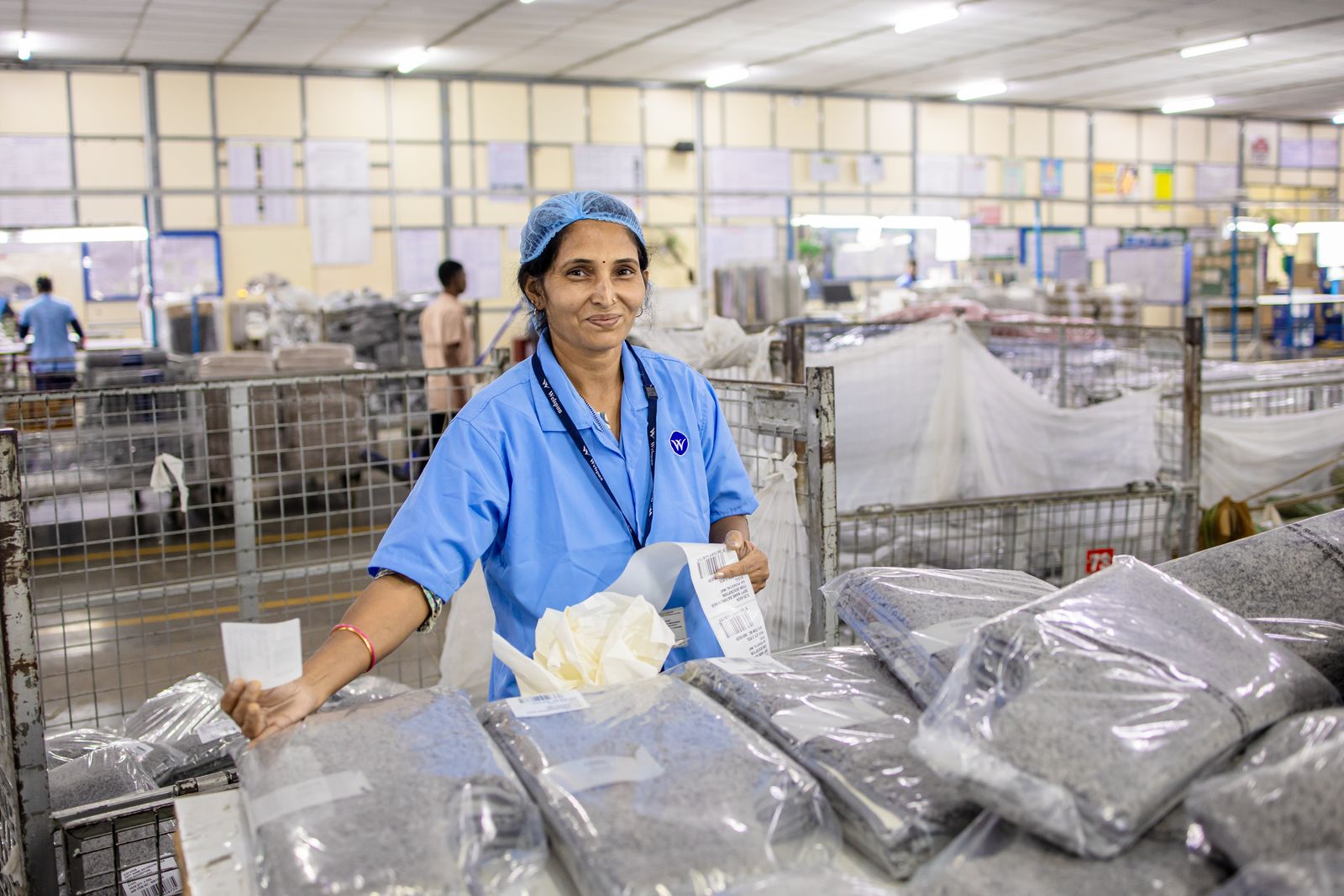
Incoming-quality checks at QSR distribution centres mirror the converter’s own line QC.
Decision matrix: which QSR supply tier should a converter target?
Decision: which QSR tier should a converter pursue first? Three realistic tiers exist, scored across four criteria below. The right answer depends on your documentation maturity, capital for certification, and appetite for audit. Volume and barrier rise together, so chasing a global account before the data pack is ready wastes a year of sampling.
| Supply tier | Entry barrier | Annual volume | Margin | Compliance load | Score (out of 12) |
|---|---|---|---|---|---|
| A. Local franchisees & cloud kitchens | Low | 0.5–2 million | Thin but accessible | FSSAI basics | 6 |
| B. National chain (domestic master franchisee) | Medium | 8–15 million / cluster | Moderate, sticky | FSSAI + BIS + EPR data | 9 |
| C. Global chain approved-vendor / export | High | 15 million+ | Best, certified premium | Full traceability + FSC/PEFC + audits | 11 |
Recommendation: Tier B is the right first target for most established Indian converters. It carries real volume, rewards a clean data pack, and builds the audit history that Tier C requires. Tier A is a sensible proving ground for newer converters to mature their QC discipline. Tier C is the destination, not the starting line. Pursue it once you can survive a brand audit without scrambling, because the cost of a failed global audit is a closed door for two to three years.
How do McDonald’s, Starbucks, and Burger King specifications differ?
The three chains converge on food safety and consistency but diverge on fibre, print, and sustainability emphasis. Exact specifications are confidential and vary by market, so the comparison below is built from each brand’s published packaging commitments and the supplier-facing requirements that flow from them, not from leaked spec sheets. The pattern is consistent enough to plan against: all three demand audited consistency, while their differentiators sit in certified fibre, print fidelity, and recycled content. According to company sustainability disclosures, all three have public commitments to source fibre-based packaging from recycled or certified-virgin sources, which is why a chain-of-custody trail has moved from optional to expected. The practical consequence for an Indian converter is that the bag body rarely decides the account; the fibre story and the print surface do. A converter who can switch between bleached café-grade stock and recycled-content kraft on the same line, with documentation for each, can quote all three brands from one qualified programme.
| Likely emphasis (inferred from public commitments) | McDonald’s | Starbucks | Burger King |
|---|---|---|---|
| Fibre source | Certified / recycled, high volume consistency | FSC-certified, premium print surface | Recycled content, cost-balanced |
| Grammage band | 90–110 GSM | 100–120 GSM (café-grade) | 90–110 GSM |
| Print fidelity | High, brand-controlled | Very high (bleached stock) | High |
| Grease resistance (KIT) and Cobb | Strict (fries, burgers) | Strict (pastries, beverages) | Strict (flame-grill grease) |
| Sustainability proof | Audited supplier programme | FSC chain-of-custody | Recycled-content declaration |
These are planning ranges drawn from the chains’ public packaging commitments, not their confidential spec sheets. Confirm exact numbers in the buyer’s RFQ.
The takeaway for a converter is that a single well-built kraft programme (strong burst factor, low Cobb, food-grade inks, and a certified-fibre trail) covers the common ground across all three. The brand-specific work is then mostly print surface and the exact recycled-versus-certified-virgin balance, both of which are grade-selection decisions rather than line rebuilds.
How can a converter actually meet QSR paper bag specs?
A converter meets QSR specs by building the evidence chain in the same sequence the buyer evaluates it. The work runs from material inward, because a spec met on a sample but not on the batch is the most common reason approved vendors get dropped. The following sequence turns capability into a defensible submission.
- Lock the substrate to spec. Select kraft grades that hold burst factor 25+ and Cobb60 below 30 at the target GSM, plus the KIT grease rating the menu needs, and verify each reel rather than trusting the mill certificate alone. A structured base paper procurement checklist is the cheapest insurance against batch drift.
- Build the test data file. Burst factor, tear index, Cobb, and GSM tolerance, logged per batch against dispatch. This file is what converts a claim into evidence at the qualification meeting.
- Qualify the ink and adhesive system. Confirm food-grade, low-migration inks and bottom-glue that holds under load and humidity. Test the finished construction, not the components in isolation.
- Assemble the compliance pack. FSSAI conformity, IS 1397 base-paper evidence, FSC or PEFC chain-of-custody, and EPR recycled-content declarations in one folder, ready before the buyer asks.
- Run a controlled pilot batch. Produce a full production run, not a hand-made sample, and measure consistency across it. QSR buyers trust the batch that proves repeatability over the perfect prototype.
- Document the audit trail. Connect mill input certificates to outbound dispatch so any batch can be traced backwards. This is what survives a brand audit and what keeps you on the panel.
Converters who follow this sequence find that the technical submission almost writes itself, because every parameter the buyer scores has a corresponding piece of evidence already on file.
Frequently asked questions
What GSM paper bag do QSR chains like McDonald’s require?
Most QSR chains specify 80–120 GSM kraft, with 90–110 GSM common for single-meal takeaway carry bags and 110–120 GSM for multi-meal or beverage-carrier formats. The exact figure is set by the heaviest expected load and the handle type, and grammage is always specified alongside a burst factor minimum (typically 25+) because weight alone does not guarantee strength.
What makes a paper bag food-grade for QSR use in India?
A food-grade QSR paper bag uses FSSAI-conformant paper, low-migration food-safe inks, and adhesives rated for food contact, with a Cobb60 below 30 g/m² for moisture and a KIT grease rating matched to the food. The converter must be able to declare that no recycled fibre of unknown provenance touches the food-contact face and, where the brand requires it, provide ink-migration test data.
How much volume does a QSR paper bag contract involve in India?
A national QSR chain programme typically runs to 8–15 million paper bags a year per regional cluster, scaling higher for global-chain master franchisees. The volume is attractive but tied to a tougher qualification barrier and audited consistency requirements, so converters should match the tier they target to their documentation and quality-control maturity.
Do QSR chains require FSC or recycled content in paper bags?
Increasingly, yes. Major global QSR chains have public commitments to source fibre-based packaging from recycled or certified-virgin sources, which translates into a requirement for an FSC or PEFC chain-of-custody trail and a declared recycled-fibre percentage. India’s EPR rules reinforce this, since the brand you supply needs your recycled-content and recyclability data to file its own returns.
How do Indian converters get on a QSR approved-vendor list?
Converters get onto a QSR approved-vendor list by clearing a technical qualification that scores substrate, strength, food-safety, sustainability documentation, and batch consistency, then surviving a pilot batch and a facility audit. The decisive factor is usually the completeness of the data pack (test results, BIS alignment, and chain-of-custody) assembled before the buyer asks rather than after.
Last reviewed: October 2026
If you are specifying kraft for a carry-bag programme, our food wrap and carry range lists each grade with a downloadable spec-sheet PDF covering GSM band, burst factor, Cobb value and food-contact status, so you can check the numbers against your brief before you speak to anyone. If the published spec looks close but not exact, write to our technical team and we will tell you plainly whether a grade can hold your requirement.
Browse all Pakka articles.
You may also like