The Business Case for Compostable Tableware in QSR Chains: ROI, Compliance, and Operational Fit

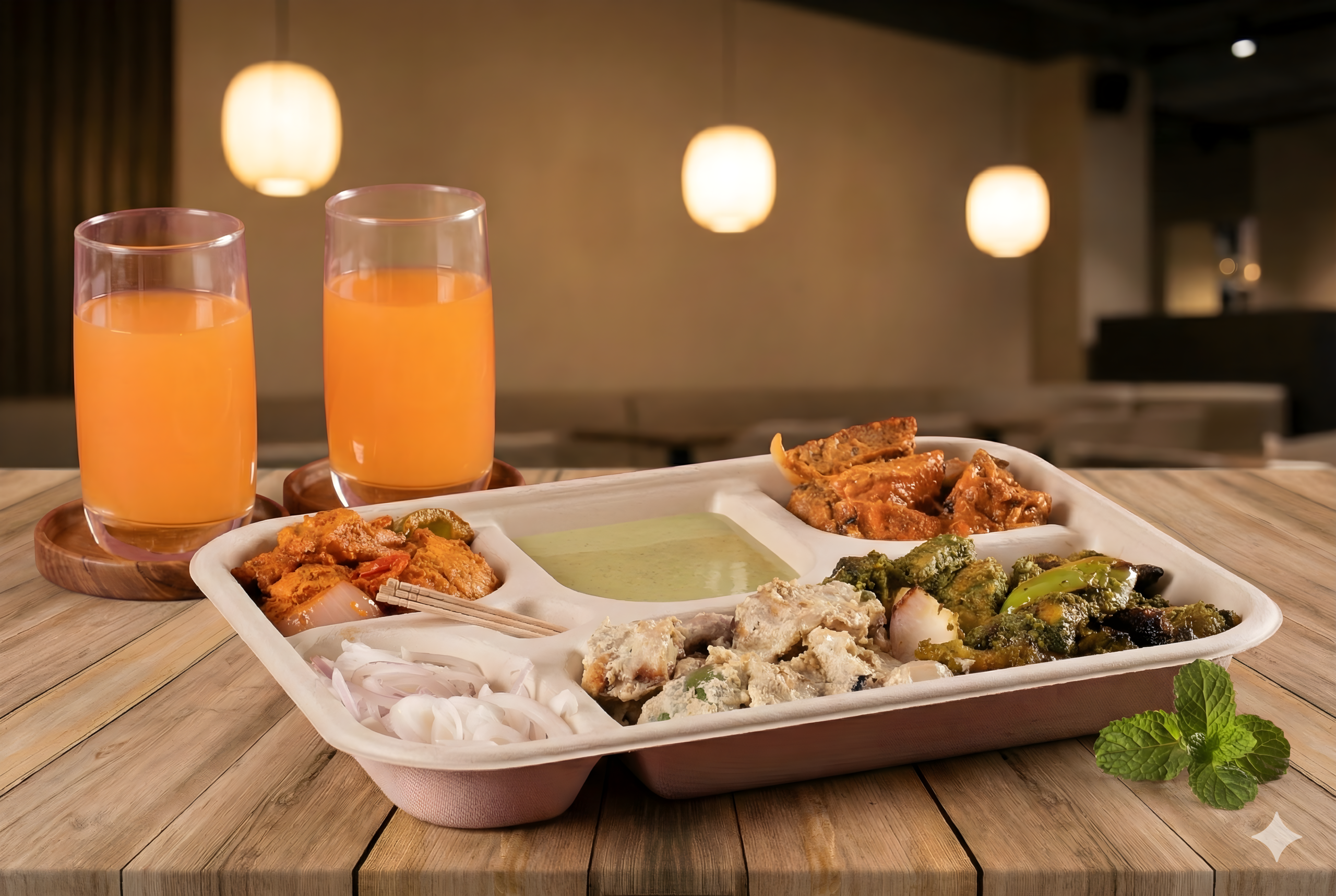
The conversation about compostable tableware in QSRs usually starts with sustainability and quickly moves to cost. That sequence is backwards. For QSR chains operating in India in 2026, compostable tableware is first a compliance decision, second a financial decision, and third a sustainability story. The order matters because it determines how the decision gets made and who in the organisation makes it.
India’s QSR market is valued at USD 28 billion in 2025, growing at 15% CAGR (NRAI India Food Services Report, 2025). The market is expanding while the packaging options are contracting: the SUP ban removed plastic, and the EPR for Packaging Rules (effective April 2026) add financial penalties for packaging that cannot be recycled or composted. For QSR procurement teams, the question is no longer whether to switch but how to switch with the least operational disruption and the best cost outcome.
Key takeaways
- The SUP ban makes plastic tableware illegal. The EPR rules make non-compostable alternatives more expensive through compliance costs. Compostable tableware is the path of least regulatory resistance.
- Bagasse tableware costs 10 to 20% more than paper alternatives on material price. When you include EPR compliance costs (INR 0.50 to 1.50 per unit for non-compostable) and non-compliance penalties (INR 10,000 to INR 1 lakh per violation), the total cost comparison favours compostable.
- 73% of Indian consumers are willing to change consumption habits to reduce environmental impact (NielsenIQ, 2023). 64% actively reduced single-use plastic consumption in the past year (Deloitte Sustainability Report, 2024).
- Bagasse tableware handles temperatures up to 220 degrees C, maintains structural integrity for 60 minutes with hot food, and runs on existing QSR operational workflows.
- A phased 4-step transition (SKU audit, pilot, supply agreement, rollout) can be completed in 8 to 12 weeks with minimal operational disruption.
The compliance argument: what QSR operations must do
SUP ban compliance is non-negotiable
Plastic plates, cups, cutlery, stirrers, straws, and polystyrene containers are banned under the Plastic Waste Management (Amendment) Rules, 2022. This is current law, not a future requirement. QSR chains still using any of these items, even in inventory, are in violation.
Enforcement is active in metro cities. Delhi, Mumbai, Chennai, Bengaluru, Hyderabad, and Pune have inspection programmes targeting food service operators. A single inspection finding banned plastic items can result in fines, confiscation, and operating permit risk.
EPR obligations add a cost layer
From April 2026, QSR brand owners must register on the CPCB portal and demonstrate that their packaging is either recycled or composted at end of life. For a QSR chain with 100 outlets, each using 3,000 to 5,000 disposable items daily, the packaging volume is significant.
Compostable tableware (IS 17088 certified) enters organic waste streams, meeting the EPR composting target. Non-compostable alternatives (paper without compostable coating, aluminium) require recycling proof, which depends on infrastructure that varies by city.
The EPR compliance cost differential between compostable and non-compostable packaging is INR 0.50 to 1.50 per unit. For a 100-outlet chain using 400,000 items per month, that differential is INR 2 to 6 lakh monthly. Over a year, the EPR cost alone can exceed INR 24 to 72 lakh.
The financial argument: total cost, not unit cost
The material cost comparison between bagasse and paper alternatives is the number QSR procurement teams see first. It is also the wrong number to optimise on.
| Cost element | Paper (non-compostable) | Bagasse (IS 17088 compostable) |
|---|---|---|
| Material cost per plate (9-inch) | INR 1.50 to 2.50 | INR 2.50 to 4.00 |
| EPR compliance cost per unit | INR 0.50 to 1.50 | INR 0 to 0.30 |
| Non-compliance penalty risk | INR 10,000 to 1 lakh per violation | Minimal |
| Wet-food hold time | 15 to 20 min (fails with Indian food) | 45 to 60 min (handles gravy, oil) |
| Customer complaint rate (packaging failure) | Higher (paper softens) | Lower (bagasse holds up) |
| Effective cost per unit (all-in) | INR 2.50 to 4.50 | INR 2.80 to 4.30 |
When EPR compliance costs and operational failure costs are included, the gap between paper and bagasse narrows to near-parity or inverts. For QSR operations serving hot, oily Indian food, paper alternatives generate customer complaints that have their own cost: replacement meals, negative reviews, and rating drops on delivery platforms.
The performance argument: does it work in a QSR environment?
QSR operations test packaging on five criteria: temperature tolerance, grease resistance, structural integrity over service time, speed of service compatibility, and stacking/storage efficiency.
Temperature tolerance. Bagasse handles up to 220 degrees C. Food from QSR kitchens arrives at 60 to 80 degrees C. The material does not deform, warp, or soften.
Grease resistance. Coated bagasse (PFAS-free water-based coatings) handles oily and greasy food for 45 to 60 minutes. For QSR service, where consumption typically happens within 15 to 30 minutes, the performance margin is generous.
Structural integrity. Bagasse maintains rigidity throughout the service window. A customer can hold a loaded 9-inch bagasse plate without it bending or collapsing. Paper alternatives at equivalent weight often bend under load.
Service speed. Bagasse tableware stacks, dispenses, and handles identically to plastic alternatives on service lines. No operational workflow changes are needed.
Storage. Bagasse products are similar in volume to equivalent plastic items. Storage footprint is comparable. Shelf life of the packaging product itself is 12+ months in dry storage.
The consumer argument: real purchasing behaviour
Consumer surveys consistently show high stated preference for sustainable packaging. The relevant question for QSR operators is whether that preference translates to purchasing behaviour.
73% of Indian consumers are willing to change consumption habits for environmental reasons (NielsenIQ, 2023). 64% actively reduced single-use plastic consumption in the past year (Deloitte, 2024). The sustainability-conscious consumer segment in urban India is growing at 15 to 20% annually.
For QSR chains, the consumer benefit manifests in three ways:
1. Delivery platform visibility. Restaurants tagged as eco-friendly on Zomato and Swiggy see higher order volumes during peak periods.
2. Social media amplification. Packaging choices are photographed and shared. Compostable packaging generates positive brand mentions; cheap or non-eco packaging generates complaints.
3. Corporate and event orders. Corporate clients increasingly require sustainable packaging for catering orders. QSR chains with compostable tableware can capture this segment.
Transition roadmap: 4 steps in 8 to 12 weeks
Step 1: SKU audit (Week 1-2)
Map every disposable item in your operation to its compostable equivalent. For a typical QSR:
– 9-inch plate → bagasse plate
– Meal tray (4-compartment) → bagasse compartment tray
– Bowl (750ml) → bagasse bowl with lid
– Clamshell container → bagasse clamshell
– Cutlery → wooden cutlery or compostable alternatives
– Cup → bagasse or paper with compostable coating
Identify the highest-volume items for priority transition.
Step 2: Pilot (Week 3-6)
Test the compostable alternatives in 5 to 10 outlets across different formats (dine-in, takeaway, delivery). Collect feedback from operations staff, customers, and delivery partners. Measure: packaging failure rate, customer complaint rate, and any service speed impact.
Step 3: Supply agreement (Week 5-8)
Based on pilot results, formalise supply agreements with volume commitments and pricing tiers. Negotiate quarterly call-off schedules that allow volume flexibility while locking in per-unit pricing. Confirm IS 17088 certification for all products.
Step 4: Network rollout (Week 8-12)
Roll out by region, starting with metro markets where enforcement is strictest. Coordinate with marketing to communicate the switch to customers. Update delivery platform profiles with eco-friendly tags.
Frequently asked questions
Is compostable tableware mandatory for QSR chains in India?
The SUP ban makes plastic tableware illegal. The choice of replacement (paper, bagasse, melamine for dine-in) is up to the operator. However, EPR rules make non-compostable alternatives more expensive through compliance costs, creating a strong financial incentive for IS 17088 certified compostable options.
How much does compostable tableware cost per outlet per month?
For a QSR outlet using 3,000 to 5,000 disposable items daily, monthly packaging cost with compostable bagasse is approximately INR 50,000 to 80,000. This is 10 to 20% higher on material cost than paper alternatives but competitive on total cost when EPR compliance is factored in.
Can bagasse tableware handle all QSR menu items?
Coated bagasse handles hot, oily, and wet food for 45 to 60 minutes. It works for burgers, fries, rice dishes, curries, wraps, and most QSR menu items. For extremely liquid items (soups, beverages), ensure the specific container format has appropriate lid seal.
How long does the transition take?
8 to 12 weeks for a complete network transition using the 4-step approach: SKU audit, pilot, supply agreement, rollout. Large chains (100+ outlets) may extend the rollout phase by 2 to 4 weeks for regional staging.
What IS 17088 documentation should procurement teams request?
The IS 17088 certificate must name the specific products being purchased. Request the certificate plus test reports showing biodegradation, disintegration, ecotoxicity, and heavy metal results. Confirm that coatings and any printing are included in the certification scope.
Does switching to compostable tableware affect delivery platform ratings?
Positively, in most cases. Restaurants using eco-friendly packaging receive visibility badges on platforms. The packaging itself performs better than paper with Indian food, reducing complaints about soggy or failed containers, which supports higher ratings.
Ready to build the business case for your QSR chain? Talk to our team about product samples, volume pricing, and pilot programme support.
Browse all Pakka articles.
You may also like