Compostable Tableware for Large-Scale Catering: What Works, What Breaks, and What to Specify

The global compostable tableware market was valued at USD 11.55 billion in 2025 and is growing at 4.64% CAGR (Towards Packaging, 2025). Catering and events are the fastest growing application segments, and for a practical reason: when you are serving 500 or 5,000 covers at a corporate event, a wedding, or a festival, washing up is not an option. Disposables are the only workable format. The question is whether those disposables end up in landfill or compost.
India’s single use plastic ban has removed the cheapest option from the table. Polystyrene plates, plastic cutlery, and plastic-lined cups are banned under the Plastic Waste Management Rules. Caterers who used to buy bulk plastic disposables at INR 0.50 per piece now face a choice between paper alternatives (which tend to fail with wet or hot food) and moulded fibre products (which handle the conditions but cost more).
Key takeaways
- Bagasse (sugarcane fibre) tableware handles temperatures up to 220 degrees C, resists moderate grease, and is IS 17088 certified compostable. It decomposes in 90 to 180 days under industrial composting.
- Compostable tableware costs roughly INR 2 to 5 per piece depending on format, compared to INR 0.50 to 1.50 for the now-banned plastic equivalents and INR 3 to 8 for melamine or ceramic rental and wash.
- According to FSSAI’s Sustainability Guide (2022), switching from plastic to compostable tableware at catering events can reduce event waste by 60 to 70% when paired with composting infrastructure.
- A 2023 Zomato Institutional Catering survey found 72% of corporate clients prefer vendors who use eco-friendly tableware, even at a slight cost premium.
- The main failure mode for compostable tableware at events is not the product itself but the disposal system. Without composting infrastructure, compostable products end up in landfill, where they do not decompose as designed.
What bagasse tableware actually handles (and where it fails)
Bagasse is the fibrous residue left after crushing sugarcane. Thermoformed under heat and pressure, it produces rigid plates, bowls, trays, and clamshell containers. The material properties matter because caterers need to know what will hold up during service and what will not.
Temperature. Bagasse tableware handles up to 220 degrees C. That means it works in microwaves and with hot food straight from the kitchen. PLA coated alternatives start softening at 45 to 50 degrees C and deform above 60, which makes them unreliable for Indian food service where dishes are served at high temperature.
Grease and liquids. Untreated bagasse resists grease at moderate levels. A dry curry or a samosa sitting on a plate for 30 minutes will not cause problems. A heavily oiled biryani or a pooling gravy will eventually soften the surface. Water-based coatings (PFAS-free) provide additional oil resistance for applications like delivery bowls and meal trays.
Structural rigidity. This is where plate size matters. A 6-inch bagasse plate holds its shape with typical loading. A 10-inch plate loaded with a full meal can flex when carried with one hand. For large format plates, look for higher GSM specifications and reinforced rim profiles.
Moisture holding time. Wet food (raita, salads with dressing, chutneys) will eventually soften any bagasse surface. The hold time depends on coating quality. Well-coated products handle 45 to 60 minutes of contact with wet food. Uncoated products begin softening at 20 to 30 minutes. For sit-down service, this is rarely a problem. For buffet events where plates sit loaded for longer, it matters.
Five product formats that work at event scale
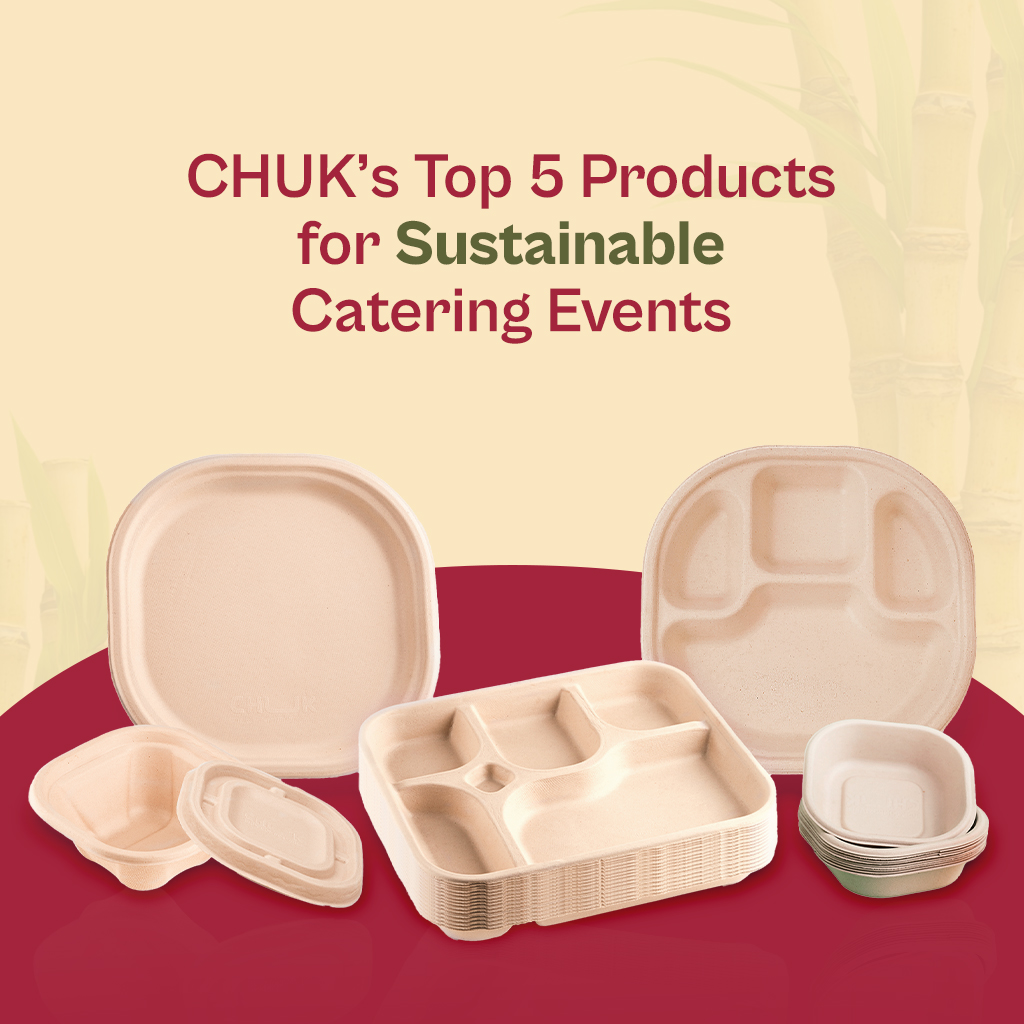
Compartment meal trays (3 or 4 compartments)
These are the workhorse for corporate events, wedding catering, and institutional meal programmes. A 4-compartment tray separates mains, sides, and dessert without needing multiple plates. That cuts serving time and plate count, which matters at scale.
The practical advantage is not environmental. It is operational. One tray per guest instead of three to four plates reduces handling time by roughly 20 to 25%. For a 500-cover corporate lunch, that is the difference between completing service in 30 minutes and taking 45.
Haldirams uses compartment trays from CHUK (by Pakka) across several locations. The feedback from operations teams consistently centres on speed: fewer items to manage per guest, simpler waste stream at the end.
Deep bowls with lids (500ml to 750ml)
For delivery catering, cloud kitchen events, and take-home meal packs, the deep bowl with a fitted lid is the critical format. The lid has to snap securely enough to prevent spillage during transport while being easy to open without tools.
Photo via Pexels — Free to use
Bagasse bowls in this size range handle biryani, dal, and curries. The key spec is leak resistance under pressure: if a stack of 20 filled bowls is loaded into a delivery crate, the bottom units must not leak from lid compression. Test this before committing to a large order. Not every supplier’s lid seal passes this test.
Small portion cups (30ml to 60ml)
Chutney, pickle, salad dressing, dessert mousse. These small items get overlooked in procurement but add up fast. A 1,000-cover event serving three accompaniments per plate generates 3,000 portion cups. If those are plastic, that is 3,000 plastic items in the waste stream from a single event.
Bagasse portion cups nest for storage and are compatible with automatic filling lines for high-speed catering operations. The small format also decomposes faster than larger items, typically within 60 to 90 days.
Clamshell containers
The hinged clamshell works for burgers, wraps, sandwiches, samosas, and rice combos. The hinge is the failure point to watch. A cheap clamshell cracks at the hinge after two or three open-close cycles. Specify hinge-tested containers if guests will be opening and closing them (at buffets, for example, or at food stalls).
Bagasse clamshells are backyard compostable, meaning they break down even in home composting setups without requiring industrial composting facilities. That is a genuine advantage over PLA alternatives which need sustained temperatures above 58 degrees C to decompose.
Flat plates (6-inch and 9-inch)
The simplest format and the most volume-sensitive on cost. Round bagasse plates are the direct replacement for banned polystyrene plates. At volume (10,000+ units), the cost premium over the old plastic price is roughly 2x. That sounds steep until you factor in that the plastic option is now illegal and the compliance risk of using it far exceeds the material cost difference.
The real cost per cover at event scale
Here is what catering operators actually pay across different tableware options, based on current Indian market pricing for orders of 5,000+ units:
| Format | Plastic (banned) | Paper | Bagasse (compostable) | Melamine (wash & reuse) |
|---|---|---|---|---|
| 9-inch plate | INR 0.80 | INR 1.50 | INR 3.00 | INR 5.00 (rental + wash) |
| 4-comp meal tray | INR 2.50 | INR 4.00 | INR 6.50 | Not available |
| 750ml bowl + lid | INR 3.00 | INR 5.00 | INR 7.00 | INR 8.00 (rental + wash) |
| 30ml portion cup | INR 0.30 | INR 0.60 | INR 1.00 | Not practical |
| Full cover cost | INR 8 to 12 | INR 14 to 18 | INR 20 to 25 | INR 25 to 35 |
The plastic column is included for reference only; those items are banned for food service. Paper alternatives are cheaper per unit but fail with hot and wet Indian food, leading to customer complaints and waste from unusable deformed plates. Melamine rental and wash is the most expensive option and only practical for sit-down events with dedicated wash stations.
Bagasse compostable tableware at INR 20 to 25 per cover is the middle ground: it performs with Indian food, complies with the law, and does not require wash infrastructure.
The disposal problem nobody talks about
India’s commercial composting infrastructure is not evenly distributed. In cities like Pune, Bengaluru, and parts of Delhi where composting facilities exist, compostable tableware enters the organic waste stream and actually composts as designed.
In cities and towns without composting infrastructure, compostable tableware ends up in landfill. It will degrade eventually (faster than plastic, slower than food waste) but it will not decompose within the 90 to 180 day window that IS 17088 certification is based on, because landfill conditions lack the temperature, moisture, and microbial activity that composting provides.
Caterers who want their sustainability claims to be genuine, not just technically legal, should confirm that composting infrastructure is available at their event venues or through their waste management contractors. Some caterers arrange post-event composting through municipal tie-ups or private composting services. That step is what turns compostable tableware from a compliance exercise into actual waste reduction.
Frequently asked questions
How much does compostable tableware cost compared to the old plastic disposables?
Roughly 2x to 3x per unit at current volumes. A 9-inch bagasse plate costs about INR 3 compared to INR 0.80 for the now-banned polystyrene plate. At full cover level (plate, bowl, cup, cutlery), expect INR 20 to 25 versus the old INR 8 to 12. The plastic option is no longer legal for food service.
Can bagasse tableware handle Indian food (gravy, oil, heat)?
It handles heat up to 220 degrees C and moderate grease. Heavy gravy pooling for more than 30 to 45 minutes will soften uncoated surfaces. For heavy-sauce applications, specify coated products (water-based, PFAS-free coatings) which extend wet-food hold time to 45 to 60 minutes.
Is compostable tableware certified food-safe in India?
Products certified under IS 17088 have passed biodegradation, disintegration, and ecotoxicity testing. Food contact safety falls under FSSAI regulations. Confirm both: IS 17088 for compostability and FSSAI compliance for food contact.
How long does bagasse tableware take to decompose?
Under industrial composting conditions (sustained temperature, moisture, microbial activity), 90 to 180 days. Backyard composting takes longer, typically 6 to 12 months. In landfill conditions, decomposition is slower and unpredictable because landfills lack the conditions composting requires.
What happens if compostable tableware goes to landfill instead of composting?
It degrades more slowly but still faster than plastic. The IS 17088 certification is based on composting conditions, not landfill. For genuine waste reduction, ensure composting infrastructure is available at the event venue or through waste management contractors.
What minimum order quantities should caterers expect?
Most suppliers offer MOQs of 1,000 to 5,000 units per SKU. For event caterers serving 500+ covers regularly, buying in bulk (10,000+ units) brings per-unit costs down by 15 to 20%. Stock standard formats (9-inch plate, meal tray, 750ml bowl) and order speciality items (portion cups, clamshells) as needed.
Planning a large-scale event and need compostable tableware at volume? Talk to our team about bulk pricing, lead times, and composting partnerships.
The Good Garbage Podcast
Influencing Sustainable Practices with Aashima Aghi
Hear Aashima Aghi discuss this topic in depth with host Ved Krishna on The Good Garbage Podcast.
Browse all Pakka articles.
You may also like