Why It Takes a Decade to Get Compostable Flexible Packaging Right

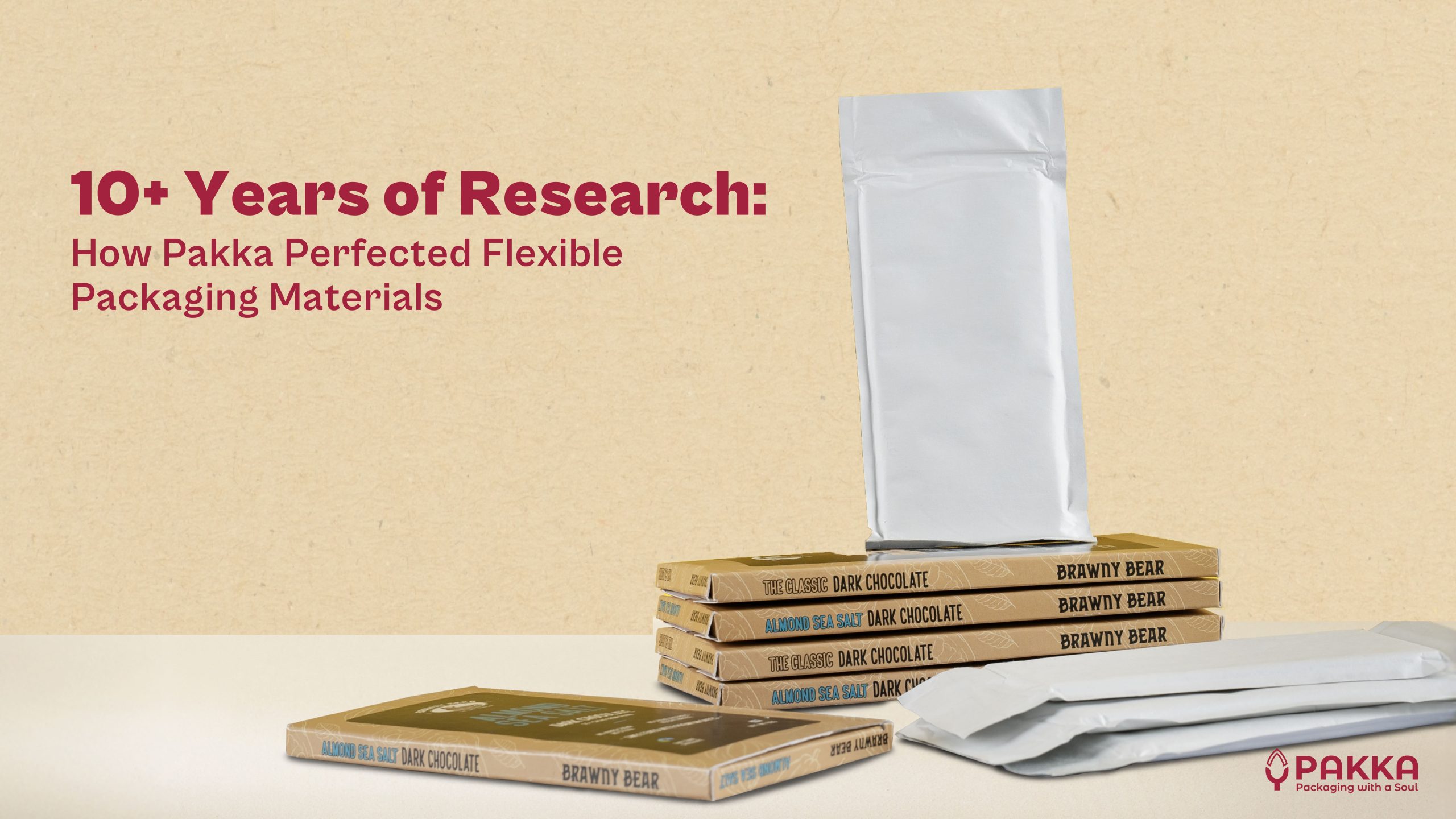
The global compostable flexible packaging market reached USD 1.63 billion in 2026 and is projected to grow at 12.3% CAGR through 2035 (Custom Market Insights, March 2026). That number makes the sector sound like it is about to explode. It is not. Most compostable films still cannot match the barrier performance food brands need, and closing that gap has never been a quick job. It is a materials science grind that plays out over ten years or more.
Key takeaways
- Conventional plastic films deliver MVTR below 1 g/m2/24hr and OTR below 1 cc/m2/24hr. Getting compostable substrates anywhere near those numbers takes repeated cycles of polymer work, coating trials, and converting line validation.
- India’s flexible packaging market is valued at USD 20.4 billion in 2025 (Mordor Intelligence). Compostable alternatives are still a sliver of that, mostly because the development pipeline grinds through years of dead ends before anything ships.
- Certification under IS 17088 (India) and EN 13432 (EU) adds 12 to 18 months to any timeline. Disintegration and ecotoxicity testing cannot be rushed.
- Brands that commit early to compostable packaging buy themselves regulatory breathing room. Non-compliance penalties under the Environment Protection Act now go up to INR 1 crore.
- The hardest commercial requirement is making a compostable film that runs on existing FFS and HFFS lines without modifications. That is what separates a lab sample from a real product.
Barrier performance is the whole problem
Here is the fundamental contradiction: compostable packaging has to keep moisture and oxygen out for months on a shelf, then fall apart completely once it hits a composting environment. Conventional polyethylene and PET achieve water vapour transmission rates (MVTR) well below 1 g/m2/24hr at 38 degrees C and 90% RH. Unmodified biodegradable polymers routinely exceed 10 g/m2/24hr under those same conditions (Michigan State University, 2025).
That is not a small gap. For tea, coffee, or spices, an MVTR difference of 2 to 3 g/m2/24hr can cut shelf life in half. Oxygen ingress causes its own damage, driving lipid oxidation in snack foods and stripping aroma from tea.
So the R&D job is not about finding a single biodegradable polymer and calling it done. You need a multilayer compostable structure where each layer handles a specific barrier job (moisture, oxygen, grease, light), and the whole thing still breaks down within certification timelines. Getting all of that to work simultaneously is why this takes years.
Four phases, roughly a decade
Phase 1: Polymer selection and formulation (years 1 to 3)
It starts with raw materials. PLA gives you decent clarity and processability but poor moisture resistance. PHA offers better barrier numbers but costs more and is difficult to process at volume. Cellulose derivatives and starch blends each have their own trade offs.
Any serious programme will test dozens of polymer blends and additive packages before landing on a formulation that balances cost, processability, and compostability. This is all bench scale work, small batches and controlled conditions. Most formulations fail.
Phase 2: Coating and barrier layers (years 3 to 5)
Biopolymers on their own rarely deliver food grade barrier performance. So you develop coatings: water based barriers, vacuum deposited metallic layers, oxide coatings. The goal is to bring MVTR and OTR down without wrecking compostability.
This is where most programmes get stuck. A coating that blocks moisture brilliantly might fail ecotoxicity testing. A vacuum metallised layer that pulls OTR below 2 cc/m2/24hr might stop the film from disintegrating in a composting environment. You reformulate. You test again. Months pass. Then you reformulate again.
Phase 3: Certification (years 5 to 7)
Photo via Pexels — Free to use
Certification timelines are fixed. IS 17088 and EN 13432 both require the same basic battery of tests. Chemical characterisation: full constituent disclosure, heavy metals below prescribed limits. Biodegradation: at least 90% conversion to CO2 within 180 days under controlled composting. Disintegration: 90% of the material must break into pieces smaller than 2 mm within 12 weeks. Ecotoxicity: the resulting compost cannot harm plant growth, verified through germination and biomass assays against reference compost.
These tests run one after another. You cannot meaningfully parallelise them. Change one coating additive, and you may need to restart the cycle. Twelve to eighteen months is the timeline for a clean submission. Multi-layer structures take longer. There is no shortcut here.
Phase 4: Line validation and commercial scale up (years 7 to 10)
A film that passes lab tests and earns certification still has to prove it can run on a real packaging line. FFS and HFFS machines are set up for conventional films with specific heat seal profiles, friction coefficients, and stiffness characteristics.
If a compostable film needs the line slowed down or retooled, most brand owners will not pay for it. So the R&D work at this stage is converting science more than materials science. The film has to seal at temperatures the existing equipment already uses, feed through registration systems cleanly, and produce finished packs at speeds that make commercial sense.
You run pilot batches at converter facilities. You adjust gauge and surface treatments. You validate across different formats: sachets, pouches, flow wraps. Tea overwrap behaves differently from snack packaging, which behaves differently from confectionery wraps. Each one is its own validation exercise.
Why brands should care about the timeline
India’s regulatory environment is moving faster than most packaging transitions can keep up with. The Plastic Waste Management (Amendment) Rules, 2026, mandate 30% recycled content for Category I plastic packaging in 2025-26, rising to 60% from 2028 (KNN India). EPR obligations now cover paper, glass, and metal packaging too, under rules effective April 2026.
Brands are left with two options, neither especially comfortable. Wait for compostable alternatives to mature and hope the regulatory timeline does not outrun you. Or start working with suppliers who have already put in the decade of development, accepting that the product may still carry a cost premium.
The global sustainable packaging market hit USD 316.8 billion in 2025, growing at 7.8% CAGR (Cervicorn Insights, 2026). Compostable flexible packaging is one of the hardest segments within that market. Supplier readiness ranges from early lab trials to fully certified commercial production, and the difference between those two stages is measured in years, not months.
How to tell lab stage from commercial stage
This matters for procurement teams because it directly affects supply reliability, cost predictability, and compliance risk.
| Criterion | Lab stage | Commercial stage |
|---|---|---|
| Barrier data | Bench scale, controlled conditions | Validated across production batches |
| Certification | Pending or partial | IS 17088 and/or EN 13432 certified |
| Line compatibility | Not tested on FFS/HFFS | Validated at commercial speeds |
| Shelf life data | Accelerated studies only | Real time data across SKUs |
| Supply capacity | Pilot quantities | Continuous production capability |
| Cost trajectory | Uncertain | Predictable per unit economics |
Ask for evidence across all six. A film with strong barrier numbers in a lab report that has never run on a converting line at production speed is not yet a packaging solution. It is a research project.
Vertical integration and why it compresses timelines
Controlling base substrate production, coating, metallisation, and converting under one roof removes the coordination drag that slows down fragmented supply chains. When a change to the base paper formulation needs testing through the full coating and converting process, a vertically integrated operation can do that within the same facility. The feedback loop from line performance back to substrate formulation takes days instead of weeks.
Most flexible packaging converters do not work this way. They source base films from one supplier, coatings from another, metallisation from a third. Every handoff introduces delay and lost context.
Frequently asked questions
How long does it take to develop compostable flexible packaging from scratch?
Seven to ten years from initial polymer formulation through certification and commercial validation. Certification alone (IS 17088 or EN 13432) runs 12 to 18 months, and that clock resets if you change the formulation.
Can compostable films match conventional plastic on barrier performance?
They are getting close for some applications. Advanced compostable structures with vacuum metallised layers now achieve MVTR of 1 to 3 g/m2/24hr and OTR below 10 cc/m2/24hr. Good enough for tea, coffee, and dry snacks. Not yet matching the sub-1 values you get from metallised PET or aluminium foil laminates.
What certifications matter?
IS 17088 in India, EN 13432 in Europe, ASTM D6400 in North America. All three test biodegradation, disintegration, and ecotoxicity. If a supplier has these, they have been through the full testing cycle rather than just one parameter.
Will compostable films run on my existing packaging lines?
If the supplier has done the converting validation work, yes. Commercially proven compostable films are made to run on standard FFS and HFFS equipment. Films still in development might need slower speeds or different seal temperatures, and that adds cost.
How do EPR rules affect the recyclable vs compostable decision?
The EPR for Packaging Rules (effective April 2026) make producers responsible for end of life management of their packaging. Compostable packaging certified under IS 17088 goes into organic waste streams. That avoids the separate plastic collection infrastructure that recyclable plastics need.
What cost premium should we expect?
Somewhere between 15% and 40% over conventional films, depending on barrier requirements and volume. The gap has narrowed over the past three years as production has scaled up. The more useful comparison is total cost: material price plus EPR compliance fees, waste management obligations, and the regulatory risk of sticking with non-compliant packaging.
If you are evaluating compostable flexible packaging for your product lines, talk to our packaging team about barrier requirements, certification status, and what is available at commercial scale today.
Specifying packaging for this application. Pakka’s food packaging range covers flexible and barrier formats for tea, confectionery and dry foods, with spec data on the category page. Talk to the Pakka team for specifications, samples and pricing.
Browse all Pakka articles.
You may also like